
Glen Burnie Tree Removal has handled tree removal in Takoma Park for more than 20 years, and the first honest thing to say about this city is that its ordinance reaches the job before the truck does. Takoma Park writes and enforces its own urban forest code, and it applies to the contractor as squarely as it applies to the property owner. A quote built without it is a quote that gets revised.
Our estimate here is free, on site, and written before any work begins, and at a Takoma Park address that visit carries legal weight rather than sales weight. The city code requires a Licensed Tree Expert in good standing with the Maryland DNR to supervise tree work done for hire, and that supervision explicitly involves a site visit. Nobody can price this work honestly from a phone description or a photograph, and in this city nobody is permitted to try.
What follows is how a job actually moves through Takoma Park: who has to look at the tree, what size of tree starts the process, how long the posting runs, and what the ground under the stump does to the grinding. The same crew that walks the property does the work and finishes the cleanup, so nothing is lost between the estimate and the last load out.
Why the site visit comes first here
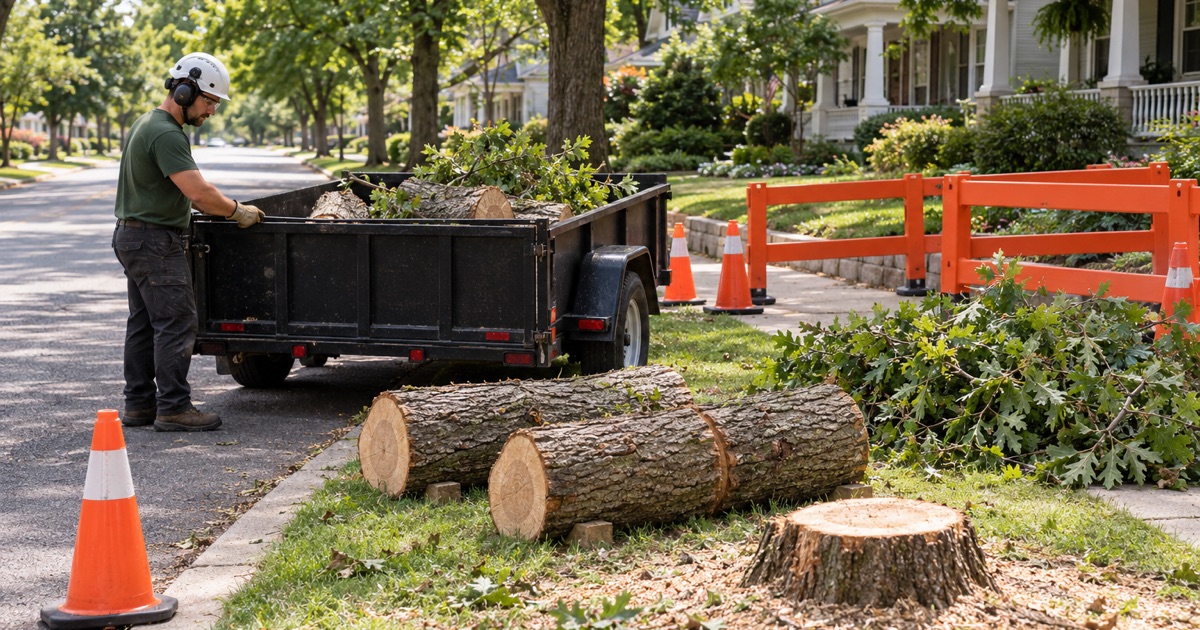
Section 12.04.110 of the Takoma Park Municipal Code is the provision that governs every paid job inside the city limits. It states that no person shall perform tree pruning, tree removal or other tree work for hire without supervision, involving a site visit, by a Licensed Tree Expert in good standing with the Maryland DNR. It also requires the work itself to follow ANSI A300 Parts 1 and 2 and ANSI Z133.1. A violation is a municipal infraction, which means the city can write it up.
That one provision changes the shape of a Takoma Park estimate. In most places a site visit is good practice a careful company chooses; here it is a condition the ordinance places on whoever performs the work. We treat it as the fixed first step and build the schedule around it, which is also why we do not quote a removal in this city over the phone.
The standards the ordinance names
ANSI A300 Parts 1 and 2 cover pruning practice and soil management, and ANSI Z133.1 is the safety standard for the work itself. Naming them inside a municipal code turns technique into compliance: cuts placed at the branch collar rather than flush to the stem, no climbing spurs on a tree that is being pruned and kept, and a controlled drop zone under every rigging pick. When a stem has to come down over a roof, sectional dismantling or a crane pick is the method that satisfies both the standard and the structure underneath it.
What the walk actually settles
The visit is where the job stops being a guess. We read the root collar for included bark and co-dominant stems, look for epicormic shoots on a stressed trunk, and work out whether crown reduction, crown thinning or deadwooding solves the problem without a removal at all. Where a tree is worth keeping, cabling and bracing is priced alongside the alternative rather than mentioned after the fact.
Access is the other half of the walk. Compact equipment gets into gated and tight back yards that a full-size machine cannot reach, matting goes down on lawn and hardscape on every job, and the debris hauling and cleanup that is included appears in writing on the estimate instead of being assumed. Root collar excavation with an air spade is a separate decision we make on site, because on some of these older trunks the flare is buried and nothing about the tree can be judged until it is uncovered.
Looking for tree-removal closer to Bel Air? See Tree-Removal Services in Bel Air.
The fifty-foot trigger and the tree size that starts it
The permit threshold in Takoma Park is low, and it is the single fact that governs most work here. Under Section 12.12.020 an urban forest tree is any tree measuring 24 inches or more in circumference at four and one-half feet above ground level, which is 7 and 5/8 inches or more of diameter at breast height. That is a tree most owners would call medium at best. Section 12.12.040 then requires a tree removal permit to remove, relocate or destroy one, subject to a waiver, an emergency, or utility work.
Section 12.12.030 reaches past removal and into ordinary yard projects. A tree impact assessment is required before excavating more than three inches deep over more than 25 square feet within 50 feet of an urban forest tree, before any activity inside its critical root zone that may destroy a significant portion of the roots, before constructing a structure other than a fence within 50 feet of it, and before paving more than 25 square feet of impervious surface inside that same 50 feet.
Fifty feet covers most of a lot here
On this housing stock the radius matters more than the number suggests. Roughly 94.5% of the units in the city were built before 1980 and 25.5% before 1940, which means small lots, mature trunks and short distances between a patio and a root plate. A shed footing, a driveway apron or a new walkway lands inside 50 feet of a protected tree far more often than owners expect, frequently a neighbor’s tree as well as their own, so the assessment becomes a scheduling item we raise at the estimate rather than a surprise a week into the job.
Pruning that crosses the line
The same section also catches pruning of more than 5% of a tree’s live canopy. In practice a genuine crown reduction on a mature oak crosses that line and a season of light deadwooding usually does not, but the difference is measured, not eyeballed. We work out which side of it a job falls on before quoting, because the answer decides whether the work starts next week or waits on paperwork.
Posting, the fifteen-day appeal, and a city outside the county code
A preliminary decision to permit a removal does not end the process in Takoma Park. The Urban Forest Manager’s approval is posted for 15 days, and during that window any Takoma Park resident may appeal it. No permit issues until the period runs out or the appeal is decided, and an appeal from a preliminary decision is heard by the Takoma Park Tree Commission.
That window is the largest scheduling difference between a removal here and the same tree a few miles away, and it is why we put dates on paper at the estimate. A planned removal is not a same-week job. Where the City determines that a tree is dead or hazardous a permit waiver is available, and action required on an emergency basis to prevent harm to life or property does not need a permit at all, which is the route our 24-hour response for storm damage and fallen trees actually takes.
Section 12.04.120 and why county advice misleads here
Takoma Park has written itself out of Montgomery County’s tree rules. Section 12.04.120 exempts the City from Montgomery County Code sections 8-26(n) and (o), 19-71, 49-35, 49-36A and 55-1 through 55-11, citing Local Government Article section 4-111 and Montgomery County Code section 1-203. County tree protection and canopy preservation provisions are therefore not the rules that apply inside these city limits, and a crew working from county guidance will quote the wrong process, the wrong threshold and the wrong timeline.
The approvals that still come from outside
Two overlays survive that exemption. Inside the Takoma Park Historic District, removing a tree larger than 6 inches in diameter can require a Historic Area Work Permit, which the Historic Preservation Commission at Montgomery Planning administers as its own process alongside the city application. A roadside tree standing in the public right-of-way needs a Tree Care Permit from the Maryland Department of Natural Resources Forest Service, and vegetation management done at Pepco’s written request or under a memorandum of understanding with the City sits outside the city permit requirement entirely.
Replanting inside six months, and the ground under the stump
A permit that receives preliminary approval carries a replacement planting plan, and that plan has a deadline: six months from preliminary approval, or the application is automatically withdrawn. Current city guidance sets the application fee at $50, or $25 where all the trees in an application are dead, with a fee-in-lieu of $312 for each required 1.5-inch replacement tree. We raise the replanting question at the estimate rather than leaving it to sit until the deadline is close.
Piedmont residuum and the stump grinder
The city sits on the Piedmont Plateau, over the Sykesville Formation, a boulder gneiss, and the mapped soil at the centroid is the Gaila series at 95% of the map unit. Residuum over shallow rock is what a stump grinder meets on these lots: a heavy, rocky root plate and a real ceiling on how deep a grind can go. We state the depth we expect to reach on the estimate rather than promising a number the ground will not give up, and where a stump sits against a foundation or a walkway we say so before the machine arrives.
Old canopy, small lots, and two kinds of client
About 45.6% of occupied units in the city are owner-occupied single-family detached houses, while 44.9% of the housing sits in buildings of five or more units. The work splits roughly evenly between an owner with one old tree and a manager buying on a maintenance schedule, which is why our scheduling is built for HOA boards, property managers and multifamily grounds with fixed access windows. Northern red oak belongs in the local mix on this side of the county, and on housing this old the yard trees routinely predate anyone now living on the block.
Sligo Creek and Long Branch, tributaries of the Northwest Branch, run through the city, and the nine-mile Sligo Creek Trail follows one of them. That stream-valley parkland puts large mature public canopy hard against private back yards, which is where a crane-assisted removal earns its cost and where compact equipment gets a rig into a yard with no side access. Pricing is clear and the estimate visit is never charged for, so the decision about which of those two approaches a tree needs can be made before any money changes hands.
Storms are the other reason to keep a number on hand. On June 5, 2024 the National Weather Service confirmed two EF-1 tornadoes in Montgomery County: one at Poolesville with estimated peak winds of 105 mph, where about two dozen pine trees with trunk diameters over two feet were snapped or uprooted, and one at Gaithersburg at 95 mph, where a large oak with a trunk about three feet across was uprooted. Local crews who know this region’s storm season and its species are the difference between a tarp and a plan, and the crew that answers that call is the same one that would have written the estimate.
- 20+ Years in Anne Arundel
- Free Written Estimates
- 24-Hour Storm Response








