
Glen Burnie Tree Removal handles shrub removal, hedge removal and brush clearing in Glen Burnie, MD, and after more than 20 years in Anne Arundel County it is one of the jobs we are asked about most and quoted for least accurately. Shrubs look small and price like they should be trivial; what actually costs money is the root ball, the access and where the material goes.
The difference between cutting a shrub and removing one is entirely below grade. A shrub cut at ground level resprouts from the crown within a season, and a hedge run cut at grade resprouts along its whole length, which is how a homeowner ends up paying twice for the same row of privet. Removal means the root ball comes out, and the bed is left ready to replant.
Disposal is the other half. Anne Arundel County curbside collection takes limbs only under 4 feet by 4 inches in bundles under 40 pounds and will not take logs at all, so the volume from a mature hedge run is not something that quietly disappears with the yard waste. We chip on site and haul in the same visit.
Shrub and Hedge Removal
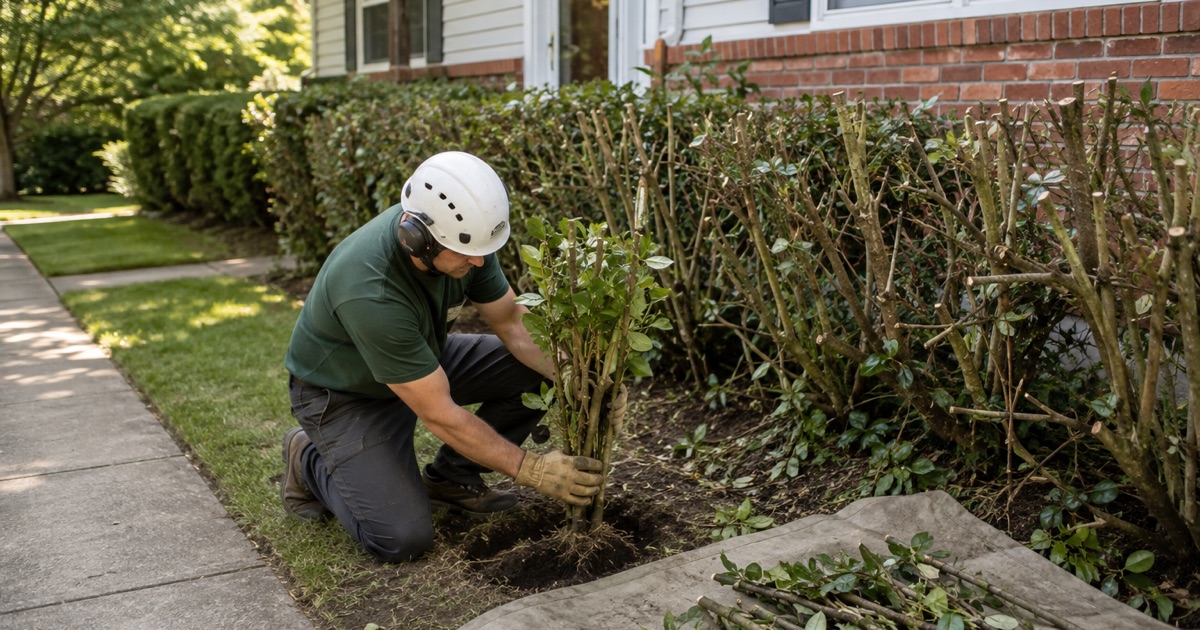
Foundation Shrubs and Overgrown Plantings
Foundation plantings that have outgrown the house are the standard call: yews, hollies and junipers grown past the window line, with root balls tight against the foundation and often into a downspout run. We extract the root ball rather than cutting at grade, work by hand where a machine would damage the wall or the footing, and leave the bed graded and ready for whatever replaces them.
Hedge Runs and Screening Rows
A hedge is priced by the run rather than by the plant, because the work is continuous. Privet, arborvitae and Leyland cypress rows come out with their root systems, and the trench line gets backfilled and levelled so the new planting or the fence line sits true. Where the hedge marks a boundary, we confirm which side of it the stems actually stand on before anything comes out.
Stumps, Root Balls and Replanting
Anything with a root ball large enough to obstruct a replanting comes out completely or gets ground, and we say which in the written scope. Where you are replanting into the same bed, residual roots and chips tie up nitrogen and hold air pockets, so the bed gets cleared and backfilled with topsoil rather than simply raked over.
Brush and Undergrowth Clearing
Overgrown Fence Lines and Boundaries
An untended fence line collects volunteer saplings, brambles and vines until it is neither a boundary nor a passage. We cut and chip the run, take out the stems that would resprout, and free the fence itself so it can be inspected or replaced. This is the job that most often uncovers a fence in worse condition than the owner believed.
Invasive Species and Regrowth Control
Tree of heaven, multiflora rose and other root-suckering species come back thicker within two seasons if the stems are only cut. Tree of heaven is also the preferred host of spotted lanternfly, which does not kill trees but is regulated in Maryland when logs, stumps, firewood and yard waste are moved. Treating cut stumps is part of the clearing rather than a later invoice.
Wooded Edges and Undergrowth
Clearing the understory back from a wooded edge opens up a yard without removing the canopy that shades it. The discipline is knowing what to leave: young stems that are worth keeping, and the root zones of the mature trees at the edge, which extend well past the canopy and do not tolerate machinery working across them.
Shrubs and Brush Inside the Critical Area
Removing shrubs is not automatically exempt from review. Inside the Chesapeake Bay Critical Area buffer, Anne Arundel County requires an approved Vegetation Management Plan before vegetation is cut, and the county has stated that the widely believed exemption for stems under 4 inches does not exist. Parts of Glen Burnie along the tidal heads of Marley Creek, Furnace Creek and Sawmill Creek fall inside that band, so we check the address at the estimate rather than after a stop-work notice.
Access, Debris and Site Conditions
Getting Equipment to the Work
Eighth-acre and quarter-acre residential lots dominate here and rear access usually runs through a side gate, so machine width decides the approach on most properties. We carry compact equipment sized to a standard gate opening and work by hand where a bed sits tight against a wall, a patio or a bulkhead.
Ground Conditions and Protection
Most of Glen Burnie sits on deep, loose, well-draining sand that carries equipment easily, but poorly drained pockets exist inside that otherwise sandy community and turn to ruts under a loaded truck. Matting goes down on the route before anything moves, so the lawn and the hardscape carry the weight rather than the topsoil.
Chips, Haulage and What Is Left Behind
The written scope states whether the material leaves the property, is chipped and spread as mulch on your beds, or is stacked. Given that county collection will not take logs and caps limbs at 4 feet by 4 inches in 40 pound bundles, hauling is normally the practical answer, and we finish with the bed and the surrounding lawn raked clean.
- 20+ Years in Anne Arundel
- Free Written Estimates
- 24-Hour Storm Response