
Glen Burnie Tree Removal has handled tree removal in Severna Park for more than 20 years, and the work here starts with a question most homeowners do not expect to be asked. Before anyone decides how a tree comes down, somebody has to establish who is entitled to approve taking it down at all. On an interior lot away from the water that answer is usually simple, and on the creeks and coves it very often is not.
This community sits under two separate vegetation overlays that operate independently of each other, and it carries a layer of community-held land that has no equivalent in a subdivision run by a single homeowners association. A protected bog buffer and a community-owned beach parcel are both perfectly ordinary here, and either one moves the decision off the individual property owner and onto somebody else. We plan around those requirements at the estimate rather than discovering them on the morning of the removal.
Every estimate we write is free, done on site, and put in writing before any work begins, including exactly what the debris hauling and cleanup covers. The crew that walks the property with you is the crew that performs the removal and does the final rake-out.
Whose Ground the Tree Is Actually Standing On
There are three different answers to that in Severna Park and they are not interchangeable. A tree can stand on your own lot, in the public right-of-way, or on a parcel owned by a community organization you happen to be a member of. Each one routes the approval somewhere different, and the third is the one that catches people out.
Your lot, the right-of-way, or common ground
Maryland treats a roadside tree as one standing in the public right-of-way, and the test turns on where the trunk stands rather than on where the canopy reaches. A tree leaning out over the roadway from well inside your property line is not a roadside tree. One growing in the strip between the sidewalk and the curb generally is, and removing it calls for a Roadside Tree Care Permit from the Maryland Department of Natural Resources Forest Service.
That permit is not a formality anyone can catch up on afterward. State law bars a county or a municipality from issuing a building permit until the Forest Service permit has been obtained, and even an emergency removal carries a one-week reporting duty. The project fee is 25 dollars, while penalties for cutting a roadside tree without the permit run to 2,000 and 5,000 dollars.
Who is allowed to do the work
Maryland requires a Licensed Tree Expert for tree care performed for hire, exempts trees 20 feet tall or less, and lets crews working under a licensed expert’s supervision operate without holding the credential individually. The governing regulations are COMAR 08.07.07, which also makes a written contract mandatory for the job. Anne Arundel County restates the same rule for its own regulated ground, stating that contracted tree removal or pruning there may only be performed by a Maryland Licensed Tree Expert.
That rule reaches further in Severna Park than it does inland, because so much of the ground here falls inside one protected area or another. Planning the removal around the county permit path and the Chesapeake Bay Critical Area requirements is part of what we do before quoting a price, so the paperwork and the crew calendar move together instead of one waiting on the other.
Looking for tree-removal closer to Baltimore Highlands? See Baltimore Highlands Tree-Removal.
Bog Buffers, and the Drainage Areas That Feed Them
The Chesapeake Bay Critical Area is the overlay most people here have already heard of. The bog protection overlay is the one that surprises them, because it is a separate county program with its own line on the map and its own trigger. Three named bog 100-foot buffers fall inside this community, along with four bog contributing drainage areas.
Cypress Creek, Dill Road and Sullivans Cove
The three named buffers here are the Cypress Creek Bog Areas, the Dill Road Bog and the Sullivans Cove Bog, out of 15 that Anne Arundel County maintains in total. A bog under the county code is a nontidal wetland with organic soils, accumulated peat, and soils saturated to the surface throughout the year. A 100-foot buffer is established around the bog wetland, and the county’s own Bog 100 Foot Buffer layer is what settles where that line actually runs on a given parcel.
Inside a Bog Protection Area, an approved Vegetation Management Plan is required before vegetation is cut, pruned or removed. The same plan requirement applies inside a Critical Area buffer, an expanded buffer and a Forest Conservation Easement, and inside the Critical Area buffer it applies to dead trees as well as living ones. The Forestry Program at the county Department of Inspections and Permits reviews those plans and answers at (410) 222-7441, and we would rather make that call from your driveway during the estimate than have you make it after a stop-work order.
Ground that will not carry a machine
Peat and year-round saturated organic soil are not only a permitting problem, they are a bearing problem. Woodland that looks perfectly walkable can stop carrying a machine within a few steps of the buffer line, and a tracked chipper that sinks is a far worse afternoon than a longer drag would have been. We size equipment to the softest ground on the route in and out, not to the tree at the end of it.
Away from the bogs the ground is the opposite problem. A nine-point soil sample inside Severna Park returned Downer-Hammonton and Patapsco complexes alongside the Evesboro-Galestown complex, sands that are excessively drained and that dig and grind easily. Sand draining that freely also gives a mature tree a wide shallow root plate instead of deep anchorage, which is why the large specimens here are usually uprooted whole by wind rather than snapped off partway up.
When a Community District Signs Off Instead of an Owner
Nine Special Community Benefit Districts hold parcels inside Severna Park: Carrollton Manor, Chartwell, Hollywood on the Severn, Kensington, Magothy Beach, Magothy Forge, Manhattan Beach, Severna Forest and Severndale. If the tree stands on a community beach, a pier approach, a district park or a shared lane, the nearest homeowner is not the person who can authorize taking it down.
How the districts are set up
Anne Arundel County Code Article 4 Title 7 Subtitle 2 authorizes these districts and requires each one to be administered by an incorporated civic or community association that offers membership to every property owner inside the district. The tax funding a district is levied as a uniform assessment per platted lot or per property tax account, not as a fee for a particular piece of work. The consequence on the ground is direct: the association holds and maintains the beaches, piers, parks and rights-of-way, so on that land the association is the decision-maker.
Working with a board rather than a homeowner
A board is a slower and more deliberate client than a homeowner, and an estimate for common ground has to survive being read by people who were never standing under the tree. Ours is written, itemized and free of charge, so a district can circulate it, compare it and vote on it without anyone spending money to reach that point. What the hauling and cleanup includes is set out in writing on the same document, which removes the question that usually comes back after the vote.
Our scheduling is built for HOA boards, property managers and multifamily grounds, so work on common land can be dated around the district’s own decision cycle rather than around ours. The crew that priced the job is the crew that performs it, which matters more than it sounds when the people who approved the work are not the people standing on the parcel the day it happens.
Working a Shared Waterfront Parcel
Water covers 15.0% of this community’s total area, and the place is threaded by tidal creeks rather than merely edged by them. Residents locate themselves by creek and cove name, and Cattail Creek, Chartwell Branch, Forked Creek and Round Bay Shore are addresses as much as they are water. To a removal crew that geography shows up as access rather than as scenery.
Access decides the method
The older waterfront lots are reached by narrow shared lanes running down to the community beaches, and those lanes were laid out for a car and a boat trailer. Bulkheads, septic fields and pier approaches limit where a crane can set up, and machine width rather than machine power decides which back yard can be reached at all. We run compact equipment for gated and tight-access yards for exactly that reason.
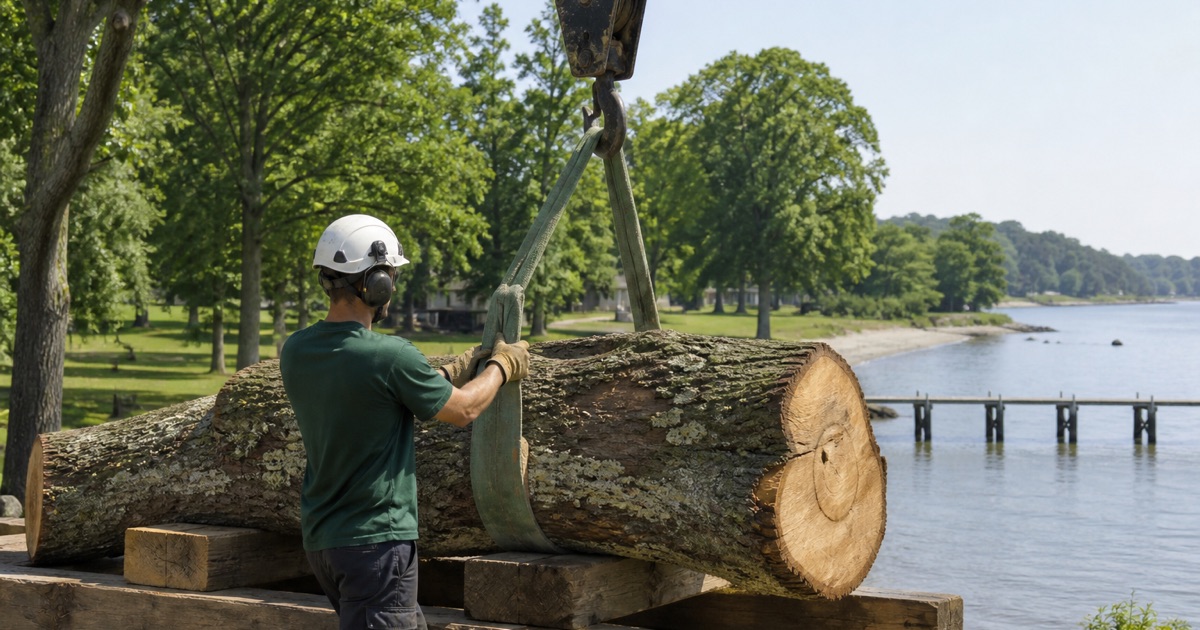
Where a tree stands over a house, a garage or a pier and there is room to set up, a crane-assisted removal lifts each section clear instead of dropping it. Where there is not, the tree comes down by sectional dismantling, rigged and lowered piece by piece off a climbing line or an aerial lift. Steep sandy ravine sides running down to the creeks are the hardest ground on any job here, giving poor bearing for outriggers and forcing rigging to work across a fall rather than along it.
Protection matting goes down on the lawn and over hardscape on every job, because the damage a crew does getting to a tree is the damage a customer remembers afterward. On sand that is not a cosmetic point, since ruts in excessively drained soil hold nothing and re-seed badly. Where a stump grinder can reach is settled during the same walk-around, because it runs into the identical width limits everything else does.
What leaves the site
County curbside collection is not a disposal plan for a removal. The Bureau of Waste Management Services takes limbs under 4 feet long and 4 inches thick, in bundles under 40 pounds, and it does not collect logs at all. BGE is equally direct that it does not remove wood debris after a line-clearance cut, which is how a utility trim leaves a yard full of material nobody has agreed to move. Our hauling and cleanup is written into the estimate, so what stays and what goes is settled before the first cut.
Storm work in this community is led by summer convective thunderstorm wind and by tornadoes rather than by anything that arrives with a name attached. We answer storm damage and fallen trees within 24 hours, which on a shared lane frequently means opening access for the neighbors before the tree that fell is dealt with at all.
Dead ash is a category of its own. Emerald ash borer has been established in Maryland since 2003 and leaves a large ash brittle within roughly three years, and brittle standing wood is not something a climber should be trusting. Those trees come down off a crane or an aerial lift instead, and a dead one inside a bog buffer or a Critical Area buffer still needs its approved plan before anybody touches it.
- 20+ Years in Anne Arundel
- Free Written Estimates
- 24-Hour Storm Response








