
Glen Burnie Tree Removal has handled tree removal in Severn for more than 20 years, and the lesson that keeps repeating here is that the biggest variable on a Severn job is usually not the tree. It is what the tree is standing in.
Every job we take starts with a free on-site estimate, written down before a rope goes up or a saw comes out of the truck. The visit itself carries no charge, the debris handling is spelled out in the same document rather than argued about afterward, and the crew that walks the property with you is the crew that arrives on the work date and rakes the lot before leaving. Gated back yards and tight side setbacks get compact equipment rather than a wider machine and a wider apology, and protection matting goes down over lawn and hardscape on every job.
What follows is the part of this trade that is specific to this community: sand that runs deep, root plates that spread wide instead of down, and an approval picture that is lighter than most of Anne Arundel County without being empty.
What deep sand does to a root plate
Soil decides how a tree is anchored, how it fails, and how long the cleanup takes, so it is the first thing we read on a Severn property. A nine-point soil sample spread across the community, drawn from the USDA soil survey for Anne Arundel County, came back in the Patapsco family at eight of those nine points. That is an unusually consistent answer for a place this size, and it is consistent in a direction that matters.
The Patapsco series, almost everywhere we look
Five of the nine points returned the Patapsco-Fort Mott-Urban land complex at 0 to 5 percent slopes. Three more returned close relatives: Patapsco-Fort Mott, Patapsco-Evesboro-Fort Mott, and a Downer-Phalanx complex. A Russett-Christiana-Urban land unit was the lone outlier.
The Patapsco series itself is classed as loamy, siliceous, subactive, mesic Grossarenic Paleudults, rated somewhat excessively drained, with an abrupt textural change recorded at roughly 124 centimeters. Translated into what a crew feels underfoot, that is deep, loose, fast-draining sand sitting on a firmer contact about four feet down. Nine sample points characterize a place rather than map every parcel, so we still probe before we commit to an access route.
Why the stump work goes cleaner here
Sand grinds and digs easily. A stump grinder cuts faster in it, the spoil comes up light and free-draining instead of as heavy wet clods, and the backfill can be raked back level the same afternoon rather than tracked across a lawn for a week. Grade rings settle less dramatically once the fines wash down, and the hole holds its shape while we work.
The same looseness cuts the other way on access. Loose sand rutted by a heavily loaded machine does not spring back, which is exactly why matting goes down before the first pass and not after the first rut.
Reading the root collar before the saw comes out
Because the surface material moves so easily, we see buried root collars on Severn properties more often than the tree’s age would suggest, particularly on lots where grade was adjusted during construction and sand was pushed against a trunk. A collar under several inches of fill hides girdling roots, decay and the flare that tells us how much anchorage is actually left.
Root collar excavation with an air spade answers that question without cutting anything, and on a marginal tree it is frequently the difference between a removal recommendation and a defensible decision to keep it. Diameter at breast height tells us what the crown weighs; the collar tells us what is holding it.
Looking for tree-removal closer to Severna Park? See Tree-Removal Services in Severna Park.
Windthrow, not a trunk snap
The failures we get called out for in this community follow a pattern, and it is a soil pattern as much as a weather one. Summer convective severe thunderstorm wind, and occasionally a tornado, leads the local storm record here rather than the coastal systems people expect on a Maryland map. Straight-line wind arrives fast, hits a full summer crown, and loads the roots before anything in the trunk has a chance to fatigue.
A wide, shallow plate lifts as one piece
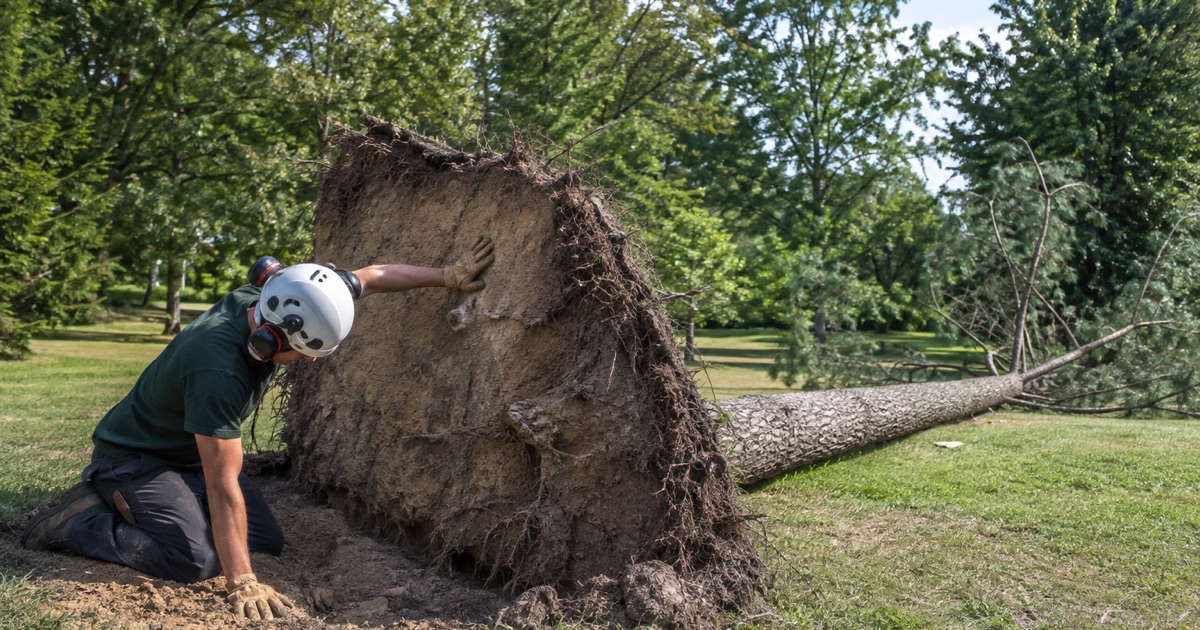
Large trees rooted in deep loose sand tend to build broad, shallow root plates rather than deep anchorage, because there is no reason to drive down through material that drains this freely. That geometry is the classic setup for whole-tree windthrow. Instead of a stem snapping partway up, the entire plate levers out of the ground, taking turf, walkway and sometimes a fence line with it.
It also changes what a leaning tree means after a storm. A fresh lean over sand with a cracked, heaving root plate is an active failure in progress, not a cosmetic problem to look at again in spring. That is the call we answer within 24 hours.
Species and defects that change the failure mode
Loblolly pine is native and common here, and the coniferous share of Severn’s woods is real rather than incidental. Pines that grew in a stand and later lost their neighbors to development carry tall, narrow crowns with very little taper, and they fail whole.
Ash is a separate problem. Emerald ash borer has been established in Maryland since 2003 and typically kills a large ash within about three years, and the standing wood left behind turns brittle quickly, which changes how a climber can work it and often argues for an aerial lift or a crane instead. Co-dominant stems with included bark, epicormic shoots on a stressed trunk, and heavy deadwood all get noted on the estimate, because deadwooding, crown thinning, crown reduction, or cabling and bracing are sometimes the honest answer instead of removal.
Lines down, and what the county will not haul
If a line is down, that call goes to BGE at 1-877-778-2222 before anyone approaches the tree; a limb resting on a conductor goes to 1-800-685-0123. BGE handles line clearance under its own vegetation-management obligations, but it states plainly that it does not remove the wood after the cut, which is how a yard ends up with a utility-trimmed tree and a pile nobody owns.
County curbside collection will not close that gap either. It accepts limbs under 4 feet long and 4 inches thick, bundled under 40 pounds, and it does not take logs. Anything above that is ours to haul, and the estimate says which parts of the pile leave with us.
The shoreline rules that do not reach Severn
Tree work across much of Anne Arundel County runs through the state’s Chesapeake Bay shoreline conservation overlay, which brings mapped clearing limits and a plan-approval step before anyone cuts. In Severn, that layer simply is not present.
A verified absence, not a missing map
A spatial query of the county’s mapped shoreline conservation layer against the Severn boundary returns no features of any class. The identical query, run the same way, returns polygons for other communities in Anne Arundel County, which is the control that makes the empty result meaningful. This is a genuine absence rather than a gap in coverage or a query that failed quietly.
Practically, that removes a tidal shoreline setback obligation, the vegetation plan requirement that would otherwise attach on that basis, and the shoreline clearing cap. No mapped bog protection area falls inside the community either, and the same control query returns named bog buffers elsewhere in the county.
What the absence is worth on a schedule
The value of that is time. A homeowner with a failing tree and a shoreline overlay on the parcel is waiting on a written plan and a county review before the work is legal, and storms do not respect that calendar. Here, most residential removals turn on access, utilities and the estimate rather than on a plan approval, which is why a Severn job can usually be scheduled around the property owner instead of around a review queue.
A younger tree population than the county average
Severn’s housing stock skews new. Only 24.5 percent of it was built before 1980, and construction through the 2000s and 2010s left a great many lots carrying planted landscape trees under 25 years old alongside a handful of retained construction-era specimens.
That mix produces two very different jobs on the same street. The young planted stock needs structural pruning and correction while the cuts are still small. The retained specimen tree, often a large oak left standing when the lot was cleared, spent its life inside a stand and now stands alone in sand with its root zone compacted by a driveway, and it deserves the more careful look.
What still needs a permit or a sign-off
The shoreline overlay being absent does not make Severn a place with no rules. Several approvals still apply, and they attach to different things than most property owners expect.
Who is allowed to do the work at all
Maryland requires a state Licensed Tree Expert for tree care performed for hire, under the Natural Resources Article. Trees 20 feet tall or less are exempt, as are loggers and underground-utility installers, and crew members working under a licensed expert’s supervision do not each need their own license. The licensing regulations sit in COMAR 08.07.07, which also makes a written contract mandatory and requires the state license credential to appear on it. Anne Arundel County states the same expectation for contracted removal and pruning work.
Roadside trees, judged by where the trunk stands
A tree in the public right-of-way needs a Roadside Tree Care Permit from the Maryland Department of Natural Resources Forest Service, and the test is the trunk, not the crown. A tree rooted inside your property line that reaches out over the road is not a roadside tree; a tree whose trunk stands in the right-of-way is one, even if most of its crown is over your lawn.
The project fee is 25 dollars, and state law bars a county or municipality from issuing a building permit until that permit is in hand. Penalties for cutting without one run to 2,000 and 5,000 dollars. An emergency removal is allowed, but it carries a one-week reporting duty afterward, which we handle as part of the storm call rather than leaving it to the property owner to discover later.
Forest conservation, easements, state land and associations
County forest conservation requirements under Article 17 Subtitle 3 attach when a subdivision, a grading permit or a sediment control permit is proposed on a site of 40,000 square feet or more, which puts them in front of builders and larger commercial parcels rather than a typical back yard. Where a Forest Conservation Easement covers ground, a Vegetation Management Plan is required before vegetation is cut, pruned or removed; the county forestry program takes those questions at (410) 222-7441.
The Severn Run corridor is a different authority again. The Maryland Department of Natural Resources manages it as the Severn Run Natural Environment Area, so a tree on or adjoining that state land is the state’s decision, not the county’s and not the adjoining owner’s. Two special community benefit districts, The Provinces and Parke West, also hold parcels here, and on common open space the incorporated association rather than an individual owner authorizes the work. We are used to working to that calendar, and to the way boards, property managers and multifamily grounds staff need the scope in writing before a vote.
- 20+ Years in Anne Arundel
- Free Written Estimates
- 24-Hour Storm Response








