
Glen Burnie Tree Removal handles tree removal in Savage, and after more than 20 years of this work we plan a job here differently than one anywhere else on our map. What changes is the ground under the tree and the room around it. Both are settled before we quote, not discovered on the morning the crew arrives.
Every estimate is free, done on site, and written out before any work begins, with the debris hauling and cleanup spelled out in the same document. The crew that walks the property at the estimate is the crew that does the removal and the crew that rakes the yard at the end of it. For storm damage and trees already down, we respond within 24 hours.
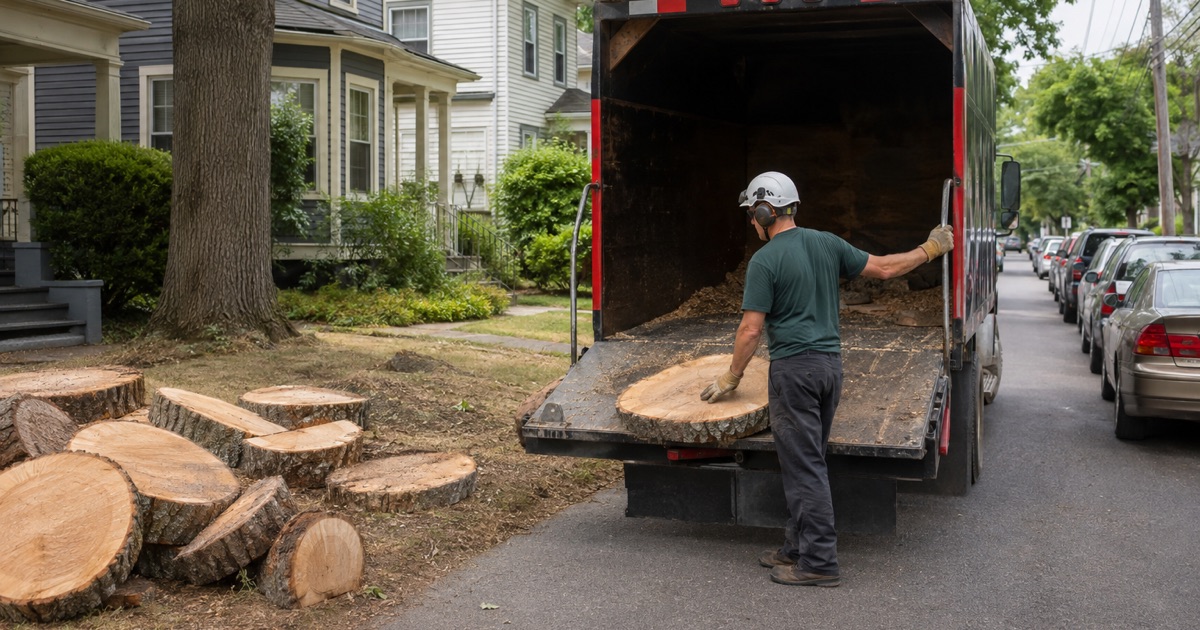
Most of what we take out of this community comes down in sections rather than in one piece, because there is usually nowhere for a whole tree to fall. That means compact machines through gates, rigging worked from inside the canopy, and a crane only where a tree stands over a structure and a boom can actually be set. Lawn and hardscape matting goes down on every job, which matters more on a small lot than on a large one.
Two ground conditions inside one small village
The community sits entirely within the Piedmont Plateau Province, on the upland side of the Fall Line, but the surface geology underneath it is not one thing. Roughly 50.1% samples as Baltimore Complex metagabbro, gabbro and amphibolite, which is hard mafic crystalline rock. Another 46.2% samples as the Patuxent, Arundel Clay and Patapsco formations, which is soft Cretaceous sand and clay. That near-even split sits inside an area small enough to drive across in a few minutes.
Why we walk the ground before quoting
The same species on the crystalline side and on the Cretaceous side is two different jobs once the saw is in it. Rock close to the surface pushes roots wide and shallow instead of down, so the root plate ends up broad, flat and laced with stone. Sand and clay let roots run deeper and finer, and the ground itself gives under weight once it is wet.
We would rather learn which of those we are standing on with a probe in hand than halfway through a removal. The estimate names it, and everything downstream of that decision, from machine choice to the time we allow for the stump, follows from it.
Wet ground and the equipment that follows it
The Little Patuxent runs through the community and its valley walls are steep, which puts a good share of the local tree cover on park land rather than on private lots. On the private side, the yards backing toward the valley are where soft ground and slope arrive together. We size the machine to the ground rather than to the tree, and matting carries the weight across turf that would otherwise rut down to mud.
Looking for tree-removal closer to Cape St. Claire? See Tree-Removal in Cape St. Claire.
Tight lots in a mill village
The old village is the access constraint that defines tree work here. Narrow streets, short setbacks, on-street parking and houses set close together mean that where the truck can stand is usually a harder question than how the tree comes apart. Crane and bucket siting is frequently the limiting factor, and on some addresses there is no siting at all.
Rear yards reached on foot
When a boom cannot reach, the route is a side gate and a compact machine walked in, with the wood carried or winched back out the same way. We keep equipment sized for exactly that: narrow enough for a standard gate, light enough not to tear up what it crosses. It is slower than dropping a tree into an open yard, and we say so in the estimate rather than pricing the fast version and then doing the slow one.
Older housing sets the risk picture
The housing stock here is not new. About 11.7% of units predate 1940 and 27.2% predate 1960, and the trees planted around those houses have had decades to grow into rooflines, service drops and shared property lines. A large limb over a house from that era is a different rigging problem than the same limb over a recent addition, and the difference is where the load goes when the piece swings.
Where a removal sits on or near a shared line, the written estimate sets out what is coming down and what is being left before the saws come off the truck. That is the cheapest hour anyone spends on a job like this.
Standing deadwood in a tight yard
Emerald ash borer has been established in Maryland since 2003, and a large infested ash is usually dead within about three years, leaving brittle standing deadwood behind it. Brittle is the operative word: a dead ash does not hold a climbing line or a rigging point the way a live one does, and that changes the whole plan. In a yard with a fence eight feet off the trunk, the honest answer is often a lift or a crane rather than a climber, and we would rather say that at the estimate than improvise on the day.
We look for the same thing on every walkthrough, whatever the species: included bark at a co-dominant union, epicormic shoots after an old topping cut, a root collar buried under years of mulch. Those are the details that decide whether a tree is a removal now or a monitored tree next season, and they are the reason the estimate is done on site rather than over the phone.
Working next to a landmark
The Bollman Truss Railroad Bridge at Savage Mill is not scenery to us, it is a work constraint. The 160-foot double span was built in 1852 and moved to its present crossing of the Little Patuxent about 35 years later, and it is the only known surviving Bollman truss in the world. It was designated a National Historic Landmark on February 16, 2000.
The Savage Mill Historic District, meaning the industrial complex together with the village of workers’ housing north of it, was added to the National Register of Historic Places on February 20, 1975. Savage Mill itself dates from about 1816. Working inside that footprint means the drop zone, the crane pad and the truck route all get planned around structures nobody is willing to have nicked.
Who signs off, and on what
Exterior alterations to contributing properties inside the locally regulated historic area covering the mill village are reviewed by the Howard County Historic Preservation Commission. Howard County’s Forest Conservation Manual notes that the program protects individual trees only in narrow cases, and a tree associated with a historic structure is one of them. That is worth establishing before a date is booked rather than after a crew is standing in the yard.
Trees at the curb are a separate question
Whether a tree is yours to remove turns on where the trunk stands, not on who planted it. Maryland’s Roadside Tree Law works from the position of the trunk within the public right-of-way, and Natural Resources Article section 5-406(d) bars a county or municipality from issuing a building permit until the roadside tree permit is obtained. The Roadside Tree Care Permit comes from the Maryland Department of Natural Resources Forest Service, penalties are set at $2,000 and $5,000, and the emergency exception carries a one-week reporting duty under COMAR 08.07.02.03C.
Trees in the county road right-of-way are a different desk again. Limb elevation, removal of dead trees, storm limb clearance and the stump afterward belong to the Howard County Department of Public Works, Bureau of Highways, Tree Division, reachable at 410-313-7450 during business hours. Their published note is that stump grinding may take up to a year depending on workload and backlog, which is usually the moment a property owner works out which trees are actually theirs.
What the ground split means for the stump
Grinding effort is not uniform across this community, and that follows directly from the geology. On the crystalline side the wheel is working through a root plate full of stone and tooth wear sets the pace. On the sand and clay side the wheel moves fast, but the roots run deeper and wider, so the grind is a larger area rather than a harder one.
Neither case is a surprise when it is priced from the ground instead of from a photograph. We quote the stump alongside the removal, state the depth we are grinding to, and say whether the grindings stay on site or leave with the rest of the debris. It goes in the same written estimate as everything else.
Where the wood goes is a regulated question as well as a logistical one. Spotted lanternfly does not kill trees, but the Maryland quarantine controls the movement of logs, stumps, firewood, yard waste and any other tree parts out of the quarantine area, so hauling is planned around that rather than around whichever transfer site is nearest. What is included in the haul-off, and what stays stacked on site if you want the firewood, is stated in the estimate before the first cut.
The permit question most homeowners are actually asking
The county’s forest conservation program does not reach an ordinary homeowner removal. Development activity on a single lot smaller than 40,000 square feet is exempt outright under Section 16.1202(b), unless that lot is already covered by an approved Forest Conservation Plan, and most old-village lots sit far below the threshold. Clearing tied to subdivision, development or grading is the case that does go to the Howard County Department of Planning and Zoning, along with a Declaration of Intent where one applies.
Who is allowed to do the work
Maryland Natural Resources Article section 5-417(a)(1) requires a Licensed Tree Expert license to do tree work for hire, with narrow exemptions at section 5-415(c)(2)(iii) for trees 20 feet tall or less, for loggers and for underground-utility installers. Crew working under a Licensed Tree Expert’s supervision do not each need their own license, under section 5-417(a)(2). COMAR 08.07.07.03D requires the written contract to carry that license, which is one more reason nothing here starts on a handshake.
Lines overhead
If a limb is resting on a line, that is Baltimore Gas and Electric’s call before it is ours. BGE holds vegetation-management duties on its own distribution circuits under COMAR 20.50.12.09 and is not responsible for removing the wood afterward. Report a limb on a line to 1-800-685-0123, and a downed line to 1-877-778-2222.
Once the line is clear, the removal and the cleanup come back to us, and the 24-hour response exists for exactly that gap. Storm work here is mostly a matter of getting a compact machine into a yard that a full-size truck was never going to reach.
- 20+ Years in Anne Arundel
- Free Written Estimates
- 24-Hour Storm Response








