
Glen Burnie Tree Removal handles tree removal in Rosedale, and after more than 20 years of this work we plan a job here around the ground as much as around the tree itself. The subsoil under these yards is stiff and water-holding, and that single fact changes how a mature trunk is anchored, how it fails, and how long the stump takes to grind out.
Most of what we take down here stands in a private back yard on a detached lot, which means the person deciding is the homeowner walking the property with us rather than a board or a manager. The estimate happens on site, it is written down before anything is cut, and the visit itself carries no charge.
That written estimate names which trunk sections are coming out, how the wood and brush leave the property, and what the yard looks like when we are finished. The crew that walked the lot with you is the crew that does the felling and the cleanup, so nothing gets renegotiated halfway through the job.
What the Arundel Clay does to a root plate
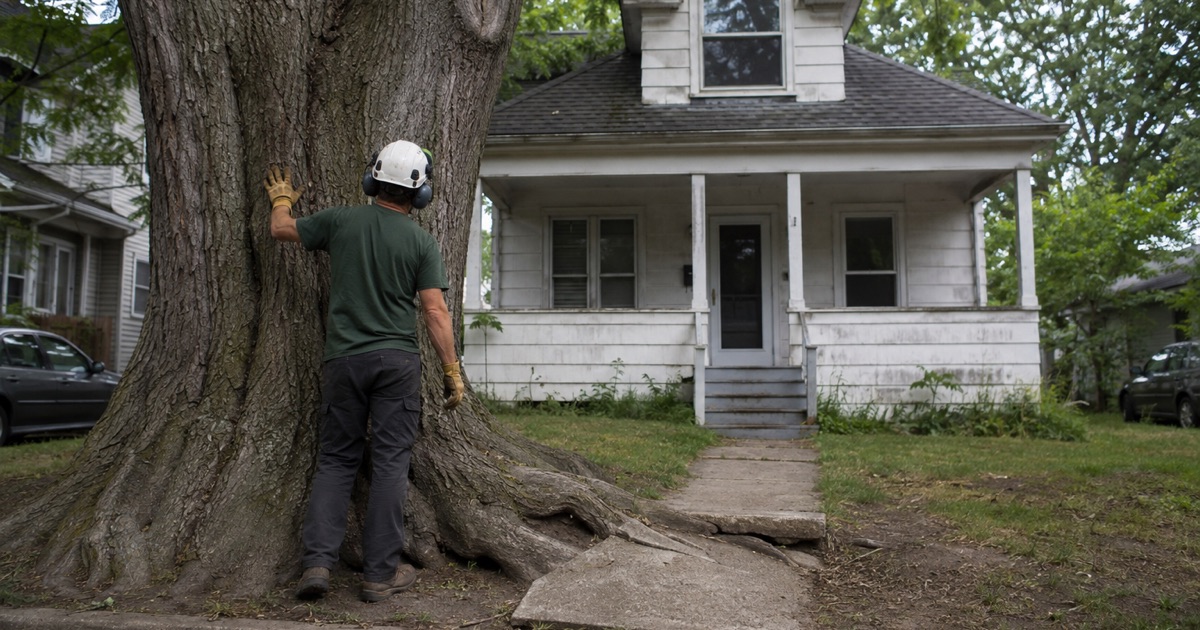
Rosedale sits on the Atlantic Coastal Plain, and the state geologic map puts the surface here in the Potomac Group, which stacks the Patuxent, Arundel Clay and Patapsco formations. The Arundel Clay is the part of that sequence a tree crew has to plan around, because it is a heavy plastic clay rather than a free-draining sand.
Mapped soil at the center of the community is the Russett series at 85 percent of the map unit, and what sits beneath it behaves the way clay behaves. It holds water, it resists root penetration, and it stays plastic long after the surface looks dry enough to walk on.
Why the plate stays broad and shallow
Roots follow air and water, and a dense clay subsoil offers little of either. A tree growing over this material spreads its structural roots wide and shallow instead of driving them down, so the anchoring plate ends up flat, broad and close to the surface.
That shape holds a tree up well in still air and much less well in saturated ground with a loaded crown above it. When one of these trees goes over it usually goes over whole, lifting a disc of soil and root together rather than snapping partway up the stem.
Reading the lean before anything is cut
So the first thing we look at is not the crown, it is the ground at the base of the trunk. A ridge of lifted turf on one side, a crack opening in the soil, or a trunk that has changed its attitude since last season all say the plate has already started to move.
Where that has happened the tree comes down in pieces rather than in one drop, because a compromised plate will not hold still while a faller works a hinge. Compact machines fit through a standard side gate for most of that work, and where a leaning trunk stands over a roof we bring a crane and lift the sections out over it.
Sectional dismantling costs more hours than a straight fell, and it is the right call more often here than owners expect. The alternative on a shallow-plated tree is a hinge that tears out early and a trunk that travels where the plate lets it rather than where the notch pointed.
Looking for tree-removal closer to North Laurel? See Tree-Removal Services in North Laurel.
Standing water and the drainage a clay lot never had
Clay-rich subsoil holds water instead of passing it along, which is why a back yard here can stay soft for days after the rain has stopped while a sandier lot elsewhere in the region has already dried out. That standing water works on the trees around it in two different ways.
The first is slow. Saturated soil starves fine roots of oxygen, and a tree that has quietly lost a share of its absorbing roots thins at the top long before anything looks wrong at the base.
The second is sudden. Soft ground gives up its grip on a shallow root plate exactly when the wind is strongest, which is why the trees that come down in a storm are so often the ones standing in the wettest corner of the lot.
What a wet corner usually tells us
A low spot that ponds, a downspout discharging a few feet from a trunk, or a patio extended out over the root zone all tend to arrive as the same complaint: dieback in the upper crown and a tree that has stopped putting on growth. The pattern is common enough on these lots that we check the drainage before we price the removal.
None of that is settled by taking the tree out on its own. Where the water is the cause we put that in the written estimate, so you can weigh whether the tree is the problem or the yard is, and spend accordingly.
Timing, ground protection and storm calls
Rosedale falls in the National Weather Service forecast zone for Southern Baltimore, MDZ011, while the northern end of the county sits in a separate zone with its own conditions. We watch the one that actually covers this community, because a removal scheduled for the wrong week is a removal carried out on soft ground.
When the work cannot wait, protection matting goes down over the lawn and over any hardscape in the path before the first machine moves, and we run compact equipment rather than something that needs a fence panel taken out. Storm damage is its own category: a fallen tree gets a response inside 24 hours regardless of what the ground is doing.
Trees that came up with the houses
The housing stock here is old and unusually consistent. Some 91.8 percent of it predates 1980, and the largest single cohort went up during the 1960s, so the typical yard tree was planted or left standing when the house was built and has had five or six decades to put on size.
That is a size at which a homeowner’s own options run out. A trunk of that age standing over a detached garage is well past what can be dropped in one piece in a suburban back yard, and well past what a rented chipper deals with once it is on the ground.
Owner-occupancy runs at 73.5 percent here, and 61.5 percent of occupied units are owner-occupied detached houses. In practice that means one decision-maker, a fenced back yard, and an approach that runs up a driveway or through a side gate rather than off a shared alley.
Access decides the machine
The gate opening is usually the constraint that picks the equipment, not the tree. We size the machine to the gap we can genuinely get through, which is why the estimate visit includes measuring the access route rather than only looking at the trunk.
Where nothing can get through at all, the tree leaves in pieces over the fence line or by crane from the driveway. Either way, the route the wood takes off the property is agreed in writing before work starts, along with what is hauled away and what is left stacked.
Defects a mature yard tree accumulates
Trees of this age standing in open yards tend to carry the same short list of defects: co-dominant stems meeting at a union with included bark, deadwood held high in the crown, and epicormic shoots pushing out of an old topping cut. None of those are exotic, and all of them change how a tree has to be taken apart.
Some are answered by crown reduction or by cabling and bracing rather than by removal, and we will say so when that is the honest answer. When the defect sits at a union carrying half the tree on each side, removal is usually the cheaper end of the conversation rather than the expensive one.
Grinding a stump out of heavy clay
Grinding is where this soil bills the most hours. In dry weather the subsoil comes up in hard dense chunks that take the edge off teeth quickly, and in wet weather the same material packs into the wheel and the cut slows to a crawl.
We price a grind on the diameter at breast height and on what is sitting underneath it, because a stump on a clay lot is a different job from an identical stump in sand. Saying that in advance is part of why the estimate is written on site rather than guessed at over the phone.
The hole a grind leaves behind
Grindings backfilled into a clay hole settle unevenly and hold water, so a ground stump in a yard here often reads as a shallow depression a season later. Where the spot is going back to lawn we state in advance what the backfill will be and how it is likely to behave.
Root removal beyond the stump itself is a separate decision and a separate line. Chasing a lateral root out through this subsoil disturbs a lot of yard for a modest gain, so it is worth settling at the estimate rather than in the middle of the job.
Who signs off on the work
There is no municipal government here to issue anything. Rosedale is an unincorporated census-designated place and Baltimore County is the authority, so there is no town permit desk in the picture. State law still applies: anyone doing tree work for hire in Maryland must hold, or work under the supervision of, a Maryland Licensed Tree Expert.
A tree whose trunk stands in the public road right-of-way is not the adjoining owner’s to cut. Those need a Tree Care Permit from the Maryland Department of Natural Resources Forest Service before the saw comes out, and along the older frontages on Philadelphia Road and Pulaski Highway that catches more front-yard trees than owners expect.
Where limbs have grown into the primary electric lines, Baltimore Gas and Electric handles clearance on its own distribution system and states that it is not responsible for removing the wood afterward. We plan around that split, and on development or grading sites the county reviews forest conservation separately under Baltimore County Code Article 33, Title 6.
- 20+ Years in Anne Arundel
- Free Written Estimates
- 24-Hour Storm Response








