
Glen Burnie Tree Removal handles property line and neighbor tree work in Glen Burnie, MD, which after 20 years in Anne Arundel County we can say is the category where the law matters more than the arboriculture. The tree is usually straightforward. Who owns it, who may cut it and who pays when it fails are the questions that actually decide what happens, and getting them wrong is expensive.
Maryland’s rule is settled and it is narrower than most people assume. In Melnick v CSX Corp, decided by Maryland’s highest court in 1988, the state adopted what is generally called the Massachusetts Rule, under which your remedy against an encroaching neighbor’s tree is self-help. You may cut back branches and roots that cross onto your property, at your own expense, and that is the extent of it — there is no general right to make the neighbor act.
The corollary catches people out. Self-help stops at the property line. You may not cross it, you may not work on the trunk if the trunk is on their side, and you may not cut so aggressively that you kill or destabilize the tree, because that is damage to their property. We survey where the stem actually stands before quoting, since a tree that looks like yours from the driveway frequently is not.
Who Owns the Tree
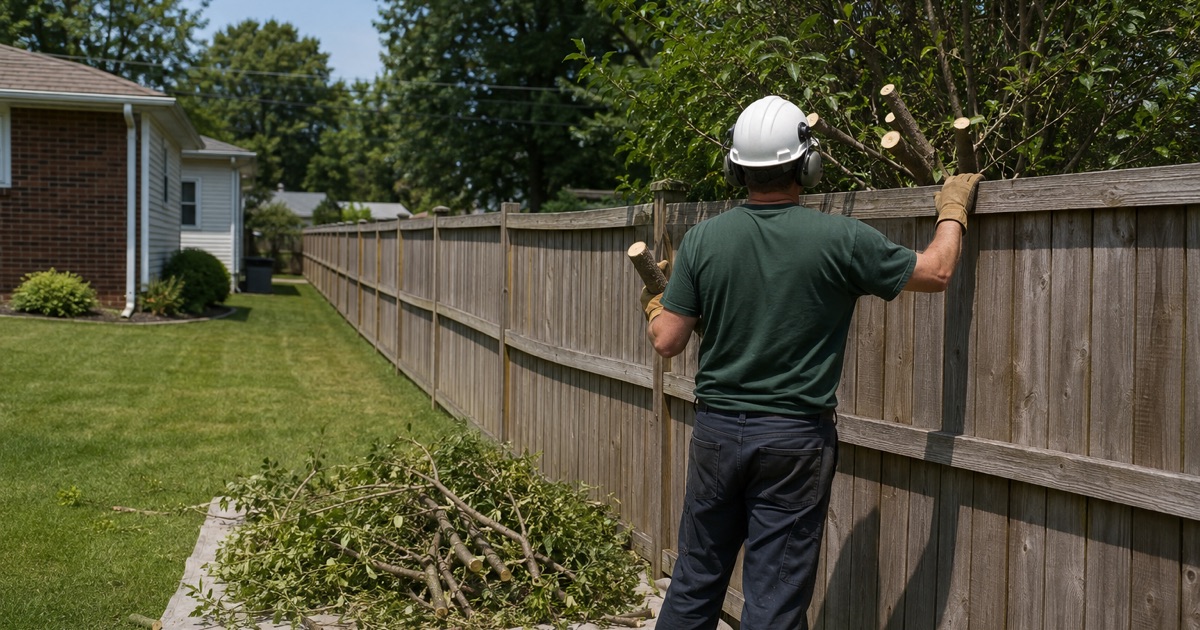
Trunk Position Decides Ownership
Ownership follows the trunk, not the canopy and not the roots. A tree whose stem stands entirely on one side of the line belongs to that owner, however far its branches reach. Because canopy spread routinely doubles the apparent footprint of a tree, the tree overhanging your roof is very often your neighbor’s, and the first thing we establish is where the trunk actually sits relative to the boundary.
Boundary Trees Standing on the Line
A tree whose trunk straddles the property line is a different animal: it is jointly owned, and neither owner may remove it unilaterally. Written consent from both owners is the practical requirement before that tree is touched, and we ask for it before scheduling. It is not a formality — removing a boundary tree on one owner’s say-so exposes both us and them.
Finding the Line Before Anyone Cuts
Fences, hedges and driveways are not property lines and frequently sit feet away from them. On eighth-acre and quarter-acre lots, feet matter. Where the boundary is genuinely uncertain and the tree is close to it, a survey is far cheaper than the dispute that follows a mistake, and we will hold the job rather than guess.
What You May and May Not Do
Cutting Back to the Line
You may prune branches and roots back to the boundary at your own cost. Doing it well matters: cuts made at the property line rather than at a branch collar leave wounds the tree cannot close, and severing structural roots on one side can destabilize a tree that then falls on you. We prune to the line in a way that respects the tree, because a dead neighbor’s tree becomes your problem.
Where Self-Help Runs Out
You cannot enter your neighbor’s property, work on their trunk, or take down their tree without permission, and you generally cannot compel them to remove a healthy tree simply because you dislike it. Where a tree is genuinely hazardous, the productive route is a written arborist assessment given to the owner, which creates a record of notice.
Liability and the Notice Question
If a healthy tree falls in a storm, the damage is normally the responsibility of the property it lands on, regardless of where it grew. Where the tree was known to be dead or defective and the owner had been put on notice, an insurer may pursue subrogation against that owner. That is why a dated written assessment delivered to the neighbor is worth far more than a conversation over the fence.
Roots, Hardscape and Underground Encroachment
Encroachment is not only overhead. Roots crossing a boundary lift walks, crack driveway edges and find their way into older laterals, and the same self-help rule applies: you may cut them back at the line and no further. The practical difficulty is that severing structural roots on one side can destabilize a tree that then falls toward you, so we judge which roots are structural before anything is cut and say so in writing when the safe answer is to raise the hardscape instead.
How We Handle These Jobs
Documenting the Situation First
We photograph the tree, the trunk position relative to the boundary and the encroachment, and we put the scope in writing before anything is cut. That record protects everybody, including the neighbor, and it turns a disagreement about what was agreed into a document anybody can read.
Working for Both Sides
Where both owners want the tree dealt with, the cleanest outcome is one crew, one scope and a written agreement about who pays for what. We are happy to quote it that way, and it is almost always cheaper than two contractors working opposite sides of the same tree to different standards on different days.
Permits Still Apply on the Line
A boundary dispute does not suspend the regulations. Inside the Chesapeake Bay Critical Area buffer an approved Vegetation Management Plan is required before cutting, and a tree in the public right-of-way needs a Roadside Tree Care Permit regardless of which neighbor mows around it. We check both before the work is scheduled.
- 20+ Years in Anne Arundel
- Free Written Estimates
- 24-Hour Storm Response