
Glen Burnie Tree Removal has handled tree removal in Parole for more than 20 years, and the first thing we settle on any job here is which government reads the paperwork. This community is unincorporated, so the county holds the file even though the mailing address says Annapolis. Getting that answer right at the estimate is what keeps a removal from stalling for a week.
Every estimate is done on site and put in writing before work begins, and the visit itself costs nothing. The written scope names the trees, the method, the debris we haul away and what stays behind. When the job starts, the crew that walked the property with you is the crew that finishes the cleanup.
Storm calls get a response within 24 hours, which matters on ground where thunderstorm wind has put trees across the same roads more than once. We bring compact equipment for gated back yards and tight service courts, and we set a crane when a tree stands over a roof rather than walking it down above the shingles.
Which rules apply on this side of the line
Addresses here read Annapolis, and that misleads people into looking up the wrong ordinance. A point at Westfield Annapolis returns Anne Arundel County with no incorporated place, and so do Annapolis Town Center, the county complex at 2660 Riva Road, 820 Bestgate Road and Luminis Health Anne Arundel Medical Center. City tree chapters do not reach any of them.
A manager who calls the wrong counter is told the property is not theirs, and several days disappear. We confirm jurisdiction against the address before quoting, because the permit path, the review timeline and the inspection all change with the answer. On a Critical Area parcel it decides whether the job needs a plan on file at all.
Permits and reviews start at the county counter
Building, grading and sediment control permits come from the Anne Arundel County Department of Inspections and Permits. Where a subdivision, grading permit or sediment control permit covers a site of 40,000 square feet or greater, the county’s Forest Conservation Regulations apply and that review sits with the Anne Arundel County Office of Planning and Zoning, Development Division. On a commercial parcel here, that threshold is easy to cross without noticing.
Forest conservation review is not the same file as a grading permit, and a removal tied to construction is judged against the site plan rather than the tree alone. We plan the sequence so clearing happens after the review closes, not the week the sediment control fence goes up.
Buffer work runs on a Vegetation Management Plan
Critical Area polygons in all three classifications — Intensely Developed Area, Limited Development Area and Resource Conservation Area — are mapped inside the boundary, following the Severn River and South River tributaries that frame it. Cutting, pruning or removing natural vegetation in the Chesapeake Bay Critical Area buffer or expanded buffer, a minimum of 100 feet from tidal waters and tidal wetlands, calls for a Standard Vegetation Management Plan filed with the Anne Arundel County Department of Inspections and Permits, Forestry Program. The county forester takes those questions at (410) 222-7441, and the state program behind them is overseen by the Critical Area Commission for the Chesapeake and Atlantic Coastal Bays.
Whose right-of-way the trunk stands in
A tree whose trunk stands in a public right-of-way needs a Roadside Tree Care Permit from the Maryland Department of Natural Resources Forest Service, which also licenses Maryland Licensed Tree Experts. Trunks inside the state highway right-of-way along US 50/301, MD 2 Solomons Island Road, MD 450 Defense Highway and MD 665 Aris T. Allen Boulevard belong to the Maryland Department of Transportation State Highway Administration. County road frontage goes to the Anne Arundel County Department of Public Works, Bureau of Highways.
Anything touching a distribution line is a call to Baltimore Gas and Electric Company before it is a call to us. We stage the site, keep the lane blocked and cut once the conductor is confirmed dead, which is slower than a homeowner expects and the only safe version of that job.
Looking for tree-removal closer to Woodlawn? See Woodlawn Tree-Removal.
Trees in a parking structure island
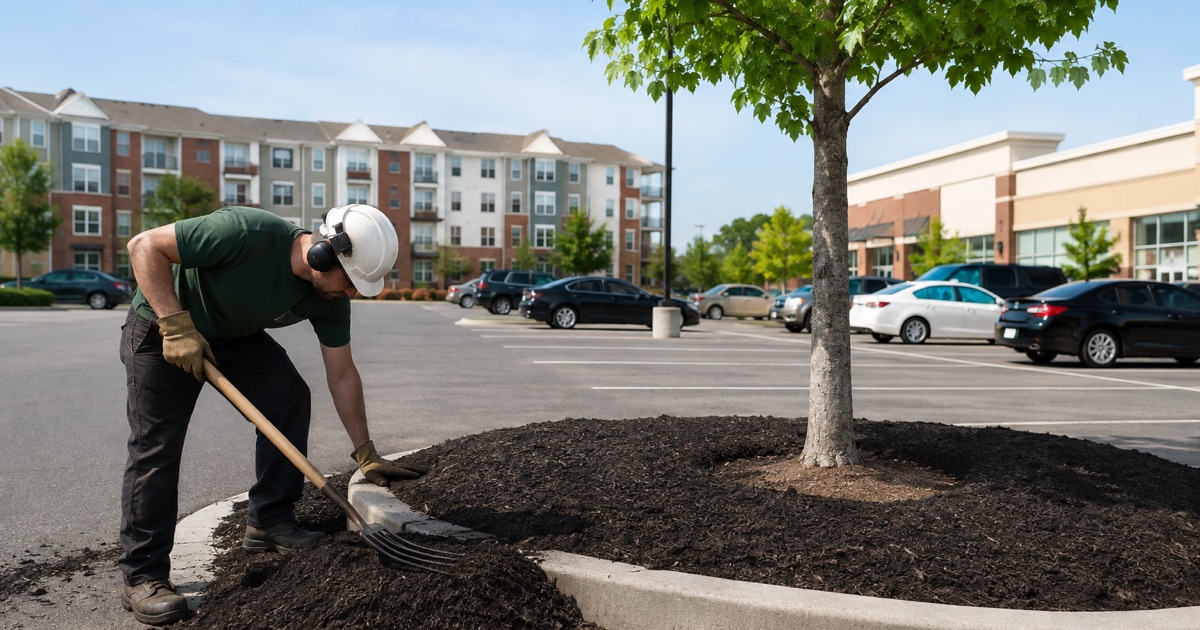
The retail and office core plants trees in islands cut into pavement, in raised planters over deck slabs, and in narrow strips between a curb and a building wall. There is no yard to drop into and no soft ground to absorb the impact. Removal becomes a rigging and lowering problem measured by what fits through a lot without closing it.
Access, clearance and the work window
Compact equipment matters more than horsepower on this ground. Our machines fit gated service courts, garage ramps and the tight lanes behind a loading dock, which is where the tree usually is. Where a deck slab limits what can drive across it, we work off an aerial lift and carry brush out.
Island trees also come with a root system nobody can see from the surface. Curbs, conduit and drain lines sit inches from the flare, and a stump grinder working blind is how a lot loses its lighting circuit. We locate before we grind and put what we found in the estimate.
Work windows are the other constraint. Starting at 6:00 a.m. and finishing before the lot fills keeps a tenant’s customers away from a drop zone, and it is the difference between one lane coned off and an aisle closed.
Crane picks and sectional dismantling
When a tree stands over a storefront roof, an entry canopy or a parked row, a crane pick lifts the load away in controlled sections instead of walking it down over the structure. Where a crane cannot set outriggers, and over a deck slab it often cannot, sectional dismantling on rigging is the alternative and it takes longer. The written estimate says which method the tree gets and why, so nobody is surprised by the day count.
Included bark between co-dominant stems is the defect we look for first on these plantings, because a split at that union drops half a canopy onto whatever is parked beneath it. Finding one changes the rigging plan, and sometimes the recommendation from pruning to removal.
Leaving the lot the way we found it
Lawn and hardscape protection matting goes down on every job, and on a commercial site that means pavers, stamped concrete aprons and irrigation heads as much as turf. Debris hauling and cleanup are itemized in writing, including whether the stump is ground and how deep. We sweep the pavement before we leave, because a lot full of chips is a complaint the next morning.
Multifamily grounds and the people who sign for them
Around 37.3 percent of the housing units here sit in structures of ten or more, and 35.8 percent are renter-occupied against 64.2 percent owner-occupied. That mix means a large share of the trees on this ground belong to a board, a management company or an owner who is not on site. The person who signs the estimate is rarely the person standing under the tree.
That changes the planning more than it changes the saw work. Access runs through gates, dumpster enclosures and fire lanes that have to stay clear, and the drop zone is somebody’s parking space. We walk the route with the property manager before quoting, so the estimate reflects what the equipment can actually reach.
A scope a board can vote on
Estimates are written before any work begins and carry no charge for the visit, which is what a board needs to put a line item on an agenda. The scope names each tree, the method, the debris that leaves the property and the condition the ground is left in. Boards approve on paper, so the paper has to be complete the first time.
Scheduling around residents and grounds staff
Our scheduling is built for HOA boards, property managers and multifamily grounds, which in practice means notice letters, resident parking moved the night before, and a start time the community can live with. We coordinate with on-site maintenance rather than working around them. The same crew runs the job from the estimate through the final cleanup, so a manager never re-explains the site to a new face.
Maturing plantings on grounds built from the 1980s onward
Much of this housing stock went up from the 1980s forward, and the landscape plantings that came with it are now full-sized trees standing close to buildings, walkways and parking. Crown reduction and crown thinning bring a canopy back off a roofline; deadwooding takes out the limbs that come down on their own over an entry. Cabling and bracing can hold a co-dominant union worth keeping, and we say plainly when a tree is past that point.
Ash on these properties needs its own look. Emerald ash borer leaves standing wood that is brittle and unpredictable to climb, so a dead ash over a walkway gets a crane or a lift rather than a climber, and it moves up the schedule ahead of a healthy tree the same size.
Epicormic shoots along a trunk after a hard topping cut are a sign of stress, not of recovery, and they are common on grounds maintained by whoever quoted lowest that year. We would rather reduce a crown properly once than clean up water sprouts every season.
Urban land, ravine walls and what the storms find
The soil map for the center of this community returns a single unit named Urban land, at a 100 percent urban land component. There is no intact profile under the built core at all — it is fill, base course and whatever was left when the shopping centers went in. A tree growing in that has a root plate shaped by the pavement around it, and it fails differently than one in open ground.
Reading a flare you cannot see
Root collar excavation with an air spade is how we find out what sits under the mulch. On urban fill we regularly find a buried flare, girdling roots wrapped at the collar, and a root plate that stops where a curb starts. Diameter at breast height tells us what the tree is; the collar tells us whether it is holding.
Annapolis series soils and the ravine walls
Away from the pavement the mapping changes completely. Annapolis fine sandy loam runs from 0 to 2 percent slopes up through 40 to 80 percent, with Annapolis loamy sand, Howell and Annapolis soils and Howell-Annapolis complexes across the middle ground and Marr and Dodon soils on the steeper faces. Collington, Wist and Westphalia soils are mapped at 40 to 80 percent slopes inside the boundary, which is as steep as ground gets in this county.
A lot backing onto one of those ravines is a rigging job, not a drop. Everything comes down on ropes to a landing we build, and the brush is carried up rather than dragged down. It is slower, it is priced that way, and it is the only version that leaves the hillside intact.
What the storm record actually shows
Summer thunderstorm wind is the driver here. A tree fell onto a house in the 200 block of Gross Avenue on June 19, 2017; a tree came down on MD 2 Solomons Island Road just north of US 50 on August 6, 2020; another blocked northbound MD 2 at MD 665 Aris T. Allen Boulevard on July 6, 2020. Tree damage was reported on MD 665 near Chinquapin Road on July 12, 2022, and trees blew down on MD 2 at Forest Drive on May 31, 2025.
A sensor at Bestgate measured a 62 mph gust on May 16, 2025, and quarter to ping-pong-ball-size hail fell near Forest Drive and MD 2 on July 1, 2020. Our 24-hour storm response exists for the night after one of those, when the first call is usually a tree on a roof or across a driveway rather than anything on the calendar.
- 20+ Years in Anne Arundel
- Free Written Estimates
- 24-Hour Storm Response








