
Glen Burnie Tree Removal has handled tree removal in Odenton for more than 20 years, and the work here is rarely a matter of dropping a stem and hauling it off. Two conditions shape almost every job we quote in this community: what the subsoil does to a root system, and which of the streams crossing the neighborhood the county watches closely. Both of them change the plan before a saw comes out of the truck.
Every job starts with a free on-site visit and a written estimate put in front of you before any work begins. There is no charge for the visit and no charge for the walk-around that produces the number. The crew that measures the tree, checks the drop zone and prices the haul-away is the same crew that arrives on the work date and the same crew that rakes the yard at the end of it.
When a tree comes down at 2:00 a.m., we answer storm damage and fallen-tree calls within 24 hours. Through the rest of the year we bring compact machines that fit a gate or a parking-court entrance, crane support for a stem standing over a roof, and lawn and hardscape protection matting on every job rather than only on the ones where the ground already looks soft.
The canopy along Jabez Branch
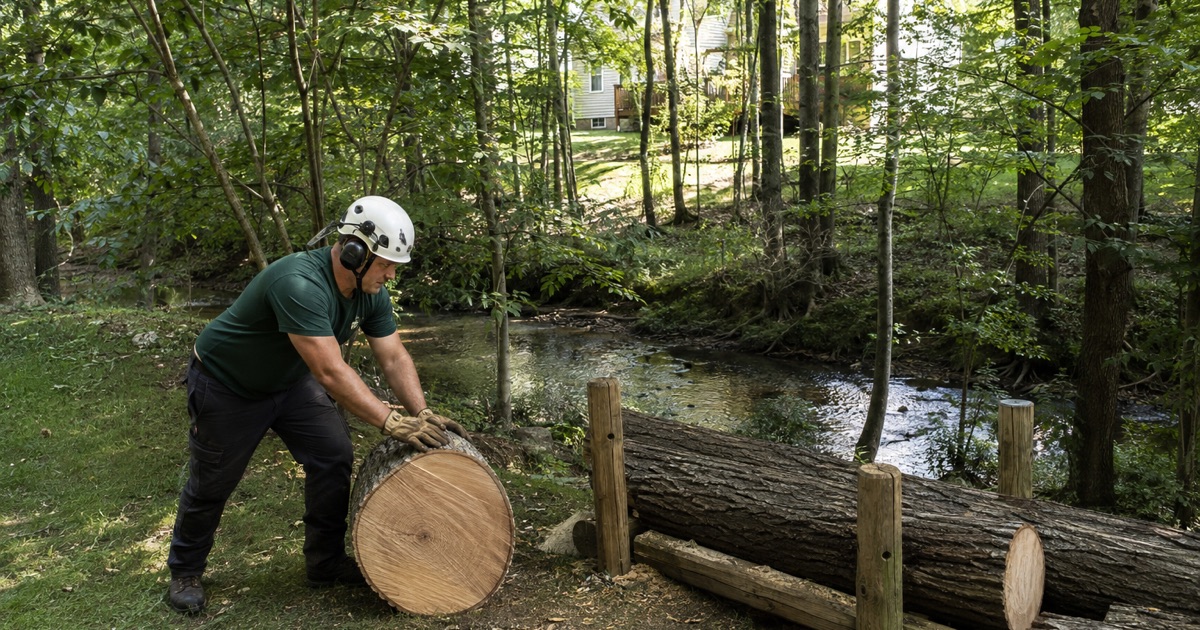
Jabez Branch runs through this community, and it is not an ordinary drainage ditch. Anne Arundel County describes it as a tributary to Severn Run and as the only stream in the Maryland Coastal Plain physiographic region that supports a native, self-sustaining brook trout population. Four of the county’s named subwatersheds here carry its name.
What the county credits for the trout
The county does not put that survival down to luck. Its record names the thick canopy growth along the stream, cool underground springs and dense forested buffers as the conditions the fish depend on. It also documents stream temperature climbing from 63.5 degrees to 73.4 degrees Fahrenheit inside a sixty-minute period after a one-inch rainfall, which is what warm runoff off pavement does to a coldwater stream.
The history behind those sentences is long. Brook trout were first found in the stream in 1977; state biologists declared them gone in December 1990 after highway construction sent solar-heated water into the Left Fork; the first of three transplants of wild fish followed in 1991, and the population had rebounded by 1995. A dry headwater channel was rebuilt in 1997, and a tributary was restored again in spring 2024 by infilling the incised channel with woodchips, sand and gravel.
What that means for a tree standing near the water
Shade is the documented mechanism, so pulling a mature tree out of the streamside strip is not a neutral act. When a customer near the water asks about removal, we look first at whether the tree can stay: crown reduction over a roof line, crown thinning to move weight off a lean, deadwooding to clear the failure risk without opening the canopy. A tree that genuinely has to come out is a different conversation from a tree that is merely inconvenient.
Where a stem does have to go, we plan it as sectional dismantling rather than a felled drop. Rigging pieces down to a set landing keeps limbs out of the channel, keeps the understory that shades the water intact, and keeps machine traffic off saturated ground beside it. The Severn River Commission and the Maryland Department of Natural Resources Fisheries Service both keep records on this water, and it is safe to assume somebody notices.
Looking for tree-removal closer to Fort Meade? See Tree-Removal Services in Fort Meade.
Rooting depth over a Butlertown fragipan
The soil survey for this part of Anne Arundel County is the reason we ask more questions about a leaning tree here than we would on the other side of the county. A nine-point sample inside the community returned the Mattapex-Butlertown complex at three of those points, on slopes of 2 to 5 and 5 to 10 percent. Butlertown is classed as a Typic Fragiudult.
What a fragipan does underground
That great group is defined by the presence of a fragipan, a dense and brittle subsurface horizon that neither roots nor water pass through easily. The taxonomy is itself the evidence the layer is there. What the survey does not publish is how deep it sits on any particular lot, so we treat depth as something to establish on site rather than something to assume from a map.
The practical consequence is that rooting depth is capped. Trees growing over a pan tend to develop shallow, plate-like root systems regardless of species, which means a healthy-looking mature crown can sit on far less anchorage than it appears to have. That is the most common surprise on a removal quote in this community, and it is why a root collar excavation with an air spade is sometimes the cheapest way to settle whether a tree is sound.
Wet ground, ruts and machine footing
A pan also perches water above itself, so the ground stays wet after rain even on a slope. The companion Mattapex series is moderately well drained with a seasonal water table in the profile, and both series are fine-silty, which is the worst case for lawn damage: fine-silty soil compacts and smears under a tire instead of draining. Protection matting goes down on every job for that reason.
Two of the nine sample points came back as Sassafras and Croom soils on 15 to 25 percent slopes. Croom is a loamy-skeletal, gravelly soil on steep ground, which is hard on stump grinder teeth and narrows where a machine can safely be set. On those lots we settle the grind and the equipment position at the estimate rather than discovering the problem on the morning of the job.
Wind over shallow roots
The storm record that matters here is led by summer convective severe-thunderstorm wind and by tornadoes rather than by coastal weather. Straight-line wind over a fragipan takes trees out by the roots instead of snapping the trunk, which is why a plate-lifted root ball beside an intact stem is such a common sight after a July line of storms. Standing dead ash is the other half of it, since emerald ash borer has been established in Maryland since 2003 and leaves a large ash brittle within about three years.
Permits and licensing before a removal
Maryland regulates this trade at the state level, and the rules are worth knowing before you accept anyone’s quote. Under the Natural Resources Article, tree care performed for hire requires a Licensed Tree Expert through the Maryland Department of Natural Resources Forest Service. The statute exempts trees 20 feet tall or less, along with loggers and underground-utility installers, and it lets crew work under a licensed expert’s supervision without holding individual licenses.
The licensing regulations are COMAR 08.07.07, and one of them makes a written contract mandatory, carrying the licensed expert’s number on its face. Anne Arundel County repeats the point in its own guidance: contracted tree removal or pruning may only be performed by a Maryland Licensed Tree Expert. It is a fair thing to ask for from anybody bidding your job.
Roadside trees in the right-of-way
A tree in the public right-of-way is a separate permit, and the test is narrower than most people expect, because it turns on where the trunk stands rather than on where the canopy reaches. A tree that overhangs the road from inside your property line is not a roadside tree. One that stands in the strip belongs to the state’s Roadside Tree Care Permit process, which carries a 25-dollar project fee and penalties running into thousands of dollars for cutting without it.
Two details catch people out. The Natural Resources Article bars a county or a municipality from issuing a building permit until that roadside permit is in hand, so a removal tied to construction has to be sequenced early. An emergency removal is allowed, but it carries a reporting duty to the Forest Service within a week of the work.
Forest conservation and easement ground
Anne Arundel County’s forest conservation requirements sit in Article 17 Subtitle 3 of the county code, administered through the Office of Planning and Zoning with the Department of Inspections and Permits, under the state Forest Conservation Act. They attach when a subdivision, a grading permit or a sediment control permit is proposed on a site of 40,000 square feet or more. In a community still building out, that threshold is reached often.
Ground inside a Forest Conservation Easement is stricter again: a Vegetation Management Plan has to be approved before vegetation is cut, pruned or removed, with farming, gardening and maintaining an existing grass lawn the only exceptions. The county forestry program at (410) 222-7441 is the office that answers those questions. We build the permit path into the schedule instead of leaving it as the customer’s problem.
Access on Odenton’s attached lots
The built form here changes the work more than the tree species does. Attached housing outnumbers detached housing in this community, with one-unit attached homes at 35.4 percent of the stock against 29.5 percent detached, and buildings of five units or more account for another 32.5 percent. Most of what we take down stands behind a townhouse row or on ground a homeowners association controls.
Rigging and debris routes on a townhouse row
An interior unit in a row has no side yard to carry brush through. Shared party walls, rear parking courts and narrow common strips mean the rigging plan and the debris route both have to be worked out from the street or across association common ground, and both need agreeing before the day. We walk that route at the estimate and put the answer in writing alongside the price.
Our machines are sized for exactly that. Compact equipment fits through a gate or a parking-court entrance a full-size chip truck cannot, an aerial lift covers what a spur climb should not, and a crane comes in when a stem stands over a roof with no safe drop beneath it. Matting protects the lawn, the walkway and the driveway apron on the way in and on the way out.
What leaves the site
County curbside collection takes limbs under 4 feet long and 4 inches thick, bundled under 40 pounds, and it will not take logs at all. That covers a pruning afternoon and nothing more, so a removal leaves wood behind that somebody has to haul. We set out in the estimate exactly what we are taking away, whether that is brush, chips, rounds, the stump grindings or all of it, so nobody is negotiating over a pile once the crew has gone.
Storm calls and lines overhead
Storm work is where the 24-hour response earns its keep. If a line is down, call BGE at 1-877-778-2222 and stay well clear of it; if a limb is resting on a line, the report number is 1-800-685-0123, and the utility’s own crews handle the clearance cut. What BGE does not do is remove the wood afterward, which is usually the call that reaches us next.
We schedule around HOA boards, property managers and multifamily grounds staff, because that is who signs off on most of this work, and the same crew stays with the job from the estimate through the final cleanup. Twenty years in Anne Arundel County is mostly twenty years of knowing which species fail, which yards hold water and which gate a truck will not fit through.
- 20+ Years in Anne Arundel
- Free Written Estimates
- 24-Hour Storm Response








