
Glen Burnie Tree Removal has handled tree removal in North Laurel for more than 20 years, and the work here is shaped less by the tree than by the route our crew has to take to reach it. Most of what we are called for stands in a rear yard behind an attached home, and the question that sets the price is whether a machine can get to the trunk or whether the wood has to come out a gate by hand.
Every estimate is free, it happens on site, and it comes to you in writing before the first cut, including what the debris hauling covers and what it does not. The crew that walks the property with you is the crew that shows up on the work date, which matters on a job where the access plan was worked out standing in the back yard rather than guessed at from the street.
Storm calls are answered within 24 hours. A tree resting on a roof, a fence or a shared wall gets a crane-assisted plan rather than a climber and optimism, and lawn and hardscape protection matting goes down on every job, because the approach to a rear-yard tree here almost always crosses somebody’s turf, walkway or common drive.
Which Laurel your address actually sits in
The mailing address says Laurel and the authority that governs the work says Howard County. North Laurel is unincorporated, with no town hall of its own, so the county is the local government for permits, roads and inspections. The incorporated Laurel of the same name lies across the Patuxent River in Prince George’s County, a separate jurisdiction whose rules stop at that river.
For a homeowner that is good news rather than a complication. A Laurel mailing address adds no municipal permit layer on this side of the river, so there is one county to deal with and, for most residential removals, a shorter path than an incorporated address would give you.
The county owns more of your street than you think
Where a trunk stands inside the county road right-of-way, the tree is Howard County’s responsibility rather than the adjoining owner’s, whoever originally planted it. The Bureau of Highways Tree Division, inside the Department of Public Works, handles limb elevation, dead tree removal, storm limb clearance and stump grinding on those trees, and its business-hours number is 410-313-7450.
That route costs nothing and it is not quick. The county says stump grinding after a right-of-way removal may take up to a year, depending on the current workload and backlog, so anyone who needs a date rather than a queue position is weighing the county’s schedule against private work on the private side of the line.
Three possible owners, one property line
On a state route the trees belong to the Maryland Department of Transportation State Highway Administration instead, and the county has no say over them. So a single address can front three different owners of the same row of trees: the private lot, the county right-of-way and the state highway right-of-way.
We settle which one applies during the estimate visit, because the answer decides who issues the paperwork, who pays for the work and how long the whole thing takes. Getting that wrong is how a straightforward removal turns into a stop-work conversation with an inspector.
Looking for tree-removal closer to Essex? See Essex Tree-Removal.
Who signs off before the saw starts
Two approvals matter on an ordinary residential removal here, and the forest conservation program most homeowners worry about is usually neither of them. One is a state permit that turns entirely on where the trunk is standing, and the other is a state license the contractor either holds or does not.
The roadside tree permit turns on where the trunk stands
Maryland’s Roadside Tree Law is keyed to the position of the trunk within the public right-of-way, not to who planted the tree or who mows around it. Work on those trees requires a Roadside Tree Care Permit from the Maryland Department of Natural Resources Forest Service, and Natural Resources Article section 5-406(d) bars a county or municipality from issuing a building permit until that permit has been obtained. Penalties are set at $2,000 and $5,000, and an emergency removal carries a one-week reporting duty under COMAR 08.07.02.03C.
Maryland also requires a Licensed Tree Expert license to do tree work for hire under section 5-417(a)(1), while a crew working under that supervision is not required to hold one individually under section 5-417(a)(2). Trees 20 feet tall or less sit outside the requirement altogether under section 5-415(c)(2)(iii). Ask any bidder for the job in writing regardless, because COMAR 08.07.07.03D requires tree work for hire to be sold under a written contract.
The forest conservation program usually does not reach your yard
Howard County’s forest conservation program runs through the Department of Planning and Zoning, which reviews clearing tied to subdivision, development and grading and accepts Declarations of Intent. It is aimed at land being developed, not at a homeowner taking down one failing oak. A development activity on a single lot smaller than 40,000 square feet is exempt outright under Section 16.1202(b), unless that lot is already subject to an approved Forest Conservation Plan.
The county’s own Forest Conservation Manual states the point without hedging: “The Forest Conservation Act is not a tree preservation act.” What does deserve a check is a recorded easement, since a pre-existing forest conservation easement is deducted from the net tract area in the county’s calculations. That is the county confirming those easements survive on land that has since been built on and lived in, so we look at the plat before quoting a removal near a rear property line.
Reaching a back yard between rows
This is where most North Laurel jobs are won or lost. Attached single-family units are 37.2% of the housing stock here against 31.0% detached, so the typical rear yard is a fenced rectangle reached through a gate rather than an open lot reached around a driveway.
Gate width, not horsepower, is the constraint
A standard stump grinder needs a gate roughly 35 inches wide to reach a townhouse back yard, and plenty of rear gates in these rows are narrower than that. The fix is a smaller machine rather than a bigger one, which is why compact equipment for gated and tight-access yards rides on the truck as standard here instead of being something we send for.
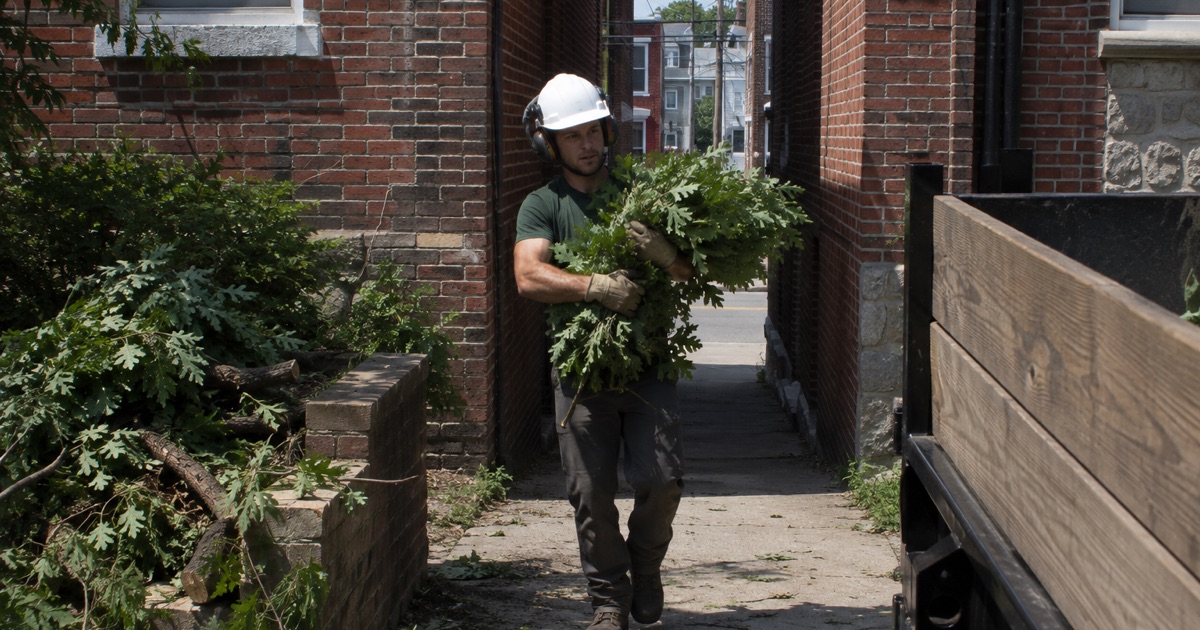
When nothing will fit, the tree comes down by sectional dismantling: rigged in pieces from the top, lowered on ropes into a space the size of a patio, and carried out the same gate the crew walked in through. That is slower, it is quoted that way from the start, and it is the reason we walk the full access route before putting a number on anything.
Soft ground, hard ground and a crane over the roof
Where Arundel Clay surfaces the ground is heavy and drains poorly, staying saturated long after the rain has stopped. That limits where a crane or a chipper can be set without rutting a lawn, and it raises windthrow risk on shallow-rooted trees, which is often why a tree that looked fine in June is leaning in July. Most of the community sits instead on hard, shallow crystalline ground, the Sykesville Formation gneiss and Baltimore Complex metagabbro, which is firm to set steel on.
When a tree stands over a house, an addition or a shared wall, we bring a crane and take the weight off in controlled picks rather than dropping limbs beside the structure. Matting protects turf and hardscape on the way in and on the way out, and the same crew loads and hauls the debris, with the cleanup scope written into the estimate rather than negotiated at the end.
Shared walls, shared lines, shared trees
A row is one structure with several owners, and that changes tree work in ways a detached lot never raises. A trunk sitting on a common line, a canopy spanning two rear yards and a lawn belonging to an association are all ordinary here.
Neighbors, boards and the schedule
We schedule around HOA boards, property managers and multifamily grounds staff, because they are frequently the ones who control the access route and the staging area rather than the owner whose tree it is. On a shared line we want both owners in agreement before a saw starts, and the written estimate says exactly what is coming down and what is being left standing.
Access across a party-wall property is a shared resource in its own right. Running a rope over a neighbor’s roof or staging a chipper on a common drive is a conversation that belongs before the work date, not on it, and sorting it out is a large part of what the estimate visit is actually for.
Utility lines and the wood left behind
Baltimore Gas and Electric carries vegetation-management duties on its own distribution circuits under COMAR 20.50.12.09, and it is not responsible for removing the wood debris that clearance work creates. Report a downed line at 1-877-778-2222 and a limb resting on a line at 1-800-685-0123, and let the utility make the conductor safe before anyone climbs or sets a ladder.
That division of labor is the thing homeowners get wrong most often after a storm. The utility clears the line; the failed tree, the hanger still in the crown and the pile across the yard remain the property owner’s problem, and that is the call we answer inside 24 hours.
The species these rows were planted with
Much of the housing here went up across three decades, 21.3% of units in the 1980s and 25.6% in the 2000s, and the yard and street trees arrived with the subdivisions. Callery pear, sold for years as Bradford, was planted heavily in exactly those years and is prohibited for sale in Maryland from January 15, 2026. The mature ones fail at their included bark and co-dominant stems, usually in a summer blow rather than at the end of a slow decline.
Ash is the other tree worth a look. Emerald ash borer has been established in Maryland since 2003 and kills a large ash in roughly three years, and what it leaves behind is brittle standing deadwood that behaves badly under a climber. A dead ash is a removal to book while it can still be climbed and rigged, which is a cheaper job than the crane picks it turns into once the wood has gone.
- 20+ Years in Anne Arundel
- Free Written Estimates
- 24-Hour Storm Response








