
Glen Burnie Tree Removal has handled tree removal in New Carrollton for more than twenty years, and the first question we settle on a job here is not the price. It is whose signature the work needs before a saw ever comes off the truck. That answer changes with the ground the trunk stands on, and it changes more sharply inside this city than in the unincorporated county around it.
Most removals we quote are private back-yard work, and those move at the pace you would expect. We come out, look at the tree, and put a written estimate in your hands before anything begins, at no charge for the visit. The same crew that walked the yard with you is the crew that runs the job and rakes the last of it up.
What slows a removal down is a tree that turns out to belong to the city, a trunk big enough to be regulated by name, or work that sits inside a building or grading application. All three are answerable in a morning if you know where to look. The sections below walk them in the order they come up on a real job.
Three sign-offs, and the order they come in
Three separate authorities can have a say in a single removal here, and they are not interchangeable. The county rule is triggered by an application, the city rule is triggered by ownership, and the state rule is triggered by where the tree stands. Sorting out which of the three applies is a short conversation at the estimate, and it keeps the job from stalling later.
The county rule attaches to applications, not to yard trees
Prince George’s County’s woodland and wildlife habitat conservation rules sit in Subtitle 25, Division 2, and they attach to applications rather than to homeowners. A building, subdivision, zoning or grading application on a regulated property needs a Type 1 or Type 2 Tree Conservation Plan, or a Standard Letter of Exemption, reviewed by the Prince George’s County Planning Department. A Letter of Exemption decision is issued within 20 calendar days, so it is worth starting before the crew is booked rather than after.
Neither the conservation plan requirement nor the exemption letter is something a homeowner files on the spur of the moment; both ride along with an application already in front of the county. That is why the practical first question on a residential removal is simply whether anything is pending on the property.
If you are taking down a declining maple in your own back yard with nothing pending, that machinery never switches on. We still walk the property line and the drip line first, because a removal that turns into a neighbor’s tree halfway through is a different job with a different conversation attached to it.
The city rule attaches to City property
New Carrollton City Code Chapter 85, adopted in December 2006, is the piece most people here have never read. No one may remove or destroy a tree on any City property, or carry out construction that may significantly and permanently detract from its health or growth, without first obtaining written permission from the Maryland Department of Natural Resources Forest Service and from the City Public Works Director. That is two written approvals for one tree, one from a state agency and one from a municipal officer, and neither substitutes for the other.
We plan around both. When a tree we are asked to look at sits on city ground rather than on yours, we say so at the estimate rather than after a deposit, and the written scope we leave behind names which approvals the job is waiting on.
Looking for tree-removal closer to Takoma Park? See Tree-Removal in Takoma Park.
Where the thirty-inch line falls
The county gives the word specimen a precise meaning, and it is worth knowing before you assume a large tree is an ordinary one. Section 25-118(65) defines a specimen tree as one measuring 30 inches or more in diameter at breast height, or 75 percent or more of the diameter at breast height of the current champion of that species.
The second half of that definition is the part that surprises people. A species that never grows large in this region can cross the line well under 30 inches, so a tape alone does not settle the question and the species has to be identified first.
Sixty-year-old plantings, all reaching size together
This city went up as a planned suburb, and 45.6 percent of its housing stock dates from the 1960s. One planting generation put trees in along whole streets at once, which means the largest yard trees are now roughly sixty years old and arriving at the same size in the same decade. On a street like that a removal is rarely a one-off, because the neighbors are looking at the same trunk diameters.
What the ground does to a big tree
The city sits on the Atlantic Coastal Plain, and the mapped soil at its center is the Christiana series, a clayey coastal-plain soil. Clay subsoil keeps roots shallow and wide rather than deep, and it holds water long after a storm has passed. The failure mode we see most often is therefore saturated ground giving way, with the root plate lifting and the whole tree going over, rather than a clean break partway up the trunk.
That changes what we look at during an estimate. Loblolly pine belongs in the local mix and carries a lot of sail area for its root plate, so lean, soil heave at the root collar and recent grade changes tell us more here than trunk taper does.
Getting the equipment to the tree
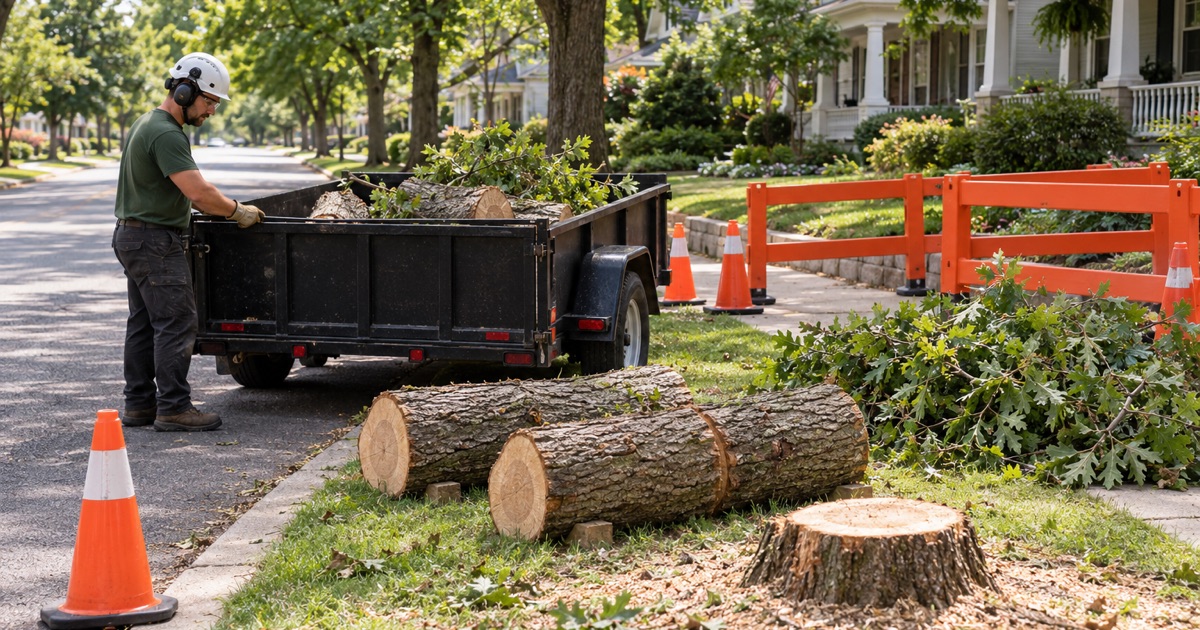
Access is suburban rather than urban: 47.8 percent of the housing is single-family detached against 0.6 percent attached, so the route to a back yard is a driveway and a side gate rather than a rowhouse alley. We run compact machines that fit through a gate without the fence coming apart. Where a large trunk stands over a roof, a garage or a fence line, crane-assisted removal and sectional dismantling bring it out in controlled pieces instead of dropping it, and protection matting goes down over lawn and hardscape before the first cut.
Trees standing in the public right-of-way
The strip between the sidewalk and the curb is where most of the confusion lives, and it is governed differently from both your yard and a city park. Section 25-119(b)(1)(D) says trimming, planting or removal of a tree in the public right-of-way needs no county Letter of Exemption, and in the same breath it preserves the permit required under the Maryland Roadside Tree Care Law.
So the county steps back and the state steps in. A Roadside Tree Care Permit from the Maryland Department of Natural Resources Forest Service is the document that authorizes the work, and it is required whether the job is a full removal or a crown reduction on a street tree.
The street tree list, and how a stump has to be left
Chapter 85 also has the City Council approve an official street tree list, which is the city’s own record of what belongs along its streets. The same chapter sets a finish standard most homeowners never hear about: stumps of street trees are to be removed below the surface of the ground, so that the top of the stump does not project above grade.
We plan the stump grinder pass around that requirement rather than treating it as an extra. It is a fair standard to hold a back-yard job to as well, because a stump left proud of the grade is what a mower finds next spring.
Lines, licensing and who to call first
Pepco is the electric utility across this part of the county, and vegetation management and line clearance on the distribution system are Pepco’s work rather than a tree company’s. A limb resting on a service line is a call to them before it is a call to us, and we will say so on the phone.
Maryland also requires that any person or firm doing tree work for hire hold, or work under the supervision of, a Maryland Licensed Tree Expert. That is worth asking about before hiring anyone, here or anywhere else in the state, and the answer belongs on the written contract rather than in a conversation.
Emergency work does not suspend any of this, though it does reorder it. When a tree comes down across a driveway or onto a roof we respond within 24 hours to make the site safe, and the permit conversation follows for whatever is still standing in the right-of-way.
What a missed sign-off costs
Chapter 85 carries its own penalty, and it is not nominal. A violation is a municipal infraction of $1,000 per violation, and because the chapter calls for two written permissions, one tree taken down off the cuff can put an owner wrong with the city and with the state in the same afternoon.
The expensive version of this is rarely deliberate. It is a contractor who assumed the tree between the sidewalk and the curb belonged to the house behind it, or an owner holding a county exemption who did not know the city wanted a signature of its own.
Where property managers get caught
43.3 percent of the housing units here sit in buildings of five or more units, so a large share of the tree work in this city is bought on a maintenance cycle by a property manager rather than by a homeowner the morning after a storm. Those are also the properties most likely to have a grading or building application open at the same time, which is exactly when the county’s conservation plan requirement is live.
Our scheduling is built for HOA boards, property managers and multifamily grounds, board dates and turnover windows included, and the permit status goes into the same written scope as the price. What the debris hauling and cleanup covers is stated in writing too, so nobody is arguing about a brush pile after the crew has gone.
Getting it right the first time
None of this is difficult; it is only sequential. Establish who owns the ground, measure the trunk against the county threshold, check whether an application is open on the property, and find out whether the tree stands in the right-of-way. Four answers, and the paperwork writes itself from there.
Not every large tree has to come down, and the threshold cuts both ways. Where a sixty-year-old tree is structurally sound but carrying co-dominant stems with included bark, crown thinning, deadwooding or cabling and bracing can buy it years, and it keeps a regulated trunk out of the approval process altogether.
That sequence is what a free on-site estimate is actually for. We look at the tree, the access and the ground it sits on, tell you which approvals apply and which do not, and leave a written price that does not move once the work has started.
- 20+ Years in Anne Arundel
- Free Written Estimates
- 24-Hour Storm Response








