
Glen Burnie Tree Removal has been handling tree removal in Maryland City for more than 20 years, and the work here almost never comes down to a clean drop into an open yard. Most of what we take out stands close to something that will not survive being hit — a home wall, a fence run, a shared driveway, a neighbor’s shed.
Every job starts with a free on-site estimate, written down before anyone touches a saw, so the price, the takedown plan and the cleanup are all on the page you approved. The crew that walks the property during that visit is the crew that turns up on work day and the crew that rakes the last of it off the grass.
What changes from one address to the next is the ground and what is sitting on it. A tree over a manufactured home, a thirty-year-old back yard in a covenanted community, and a lot that loses its road when the river comes up are three different jobs, planned differently before the truck is loaded.
Working over a manufactured home
Manufactured housing is a real part of the housing stock in Maryland City rather than an outlier — 331 mobile homes, about 4.4 percent of the units here. That changes a removal: a manufactured roof does not take a hit the way a stick-built one does, and a limb a shingled ranch would shrug off can punch through a panel and a ceiling.
Rigging instead of dropping
Over a manufactured roof we rig rather than fell. Sectional dismantling takes the tree apart in pieces small enough to be lowered on a line and set down by hand, which keeps the shock off the structure and off the skirting. It is slower than dropping a stem, and it is the only honest method when the clear ground is narrower than the tree is tall.
When the trunk genuinely stands over the home and there is no rigging point that clears it, we bring a crane. A crane-assisted removal lifts each section away from the building instead of swinging it past, and on a tight pad it often finishes in a fraction of the time a piece-by-piece climb would need.
Piers, tie-downs and the service drop
A manufactured home sits on piers and tie-downs rather than a continuous foundation, so the anchor pattern around the perimeter is something a crew has to know about before it sets a rigging point or walks a grinder past. We keep the equipment off the anchor line and off the skirting, and matting goes down on the travel path so the pad and the yard do not rut.
Overhead, the service drop to a manufactured home is frequently the lowest wire on the property. Baltimore Gas and Electric Company owns clearance on the distribution lines and responds to a downed conductor, and we work to that boundary rather than around it. If a limb is lying on primary wire, the call goes to BGE before a saw goes anywhere near it.
Getting in through the gate
Many lots on this side of Anne Arundel County are served by one driveway with a fence gate at the back, which rules out a full-size chip truck at the work face. Our compact equipment fits a standard gate opening, so the wood comes out through the yard instead of over a fence panel, and lawn and hardscape protection matting is on the job whether or not the ground looks soft on the day.
Looking for tree-removal closer to Savage? See Savage Tree-Removal.
Thirty years on from Russett’s first phase
Russett is a 613-acre planned community inside Maryland City; construction began in the late 1980s and the first phase opened in 1992. The yard and street trees that went in with those early sections are now in their thirties, which is the age at which a fast-growing landscape tree starts showing you exactly what it intends to do next.
The defects that surface at thirty years
Co-dominant stems with included bark are the common one. Two leaders of near-equal size grow bark into the union instead of wood, the joint never knits, and it splits in a storm at the precise spot everyone had been looking at for years. Deadwooding, crown thinning and a conservative crown reduction handle a good deal of it, and cabling and bracing can buy years on a union that is worth keeping.
Epicormic shoots running up a trunk that somebody topped a decade or two ago are the other thing we find at this age, and they are weakly attached by definition. Where the wood underneath is sound we can reduce and retrain them; where the old cut left decay running down the stem, taking the tree is the cheaper answer measured over any ten-year horizon.
Common ground, covenants and who signs off
Inside Russett the covenant and common-area standards belong to the Russett Community Association, and a tree on association-maintained ground is not an individual homeowner’s decision to make. We know the sequence that follows: the board or the property manager needs a written scope and a firm price before a vote, and the resident wants a date. Our scheduling is set up for HOA boards, property managers and multifamily grounds for that reason.
Gravel-pit ground under the root plate
Parts of the community sit on reclaimed gravel workings — ‘Pits, gravel’ and Udorthents on reclaimed gravel pits are both mapped inside the boundary. Under those units you get fill and a disturbed profile instead of an intact soil horizon, which is why a thirty-year-old tree there can look full in the canopy and still sit on a root plate that never spread the way it should have.
Away from the pits, the soils carry the Russett and Christiana names. The middle of the community maps as a Christiana-Sassafras-Urban land complex on 5 to 15 percent slopes, Christiana moderately well drained and Sassafras well drained, with Russett-Christiana-Hambrook complexes running through the rest. Where we need to see what is happening at the base of a stem, root collar excavation with an air spade opens the flare without severing roots the way a shovel does.
When the Little Patuxent takes the road out
The Little Patuxent River runs along the western side of the community, and the gauge on it at Savage is the reading we check before committing a truck to a job over there. Flood stage on that gauge is 10 feet. It peaked at 15.06 feet on June 3, 2018 and put water across Brock Bridge Road and Laurel-Fort Meade Road, then reached 12.27 feet on December 15, 2018 with water up against Brock Bridge Road and the fields off Bald Eagle Drive.
Reading the ground before the equipment goes on it
Along that floodplain the mapped soils are Codorus and Hatboro, both frequently flooded, with Comus and Codorus occasionally flooded beside them. Ground in that condition will not carry a wheeled chipper or a stump grinder for a good while after a rain, and pushing it anyway leaves ruts a homeowner is still looking at the following summer.
So the order of work changes on a wet week. We climb and cut while we can reach the tree safely, stage the wood well back from the low ground where it will not float, and bring the grinder in once the soil has drained.
Storm calls, and which road is closed
Severe thunderstorm wind is the recurring reason trees come down around here, not anything more exotic. Trees were blown down on MD 732 Dorsey Run Road near Brock Bridge Road on July 21, 2020, and again on Brock Bridge Road near River Bridge Way on June 21, 2021 — both of them on routes people use to get in and out of this community.
Our 24-hour storm response is partly a routing problem on this side of the county. We keep the alternate approaches in mind when a road near the river is under water or blocked, because a crew that cannot reach the driveway is not a response at all. The community sits in National Weather Service zone MDZ014, forecast out of the Baltimore/Washington office, and that is the forecast we plan a storm week against.
What leaves the property
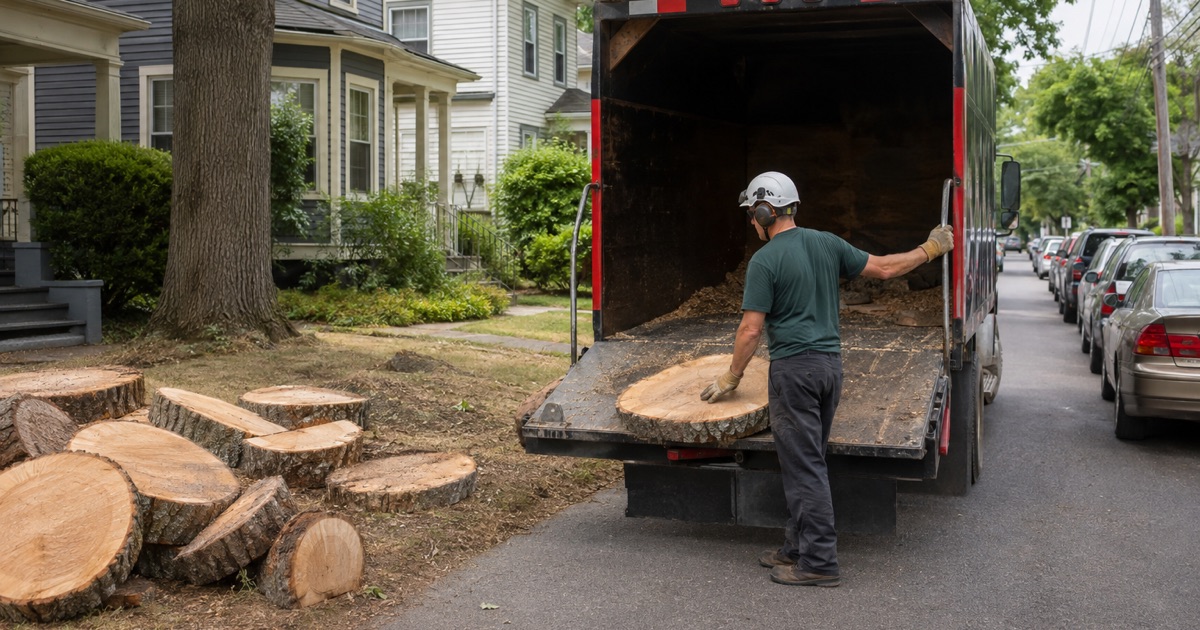
Debris hauling and cleanup are written into the estimate rather than left to assumption, and near a floodplain that line earns its place. Wood stacked low on ground that has taken water twice in one year is wood that can move again, so we state plainly what is being hauled away and what is being left cut and stacked where you asked for it.
The same crew that walked the property on the estimate visit finishes that end of the job. Nobody hands the cleanup to a subcontractor who never saw the tree, and the matting comes up last so the lawn and driveway look as they did before the truck arrived.
Permits, right-of-way and a narrow lot
Maryland City has no municipal government of its own, which means the mailing address is a poor guide to who reviews the work. Properties here carry a Laurel, MD 20724 address while sitting squarely in Anne Arundel County, and it is the county — not a city hall — that issues the permits a tree job may touch.
Who issues what
Building, grading and sediment control permits come from the Anne Arundel County Department of Inspections and Permits. Forest conservation review sits with the county Office of Planning and Zoning, Development Division, and attaches where a subdivision, grading permit or sediment control permit covers a unit of land of 40,000 square feet or greater — which is why an ordinary back yard removal rarely reaches it while a clearing job on acreage does.
A tree whose trunk stands in a public right-of-way is a different matter. The Roadside Tree Care Permit for that work is issued by the Maryland Department of Natural Resources Forest Service, the same office that licenses Maryland Licensed Tree Experts. Where the right-of-way is state highway — MD 32, MD 198 and MD 175 — the Maryland Department of Transportation State Highway Administration controls the trees in it, while county road right-of-way belongs to the county Department of Public Works, Bureau of Highways.
The Baltimore-Washington Parkway draws one more line across the map. The National Park Service maintains the Parkway from its southern terminus through the MD 175 interchange, and north of MD 175 the State Highway Administration takes over and MD 295 signage begins. A tree on the Parkway frontage on this community’s side of that interchange therefore stands on federal parkway land rather than a state right-of-way.
Fitting the work to the lot
Working a narrow lot is mostly a question of where the pieces are allowed to land. We measure the clear ground against the tree’s height and its lean, and when that arithmetic does not work we go to sectional dismantling, or an aerial lift set on the driveway, rather than trying to make one fall fit. Diameter at breast height, not canopy spread, is what tells us how much wood is actually coming down.
Pruning and removal follow ANSI A300 practice and the Z133 safety standard, which is the difference between a cut that closes over and one that starts decay behind it. On a wooded parcel a specimen tree gets considered on its own terms rather than swept into a clearing, and we will say so on the estimate when we think a tree is worth keeping.
- 20+ Years in Anne Arundel
- Free Written Estimates
- 24-Hour Storm Response








