
Glen Burnie Tree Removal has been handling tree removal in Linthicum for more than 20 years, and the work here opens with a question that never comes up a few miles inland: how high the boom goes, and whether the Federal Aviation Administration needs to hear about it first.
Linthicum sits directly north of BWI Marshall, and airport property rather than county residential land forms the southern edge of the community. That puts part of the neighborhood under a federal notice surface that drops closer to the ground the nearer you get to the runways. On most jobs it changes nothing at all. On a large removal that needs a crane, it can decide the schedule.
We answer that question before we quote, not after. Estimates are free, made on site, and written down before any work begins, including what leaves the property and what stays. The crew that walks the yard at the estimate is the crew that runs the saws and the crew that rakes the site at the end.
When a Crane Beside BWI Needs Federal Notice
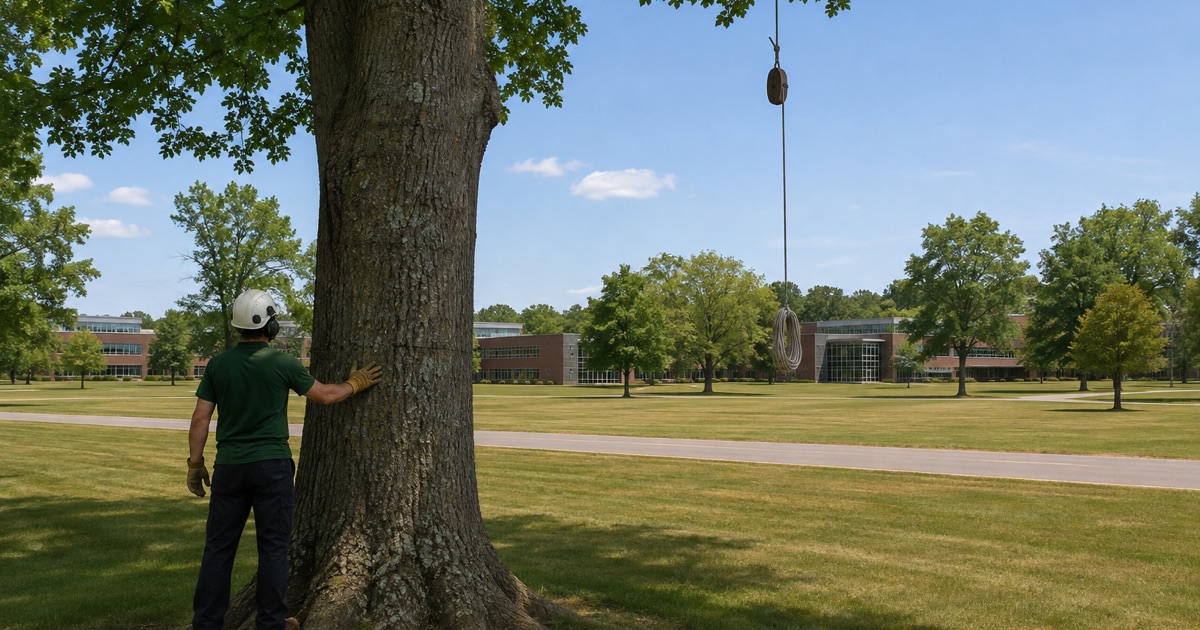
Federal law treats a crane much the way it treats a building. Under 14 CFR Part 77, notice on FAA Form 7460-1 is required for construction or alteration reaching more than 200 feet above ground level, and separately for anything that exceeds an imaginary surface rising at 100 to 1 for a horizontal distance of 20,000 feet from the nearest point of the nearest runway. The rule applies at airports whose longest runway exceeds 3,200 feet in actual length, and BWI Marshall qualifies.
The filing, and who else receives it
14 CFR 77.9 sets those two triggers: 77.9(a) covers the 200-foot case and 77.9(b)(1) covers the sloping surface. The timing sits in 14 CFR 77.7(b), which requires the form at least 45 days before construction begins. A copy of any Form 7460-1 also goes to the Maryland Aviation Administration, and airport zoning and obstruction review fall under COMAR 11.03.05. Forty-five days is not a rounding error on a calendar, which is why we raise the question during the estimate visit rather than the morning a crane is booked.
What actually triggers notice on a residential lot
No published height limit exists for Linthicum, and none should be expected. Part 77 works from the geometry of a particular runway and a particular point on the ground, and the answer comes from the FAA’s study of a filed form rather than from a rule of thumb. What can fairly be said is that a crane or boom lift set for a large removal in the southern part of the community may reach into that surface, while the identical setup a mile north very likely does not. We treat it as a per-property question and check it per property.
Building the schedule around the interval
Where a removal is not urgent, the cleanest path is usually to file, wait, and put the rest of the property’s work into the gap: crown reduction on the trees that are staying, deadwooding over the driveway, cabling and bracing on a stem worth keeping, stump grinding once the drop zone is clear. For a homeowners association board or a property manager coordinating access across several buildings, that interval is often easier to absorb than it sounds, and we sequence the site so nothing sits half finished while the notice runs.
Looking for tree-removal closer to Severn? See Tree-Removal in Severn.
Reading the 100 to 1 Surface Over This Community
The geometry is simpler than the citation makes it sound. The surface climbs one foot for every hundred feet of horizontal distance out from the runway, which means that within a few thousand feet of a runway it stands only tens of feet above the ground. That is lower than a mature tulip poplar and comfortably inside the working range of a boom.
Tree height is not the number that matters
A removal does not reach the surface because the tree is tall. It reaches it because the equipment is. A crane boom at working angle, plus the sections it picks and swings, sits well above the crown being dismantled, and that combined height is what the form describes. It is also why two removals on the same street can land on opposite sides of the answer, and why measuring diameter at breast height tells you plenty about the rigging plan and nothing about the notice question.
The ground under the machine counts as well
Roughly half the mapped soil units here carry 5 to 15 percent slopes, so a machine set uphill of its target begins higher than a flat site plan suggests. The soils themselves are close to the best case for this trade. Sassafras dominates the sample: a fine-loamy, well-drained series that holds a root plate firmly, digs predictably, and does not turn to soup under a stump grinder after a wet week.
The exception is the floodplain along the local stream corridors, where a frequently flooded Zekiah and Issue unit means saturated ground and poor bearing decide what can be brought in at all. Linthicum drains entirely to the Patapsco, split between the non-tidal and tidal watersheds, with Stoney Run, Cabin Branch and Holly Creek among the named subwatersheds.
Noise zone maps and recorded easements
COMAR 11.03.01.12 defines the certified BWI Noise Zone as the 65, 70 and 75 Ldn contours overprinted on Anne Arundel County tax maps 3, 4, 8, 9 and 15. That zone governs land use and residential compatibility rather than tree work directly, but it is the reason parts of the community carry recorded avigation and noise easements. It is worth reading the plat before anyone assumes a back yard is unencumbered.
Storm Damage and the Five-Day Filing
Emergencies do not wait 45 days, and the regulation accounts for that. 14 CFR 77.7(e) waives the advance requirement where immediate construction or alteration is required by an emergency involving essential public services, public health or public safety. Notice may then be given by any expeditious means, with a completed Form 7460-1 filed within 5 days of that initial notice. Outside normal business hours, the nearest flight service station accepts the emergency notice.
What the waiver means at two in the morning
We respond to storm damage within 24 hours. The practical effect of the waiver is that a trunk across a roof near the airport does not sit for six weeks waiting on paperwork: the notice goes in by the fastest route available, the lift or crane comes up, and the form follows inside the five-day window.
The storm record here is led by summer convective severe-thunderstorm wind and tornadoes rather than by systems that arrive with a week of warning, so the difference between 45 days and 5 is not an academic one. The area sits in National Weather Service forecast zone MDZ014, which is county-wide, so a warning never distinguishes this community from its neighbors and the read has to be made on the property.
Lines, and what the utility will not do
BGE carries the line-clearance obligation under COMAR 20.50.12.09, and it states plainly that it is not responsible for removing wood debris after a clearance cut. Report a downed line to 1-877-778-2222 and a limb resting on a line to 1-800-685-0123, and stay well clear of both until someone answers. Nothing we do starts until the conductor is confirmed dead or the line is cleared.
Getting the wood off the property
Anne Arundel County curbside collection takes limbs under 4 feet long and 4 inches thick, in bundles under 40 pounds, and it does not collect logs. A storm-felled oak therefore leaves by truck or it does not leave. That is why the written estimate spells out what is hauled and what stays behind, whether that is rounds stacked for firewood or a site swept clean, before the first cut is made rather than after the chipper is loaded.
Removals That Never Need a Crane
Most of the work in this neighborhood involves no crane whatever. Lots are open enough that a climber and an aerial lift cover the majority of removals, and compact equipment fits through a side gate and around a fence line where a full-size machine would have to take the fence with it.
Sectional dismantling in a 1950s yard
71.1% of the housing here was built before 1980, and 37.9% of it went up in the 1950s alone. The trees planted around those houses are now 65 to 75 years old, which is the age at which an oak or a tulip poplar on a quarter-acre lot has outgrown the room it was given. What we find is predictable enough to plan for: co-dominant stems with included bark at the union, epicormic shoots pushing from an old topping cut, limbs over a roofline that were nowhere near it when the tree went in.
Those come down in sections, rigged and lowered rather than dropped, with matting protecting the lawn and the hardscape on every job. Nothing is shock-loaded off a weak union: the pieces come off small and ride down a controlled line rather than bouncing off a crotch on the way. It is slower than felling, and on a lot this size it is the only way a mature oak leaves the back yard without taking the fence with it.
When brittle wood changes the plan
Emerald ash borer has been established in Maryland since 2003, and a large ash it kills is brittle standing wood within about three years. Brittle wood is a rigging problem before it is a removal problem, because a limb that will not hold a climber’s line is a limb that has to be reached from a lift or a crane instead. Loblolly pine is native and common on this coastal plain and behaves nothing like a dead ash under load. Knowing which species is in front of us is the difference between a plan made at the estimate and a decision made in the air.
Permits, plans, and who may hold the saw
Maryland requires tree work performed for hire to be done under the state’s Licensed Tree Expert program, with trees 20 feet tall or less exempted, and COMAR 08.07.07.03D makes a written contract carrying the licensee’s number mandatory. Look for that number on any estimate you accept. If the trunk stands in the public right-of-way, the job also needs a Roadside Tree Care Permit from the DNR Forest Service, and the test is where the trunk stands rather than where the canopy hangs, so a tree overhanging the road from inside the property line is not a roadside tree.
Along the northern edge, where the Chesapeake Bay Critical Area reaches tidal Patapsco frontage, an approved Vegetation Management Plan is required before vegetation comes out of the Buffer, dead trees included, and the county is clear that stems under 4 inches are not exempt. County forestry answers those questions at (410) 222-7441.
- 20+ Years in Anne Arundel
- Free Written Estimates
- 24-Hour Storm Response








