
Glen Burnie Tree Removal has been doing tree removal in Ilchester for more than 20 years, and the work here starts below the ground rather than above it. What a saw finds in the trunk matters less than what the roots found when the tree was young. That single fact sets how a removal here is planned, staged and finished.
Every removal we quote begins with a free on-site visit and a written estimate that states the scope, the debris we haul away, and what stays behind. There is no charge for that visit and nothing attached to it. The crew that walks the property with you is the crew that shows up on the work day.
Storm calls get a 24-hour response, because a trunk across a driveway is a different job from a scheduled takedown and cannot wait in the same queue. For back yards behind gates or a tight fence line, we bring compact machines sized to fit through the opening rather than around it. Where a tree stands over a roof, we plan a crane-assisted lift instead of picking it apart over the shingles.
What Shallow Rock Does to a Root System
Ilchester sits on the upland side of the Fall Line, wholly inside the Piedmont Plateau Province, and the rock beneath it is not one uniform sheet. Point sampling across the community returns 60.3% Baltimore Complex metagabbro, gabbro and amphibolite, with another 38.3% falling on the Cretaceous Patuxent, Arundel Clay and Patapsco formations. Those two grounds behave nothing alike, and they can sit two streets apart.
Metagabbro Sits Hard and Sits Close
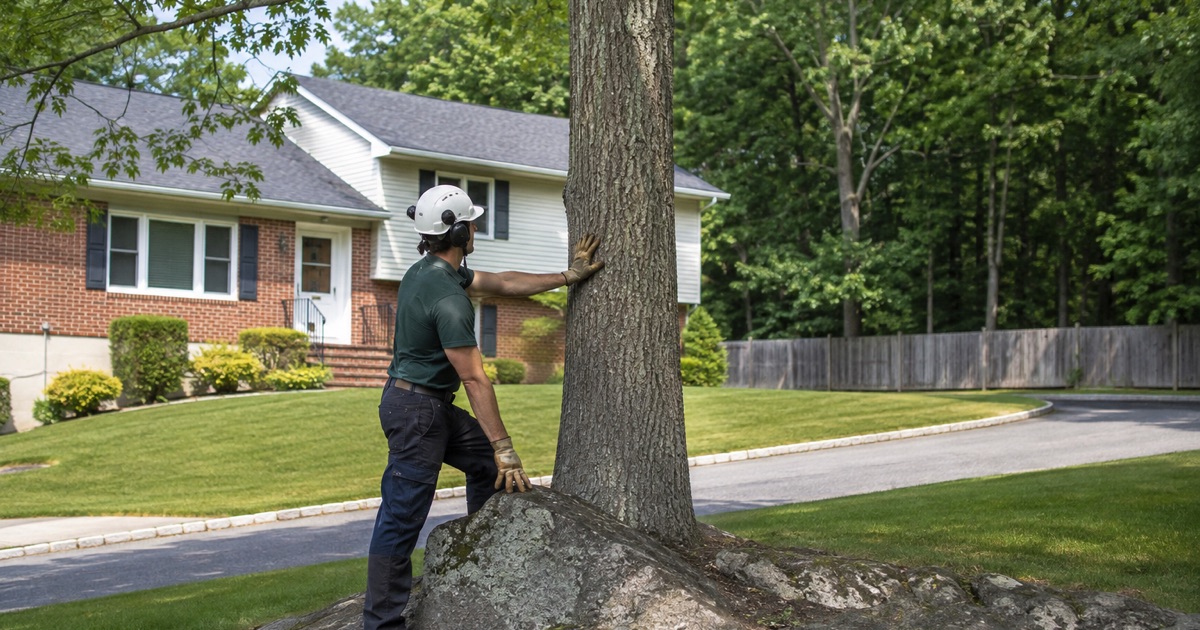
Metagabbro is a dense mafic rock, and where it lies close to the surface a tree simply cannot drive a taproot through it. The root plate spreads wide and shallow instead, riding the soil layer above the stone. That is a stable enough arrangement in still air and a real liability in saturated soil under a hard wind.
We read that in the field before we price anything. A root plate that lifts on one side when the trunk is levered tells us the anchorage is already gone, and it turns what looked like a routine takedown into a job we rig rather than fell.
Where the shallow rock runs out, the picture flips rather than improves. On the Patuxent and Arundel Clay ground the rooting goes deeper, but the clay holds water, and a tree that failed there in a wet spring failed for the opposite reason.
Slope Decides the Setup
The Patapsco river gorge forms the northern edge of the community and drops steeply toward the water. On the streets that fall away toward the river, slope rather than distance governs how equipment gets in, and a chipper or a crane often has to be staged from the street while the crew works the drive on foot.
Lawn and hardscape protection matting goes down on all of our jobs, and on a pitched drive it earns its keep twice over: it spreads the load of a tracked machine and keeps the surface from scarring under repeated turns. Where the grade rules out a lift entirely, sectional dismantling on a climbing line is the honest answer, and we say so in the estimate rather than on the morning of the work.
Looking for tree-removal closer to Arnold? See Arnold Tree-Removal.
Trees the Age of the Subdivision
Only 7.1% of the housing here was built in 1979 or earlier. Roughly two-thirds of it went up between 1980 and 1999, with 26.5% dating to the 1980s and 33.4% to the 1990s, and another 17.4% was added in the 2000s. The planting that came in with those subdivisions has now been in the ground for twenty-five to forty-five growing seasons.
That is a specific and slightly awkward age for a yard tree. It is old enough that the trunk carries real weight and the structure is fixed, and young enough that most of these trees were never pruned for form back when the correction cost nothing. What would have been a two-minute cut in 1998 is a rigging job today.
Species the Developer Chose
Northern red oak is a locally appropriate species on this side of the Fall Line, and the ones set out with these subdivisions are doing what oaks do. The trouble is the fast, cheap nursery stock that went in alongside them. Callery pear, sold as the Bradford pear through the 1990s and 2000s subdivision era, is the tree we take down most often on these lots.
Maryland prohibits the sale of Callery pear from January 15, 2026, which tells you how the state now reads a tree that was planted by the hundreds in exactly this era. The failure mode is structural rather than biological: a whorl of co-dominant stems leaving the trunk at one point, with included bark in each union. They come apart in a summer thunderstorm at about the size these have now reached.
Ash on the Same Lots
Emerald ash borer has been established in Maryland since 2003 and takes a large ash down in roughly three years. What is left standing is brittle deadwood, and brittle wood does not behave like green wood under a rigging line or a climber’s weight. An ash dead two seasons is a removal we plan differently and stage differently than the same tree taken while it is still alive.
We name deadwood out loud in the estimate because it changes the method rather than the invoice. A standing dead ash usually gets sectional dismantling from an aerial lift or a crane instead of a climber on the spar, and the debris hauling that follows is written into the same document you signed at the walk-through.
Townhouse Lots and Common Ground
Detached single-family homes are 45.7% of the stock here and attached single-family another 23.7%, so a good share of these removals happen on townhouse lots where the tree, the fence and a neighbor’s patio all sit within twenty feet of each other. Those jobs are won or lost on access rather than on cutting.
Where the tree stands on common ground, the decision usually belongs to a board rather than a household. We schedule for that: one written estimate a board can circulate, a work date set after it votes, and a single point of contact for property managers and multifamily grounds staff who need the lot usable again by Monday.
Grinding Where the Rock Is Close
Stump grinding is the part of a removal that the geology decides for you. Where metagabbro sits shallow, the grinder reaches rock before it reaches the bottom of the root plate, and the wheel starts working against stone instead of wood. That costs teeth, time and fuel, and it changes what a finished grind can honestly be expected to look like.
So we quote grinding as a depth below grade rather than as a promise to take out the whole root system, and on shallow-rock ground we say where that floor is likely to sit before the machine ever arrives. A grind that stops on stone has stopped on stone. Describing it any other way is how a customer ends up unhappy with work that went exactly right.
The Right-of-Way Is a Different Queue
If the trunk stands in the county road right-of-way, the tree is not yours to hire out. The Howard County Department of Public Works, Bureau of Highways - Tree Division handles limb elevation, dead tree removal, storm limb clearance and stump grinding on those trees, and its business-hours line is 410-313-7450.
The county’s own note on that queue is worth reading before you plan around it: grinding a right-of-way stump “may take up to a year, depending on the current workload and backlog.” On a private tree a few paces inside the property line we are on our own schedule, and the grind can follow the removal the same afternoon.
Which side of that line a tree falls on turns on where the trunk sits within the public right-of-way, not on who planted it or who has mowed around it since the house was new. Maryland Natural Resources Article section 5-406(d) bars a county from issuing a building permit until the roadside tree permit from the Maryland Department of Natural Resources Forest Service is in hand, and the penalties written into the Roadside Tree Law are $2,000 and $5,000.
Forest Conservation, and What It Actually Reaches
Howard County’s forest conservation program is run by the Howard County Department of Planning and Zoning, which reviews clearing tied to subdivision, development and grading and accepts a Declaration of Intent where one applies. The county’s own manual is blunt about the scope: “The Forest Conservation Act is not a tree preservation act.” The emphasis is on forest communities, and individual trees are protected only in narrow cases such as Champion trees or trees tied to historic structures.
For an ordinary homeowner removal the program usually does not reach at all. A single lot smaller than 40,000 square feet is exempt outright under Section 16.1202(b) of the county’s Subdivision and Land Development Regulations, provided the area is not already covered by an approved Forest Conservation Plan. That last clause is the one that bites in Ilchester.
The subdivisions platted here through the 1980s and 1990s fall in precisely the period when Howard County began recording forest conservation easements over subdivision open space, and a recorded easement is deducted from net tract area to this day. An easement across common ground or a rear lot line is the restriction most likely to catch a homeowner out, and it survives the sale of the house. We look for it before quoting rear-yard work, and we tell you plainly if what you want is going to need the county’s sign-off first.
Structural Pruning Before It Becomes a Removal
The cheapest tree work on a 1990s subdivision lot is the pruning that nobody did in 2005. Structural pruning on a young tree takes out a competing leader with a cut the width of a thumb, while the same correction three decades later is a crown reduction, a cabling and bracing job, or a takedown with a crane over the roof.
We would rather sell the small job. Crown thinning, deadwooding and an early cut on a co-dominant stem are what keep a tree off the removal list, and on shallow-rock ground, where the root plate is already wide and flat, reducing the sail area of the crown buys more than the same cut would buy on deep soil. We prune to ANSI A300 and work to ANSI Z133.
What the Rules Say About Who Cuts
Maryland Natural Resources Article section 5-417(a)(1) requires a Licensed Tree Expert license to do tree work for hire. Trees twenty feet tall or less are exempt under section 5-415(c)(2)(iii), along with loggers and underground-utility installers, and section 5-417(a)(2) lets a crew work under a Licensed Tree Expert’s supervision without each member holding a license of their own.
COMAR 08.07.07 is the chapter that governs that licensing in Maryland, and COMAR 08.07.06 is a different chapter entirely, covering State Parks. A written scope before any work begins is our practice regardless, because it is the document that settles what leaves the property and what does not.
Lines, Limbs and the Wood Left Behind
Where a limb is growing into a distribution circuit, Baltimore Gas and Electric carries the vegetation-management duty under COMAR 20.50.12.09, and it is expressly not responsible for hauling away the wood its clearance work creates. Report a downed line to 1-877-778-2222 and a limb resting on a line to 1-800-685-0123.
What that clearance leaves behind is a yard full of brush and cut wood, and that is a job we take on its own terms. Debris hauling and cleanup is stated in writing along with the rest of the scope, so what is included is a line you can read at the estimate rather than a conversation on the last afternoon of the job.
- 20+ Years in Anne Arundel
- Free Written Estimates
- 24-Hour Storm Response








