
Glen Burnie Tree Removal has handled tree removal in Dundalk for more than twenty years, and the work here has a shape that crews from outside the area learn the hard way. Most of what we take down stands behind a house that shares a wall with the one next door, on a lot reached through a rear alley or a side gate rather than an open driveway. The estimate has to account for that before anyone puts a number on the job.
Every estimate we give is free and written down before a saw comes off the truck, and it says plainly what the price covers: the takedown, the stump, the debris and the cleanup. We run compact equipment sized to a gate opening instead of a driveway, and lawn and hardscape matting goes down on every job. The crew that walks the property with you is the same crew that sweeps up at the end.
Storm work runs on a faster clock. We answer fallen-tree and storm-damage calls within 24 hours, and when a trunk is leaning across a roof we bring a crane rather than trying to rope that weight down over the shingles.
What the May 2025 track left in these yards
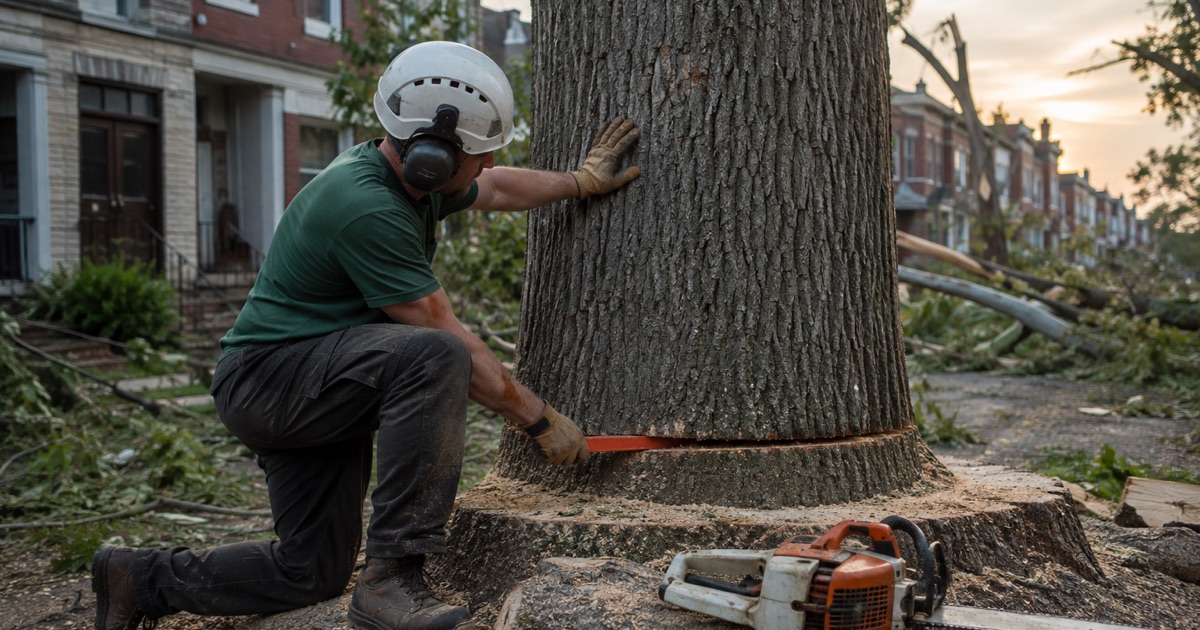
A National Weather Service survey rated the storm that came through on May 16, 2025 an EF-1, with estimated peak winds of 110 mph along a path 5.8 miles long and roughly 75 yards wide. It tracked out of Baltimore City into southeastern Baltimore County between 5:51 and 6:01 p.m. EDT, crossed the Dundalk Historic District, and lifted near Stansbury Park. Along the way it took the roof off a warehouse at Holabird Industrial Park and overturned two tractor-trailers.
The survey recorded what the wind did to the trees as well: whole trunks uprooted, and upper and middle branches snapped off crowns that stayed standing. Ten minutes of track is not long enough to clear a canopy, and it is far more than long enough to leave a street’s worth of trees half-damaged. Those half-damaged trees are what we are still being called out to look at.
The damage that surfaces months later
A tree that lost its top in that ten-minute window rarely looks like an emergency the following week. Broken limbs hang up in the crown and stay there until the next hard blow drops them, and a root plate that lifted an inch settles back looking ordinary while the anchoring roots on one side are already torn through. We check for both when we assess a storm-damaged tree, along with cracked unions where a co-dominant stem twisted against its partner and never went back.
Age makes that assessment harder rather than easier. A crown that was already carrying deadwood before the storm hides the fresh breaks inside it, which is why we walk the tree from more than one angle and, where the view from the ground is not enough, put someone up in it.
Deciding between removal and repair
Not every damaged tree along that path has to come down, and we would rather say so than sell you a removal. Crown reduction takes weight off a lopsided canopy so the remaining structure is not carrying a load it was never grown for, and deadwooding clears the broken material that would otherwise come down on its own schedule. Where a union is strained but still sound, cabling and bracing can hold a stem that would otherwise be a removal in three years.
What we will not do is guess. The recommendation goes in the written estimate with the reasoning attached, the estimate visit costs nothing either way, and if the answer is that the tree is fine, that is the answer you get.
Looking for emergency-tree-removal closer to Baltimore? See Emergency-Tree-Removal Services in Baltimore.
Getting equipment in behind a shared wall
Nearly half the housing here, 46.7% of it, is single-family attached, and most of the detached houses sit on lots that were platted just as tightly. The back yard is usually reached through a shared alley, a gate between two fences, or a walkway about the width of a wheelbarrow. Machine width, not machine power, decides whether a stump grinder or a mini-loader reaches the stump at all.
We measure the access before we quote
The first thing we do on a rowhouse estimate is measure the narrowest point between the street and the tree. That measurement decides whether the stump comes out with a walk-behind grinder the same day, whether we bring a machine sized to fit a standard back gate, or whether a fence section has to come off its posts and go back on at the end. Learning that at the estimate is cheaper for everyone than discovering it on the morning of the job.
Taking the tree down in pieces
An attached lot almost never has a felling zone. Most removals here are sectional dismantling, with the tree coming down in controlled pieces that are rigged and lowered rather than dropped, worked from an aerial lift where the alley will take one and by a climber where it will not. When a large trunk stands over a roof, and on a row that means over a neighbor’s roof too, a crane pick is the safer answer and we plan the whole job around it from the first visit.
What we protect on the way in and out
Everything we carry in travels across somebody’s lawn, walk or patio, and on a narrow lot it frequently crosses the property next door as well. Matting goes down over lawn and hardscape as standard practice rather than as an upcharge, and we walk the route with you before anything rolls over it. We also flag the service drop before the first cut, because on lots this size the wires feeding the house often run straight through the canopy we are working in.
Trees older than the rows they shade
About 78.9% of the housing stock here went up before 1960, and 37.2% of it in the 1950s alone. The yard canopy has aged along with the houses, so a routine removal is often a tree sixty or seventy years old that has grown up around a garage, a party-wall fence and a utility drop all added long after it was planted. The planned community itself dates to 1917, when The Dundalk Company laid out the first two-story stucco houses with their steeply pitched roofs.
What a sixty-year-old yard tree develops
Trees of that age accumulate particular defects, and they are worth naming because they change what the work costs. Co-dominant stems with included bark between them are the common one: two trunks of near-equal size pressed together with bark trapped in the union instead of wood, which is a failure waiting for a wind event. Epicormic shoots crowded along an old topping cut are another, and crown thinning is often the honest recommendation where a full removal is not yet warranted.
We take a diameter at breast height measurement on every tree we price. That number, not the height everybody tends to guess at from the sidewalk, is what actually drives the rigging plan and the cleanup volume.
What is waiting under the stump
The ground here is not what the equipment expects. Surface geology across the community is Quaternary Lowland Deposits on the Atlantic Coastal Plain, unconsolidated sand, gravel, silt and clay rather than rock, and the soil survey maps the interior as Udorthents, its designation for ground that has been cut, filled or otherwise reworked. Fill hides brick, concrete and slag, and a grinder’s teeth find all three. Closer to the Bear Creek shore the mapped series changes to Sassafras, a deep well-drained coastal-plain loam that grinds much the way you would expect it to.
Who signs off on tree work here
Dundalk has no municipal government of its own, and no town tree permit goes with it; as an unincorporated community it falls under Baltimore County and the laws of the State of Maryland. For most homeowners that is good news, since the county’s forest conservation review is aimed at development rather than at back yards.
County review, and when it actually applies
Baltimore County’s Department of Environmental Protection and Sustainability runs Environmental Impact Review under Article 33, Title 6 of the county code. It reaches applications for development, subdivision, project plan, building, grading or erosion and sediment control approval on units of land of 40,000 square feet or greater, and commercial logging and timber harvesting operations. A homeowner taking one storm-damaged tree out of a rowhouse yard is not filing under it, while a property manager clearing a multifamily parcel may well be, and we schedule that kind of work around the approval instead of after it.
The Critical Area line, and the right-of-way line
Two boundaries change the job before a saw starts. The Chesapeake Bay Critical Area reaches the waterfront under Article 33, Title 2 of the county code: a point at Merritt Point Park on Bear Creek falls inside it as an Intensely Developed Area, a point at Watersedge falls inside it as a Resource Conservation Area, and the same query returns no feature at all at the community’s inland centroid. Which designation a parcel carries changes what clearing is allowed, so the shoreline block and the block four streets inland are not the same job on paper.
The second boundary is the curb. A tree whose trunk stands in the public road right-of-way is a roadside tree under state law and needs a Tree Care Permit from the Maryland Department of Natural Resources Forest Service before it is cut or trimmed. The test is where the trunk stands, not who has been mowing the grass around it.
Licensing, and the wood the utility leaves
Maryland requires any person or firm doing tree work for hire to hold, or to work under the supervision of, a Maryland Licensed Tree Expert, and that applies to whoever writes the estimate as much as to whoever runs the saw. The work standards behind a competent job on a tight lot are ANSI A300 for the pruning specification and ANSI Z133 for crew safety.
Baltimore Gas and Electric handles line clearance on its own distribution system, but the company states that it is not responsible for removing the wood its clearance crews leave behind. That leaves the cut-and-haul on a utility-driven job for the property owner to buy, which is one of the things our written estimate settles before you agree to anything.
- 20+ Years in Anne Arundel
- Free Written Estimates
- 24-Hour Storm Response








