
Glen Burnie Tree Removal has been doing tree removal in Crownsville and across Anne Arundel County for more than 20 years, and this is one of the few places where the first question is not how a tree comes down but whether it may come down at all. Conservation easements, a Chesapeake Bay Critical Area buffer and a protected bog buffer all reach into this community. The deed and the overlay settle the job before anyone looks at the tree.
So the paperwork gets read first. An estimate here starts with who holds the rights to the standing timber, which overlay the trunk sits inside, and whether the work needs an approved plan before a saw comes off the truck. The visit is free, it happens on site, and what we find goes into writing before any work begins.
That order matters more here than in most of the county. A removal that would be routine on a quarter-acre lot in town can need a written plan, an easement holder’s consent, or both, and the crew that writes the estimate is the crew that turns up to do the work. Getting the approvals wrong costs weeks.
Reading the easement before we read the tree
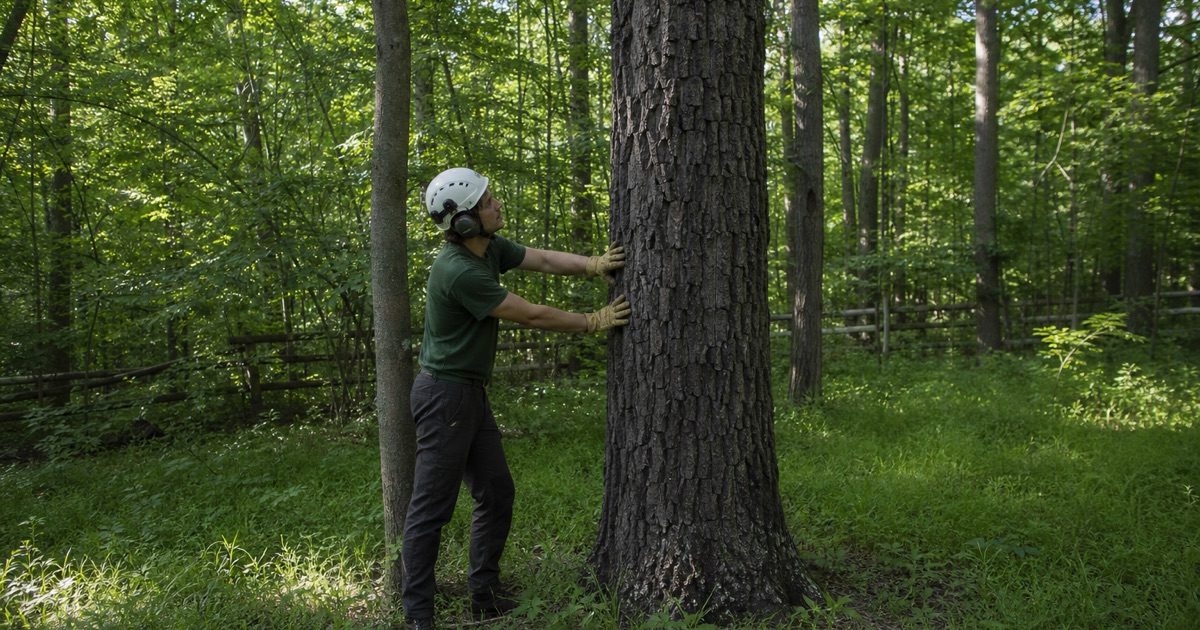
Anne Arundel County, the Maryland Environmental Trust and Scenic Rivers Land Trust hold conservation easements over large forested tracts here, and on eased ground the easement holder rather than the landowner controls what may be cut. Bacon Ridge Natural Area carries more than 1,100 acres of mature forest and wetland, 630 acres of it permanently protected by an easement among those three parties. A property owner holding eased acreage cannot authorize a removal on their own signature.
The Crownsville Hospital Memorial Park property sits under the same kind of restriction. Anne Arundel County took ownership from the State of Maryland in 2022, and about 160 acres of the roughly 500-acre site carry a Maryland Environmental Trust easement, with about 20 more under a historic easement over the core hospital complex. The county has reported conserving a further 158 acres of forest there.
The Critical Area buffer, and the four-inch mistake
The Chesapeake Bay Critical Area reaches Crownsville along the tidal heads of the Severn and South river tributaries. Only two of its classes are mapped inside the community, Limited Development Area and Resource Conservation Area, and the latter is both the more extensive of the two and the least intensively developed designation in the program, which is to say the one with the tightest clearing expectations.
Inside the Critical Area buffer, Anne Arundel County requires an approved Vegetation Management Plan before vegetation is cut, pruned or removed, dead trees included, and it specifically rebuts the widespread belief that stems under 4 inches across are exempt. The same requirement covers an expanded buffer, a Forest Conservation Easement and a Bog Protection Area, and the Forestry Program in the Department of Inspections and Permits takes those questions at (410) 222-7441.
The bog most people do not expect
Crownsville also carries a protected bog, a separate overlay from the Critical Area that is not triggered by tidal water at all. The Deep Ditch Bog 100-foot buffer falls inside the community along with its contributing drainage area. Under the county code a bog is a nontidal wetland with organic soils, accumulated peat and ground saturated to the surface throughout the year, and vegetation removal inside a Bog Protection Area needs its own Vegetation Management Plan.
Roadside trees and the trunk test
A tree in the public right-of-way belongs to the Maryland Department of Natural Resources Forest Service under a Roadside Tree Care Permit. The test turns on where the trunk stands and not on where the crown reaches, so a tree leaning out over the road from inside the property line is not a roadside tree. State law bars a county from issuing a building permit until that permit is in hand, and an emergency removal carries a one-week reporting duty.
Maryland separately requires a Licensed Tree Expert for tree care performed for hire, backed by a written contract naming that expert. Trees 20 feet tall or less are exempt, as are loggers and underground-utility installers, and a crew may work under a licensed expert’s supervision without each member holding their own credential. Inside a buffer or an easement, the county states that a Maryland Licensed Tree Expert is the only lawful option for contracted removal or pruning.
Looking for tree-removal closer to Ilchester? See Tree-Removal Services in Ilchester.
Greensand, the Annapolis series and what roots do in it
The soil under this community is unusual enough to be worth naming out loud. A nine-point survey sample inside Crownsville returned Annapolis loamy sand on 5 to 10 percent slopes at two of the points and Annapolis fine sandy loam on 25 to 40 percent slopes at one more. The Annapolis series is classed fine-loamy, glauconitic, mesic Typic Hapludults, and it is well drained.
Glauconitic is the word that matters there. Glauconite is the green iron-potassium silicate that gives the Atlantic Coastal Plain its marl beds, and greensand is what those beds are called where they surface. What greensand does to a grinder wheel is not something we have seen established anywhere, so we read the spoil on the day rather than a rule of thumb.
Two further points returned the Collington-Wist complex on 5 to 10 percent slopes and one the Collington-Wist-Urban land complex on 5 to 15 percent slopes; Collington is fine-loamy, mixed, active, mesic Typic Hapludults, and also well drained. Deep, well-drained sandy ground lets a root plate run wider than most people picture, which is worth knowing before anyone guesses where it ends.
Steep ground on the ravine sides
The single sample point on Annapolis fine sandy loam at 25 to 40 percent slopes is not a rounding error. That is genuinely steep ground, steeper than a wheeled chipper or a stump grinder has any business crossing, and it turns up on the ravine sides falling toward the creeks. Sectional dismantling from a climbing line or an aerial lift is the default there, with every piece lowered on a rope rather than dropped.
When the tree does not have to come down
Not every large tree on a wooded lot needs removing, and on eased ground the plan review may well prefer that it stays. Root collar excavation with an air spade shows what is happening where the trunk meets the soil, and crown reduction, crown thinning and deadwooding take weight and risk out of a tree without taking the tree. Cabling and bracing can hold co-dominant stems with included bark that would otherwise split in a summer squall.
Lawn and hardscape protection matting goes down on the jobs we run, which matters more on sandy loam than people expect: well drained does not mean strong, and a loaded chip truck will still print a rut into it. Compact equipment gets us through gated side yards and tight back-lot access without a fence panel coming out first.
Ground that will not carry a machine
Three of the nine sample points returned Widewater and Issue soils on 0 to 2 percent slopes, frequently flooded, which makes it the most common map unit in the sample. That is active floodplain and it behaves like it. Ground that looks flat, dry and drive-anywhere on a visit in August can be impassable a week later after two days of rain.
Add the bog buffer and the picture stays consistent. Peat and organic soil saturated to the surface will not carry a machine in any season. Between that and the frequently flooded units, bearing capacity is the recurring practical problem on this trade in Crownsville, ahead of overhead clearance and access width.
Timing, matting and the crane
So the approach gets planned around the ground rather than around the tree. That can mean waiting out a wet week, laying matting across a soft run, staging the chipper on the driveway and rigging the wood out to it, or bringing in a crane so the load never crosses soft ground. Crane-assisted removal is also the answer when a tree stands over a structure.
Where the wood goes afterward
Debris is a problem of its own here, because the lots are wooded and the stems are large. Anne Arundel County curbside collection takes limbs under 4 feet long and 4 inches thick, bundled under 40 pounds, and it will not take logs at all. Baltimore Gas and Electric is equally clear that it does not remove wood debris after a line-clearance cut, which is why a utility trim so often leaves a pile standing.
Hauling and cleanup are written into the estimate before work starts: how much wood leaves the property, whether any is left cut to length, and what the stump grindings are backfilled with. On a two-acre wooded lot that one line is the difference between a finished job and a weekend of your own hauling.
Watersheds and who is watching them
Everything that drains off this ground goes to the Severn River or the South River, and none of it reaches the Patapsco. Bacon Ridge Branch, Brewer Creek, Clements Creek, Gumbottom Branch, Hopkins Creek and Maynadier Creek are among the named subwatersheds, and the Anne Arundel County Severn River Commission advises on the Severn side. Sediment leaving an open stump hole on a slope is a water-quality question here, not just an untidy one.
Acre-plus lots inside standing woodland
More than half of Crownsville’s land, 51.2 percent, sits in a forest land use class: mixed woods at 45.4 percent, forested wetland at 4.4 percent and coniferous woods at 0.7 percent. That is a share of land use rather than a measure of leaf cover, and yard and street trees inside residential parcels are not counted. Residential land accounts for another 28.2 percent, and the biggest slices of that are 1-acre and 2-acre lots.
Big lots, big trees and houses set inside the woodland rather than beside it decide what storm work looks like. The severe-weather record here is led by summer convective wind and by tornadoes, and in a community built this way that means trees onto structures rather than trees across streets. Our 24-hour response for storm damage and fallen trees exists for that pattern.
If a line is involved the order of operations changes first. A downed line goes to Baltimore Gas and Electric at 1-877-778-2222 before anyone walks near it, and a limb resting on a line goes to 1-800-685-0123. The utility carries its own vegetation-management duty under state regulation, and we work behind what it has cut.
Species worth a second look
Loblolly pine is native and common on this stretch of coastal plain. Northern red oak is documented as rare here, so an identification is worth confirming before it goes into a management plan. Emerald ash borer has been established in Maryland since 2003 and a large ash is usually dead within roughly three years, leaving brittle standing wood that is a poor candidate for a climbing removal and a good one for a lift or a crane.
Large tracts and the plans they trigger
Forest conservation runs on a separate track from the Critical Area, and on tracts this size it comes up often. The county’s requirements under Article 17 Subtitle 3 attach when a subdivision, a grading permit or a sediment control permit is proposed on a site of 40,000 square feet or more, under the state’s Forest Conservation Act. Clearing tied to a development approval is a different conversation from taking one hazardous tree off an existing lot.
Crownsville is also where the county fairgrounds sit and where the Maryland Renaissance Festival runs at Revel Grove on Crownsville Road, so a summer or fall weekend can turn access into a scheduling question as much as a technical one. We plan around that, around board meetings, and around property managers who need the work documented in advance. The on-site estimate is free, written before anything starts, and never charged for.
- 20+ Years in Anne Arundel
- Free Written Estimates
- 24-Hour Storm Response








