
Glen Burnie Tree Removal has handled tree removal in Crofton for more than 20 years, and the first thing we tell a Crofton caller is that the approval question here is an unusual one. On most jobs in Anne Arundel County the only sign-off that matters is the county’s. In Crofton a private committee often reviews the work as well, and that review runs on a calendar of its own.
That changes how we write an estimate. Every estimate we give is free, made on site, and put in writing before any work begins, and for a Crofton property we set out what is coming down, how the crew will reach it, and exactly what the debris hauling and cleanup line covers. Those are the parts a committee or a board asks about first, and the same crew that walks the property with you does the work and the final rake-out.
We bring compact equipment for gated back yards, crane assistance when a tree stands over a roof, and lawn and hardscape protection matting on every job. Pricing is stated plainly and the estimate visit costs nothing. When wind puts a tree down, we answer inside 24 hours.
Who Actually Approves the Work Here
Crofton is not a municipality. It is a census-designated place in Anne Arundel County, and the original community is a Special Community Benefit District governed by the Board of Directors of the Crofton Civic Association, which runs a town manager and a figurehead mayor but issues no permits of its own. Every permit that attaches to a tree job here is an Anne Arundel County permit.
The Covenant Review Committee
The Crofton Civic Association operates a Covenant Review Committee, and home improvement projects inside the Special Community Benefit District are submitted to it for review, as are complaints. Most neighborhoods in the district carry covenant restrictions of one kind or another. A removal that changes what a front elevation looks like from the street is the sort of project that gets asked about, and the question is far easier to answer before the saw comes out than after.
We write our estimates so they can be handed straight to a committee: species, diameter at breast height, what is being removed, what is being reduced or thinned instead, and what the yard looks like when we leave. If a condition needs explaining because it is the reason for the work, we put that in the same document rather than making you relay it. Included bark at a co-dominant union and a decayed root collar are two we describe often.
Newer sections answer to different boards
The neighborhoods built outside the original Civic Association area have their own homeowners associations, with their own architectural standards and their own meeting schedules. If your street went in during the 1970s or the 1990s, the body that reviews your project may not be the Civic Association at all. We ask which one governs your lot before we schedule, because a private approval and a county permit can both land on the same job and they do not move at the same speed.
Working around a board is routine for us. We keep schedules for HOA boards, property managers and multifamily grounds staff on their meeting cycles, and we will hold a date while a submission is pending rather than pushing a household to decide before its committee has met.
Looking for tree-removal closer to Maryland City? See Tree-Removal Services in Maryland City.
Getting a Machine Through the Gate
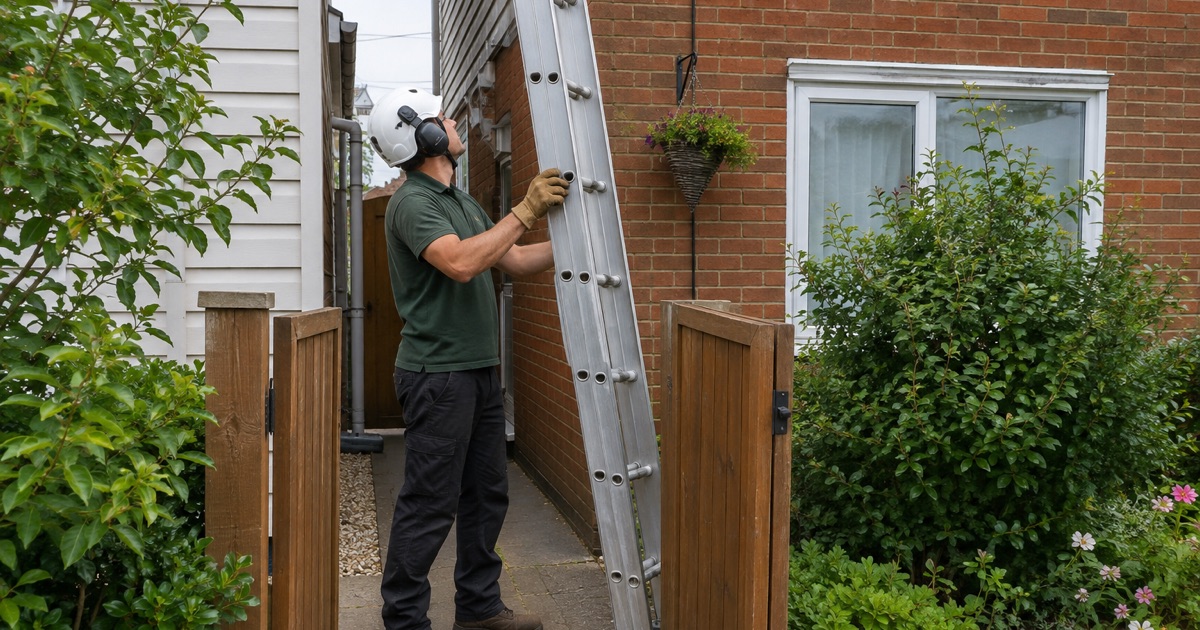
Crofton’s housing stock splits almost evenly between two shapes: 45.8 percent of units are single-family detached and 45.9 percent are single-family attached. Owner-occupied attached units number 3,810, against 4,707 owner-occupied detached. That near-even split is the single largest thing that changes about doing tree work here, because a townhouse rear yard is reached on foot through a gate rather than by driving a truck across a lawn.
Measuring the access before we quote
On an attached row the gate is the constraint, so we measure it during the estimate rather than discovering it on the morning of the job. Our compact machines exist for exactly this situation, where a full-size chipper truck never gets past the fence line and everything else has to be walked in and walked out. Whatever has to be carried, we say so in writing, so the debris hauling line in your estimate matches what actually happens in the yard.
Gate width also decides what becomes of the stump. A stump grinder that clears the opening can follow the crew in the same day; one that does not means either a narrower machine on a second visit or a panel of fence out and back in. Either way you should know which before you sign, so we put it in the estimate and there is no second conversation about it.
Taking a tree down in pieces
Where there is no room to fell, we work by sectional dismantling: a climber or an aerial lift operator takes the crown apart in controlled pieces and rigs each one to the ground inside the footprint of the yard. ANSI Z133 governs how that work is set up and ANSI A300 covers the cuts themselves, whether the job is a full removal or a crown reduction, crown thinning or deadwooding on a tree that is staying. Protection matting goes down over the lawn and any pavers before the first piece comes off.
Emerald ash borer has thinned the ash across this part of Anne Arundel County, and a dead ash is a different removal from a live one. The wood is brittle, it fails without warning under a climber, and it is the case where a crane or an aerial lift stops being a convenience. Tree of heaven is the other species we get called about on these lots, usually because it has come up along a fence line and started lifting it.
When a tree stands over the roof of an attached unit, or over two of them at once, we bring a crane. Setting one on a Crofton street takes staging room and a word with the neighbors whose parking we borrow for the morning, and we make those arrangements ourselves rather than leaving them to you.
Attached Lots and the Ground Under Them
The ground here sits at the wet end of the local range. The community’s centroid maps as Adelphia-Holmdel-Urban land complex on 0 to 5 percent slopes, where Adelphia is moderately well drained and Holmdel somewhat poorly drained, and Shrewsbury loam and Fallsington sandy loams are mapped in the community as well. Wet soil holds a root plate less firmly than dry soil does, which is why a leaning tree in Crofton earns a second look after a saturated week.
Where the lot backs onto a creek
Along the stream corridors the mapping changes completely: Sassafras and Croom soils at 15 to 25 and 25 to 40 percent slopes, and Collington, Wist and Westphalia soils at 25 to 40 percent, all of them better drained and considerably steeper. A lot on the flat interior of the community and a lot dropping toward a creek are two different sites. They get two different plans for where the crew stands, where the wood is dropped and how it leaves the property.
Roots, stumps and the shared fence
Root collar excavation with an air spade is how we look at what is happening below the flare without tearing the roots apart, and on an attached lot where the trunk sits a few feet off the line it is usually the least invasive way to settle whether a tree stays. Where the answer is that it stays, cabling and bracing can buy years on a co-dominant union with included bark in it. Where the union has already opened, it cannot, and we will say so.
Epicormic shoots along a stripped limb, a hollow at the base, or a heaved plate on the fence side are conditions we photograph and describe in the estimate. Stump grinding on an attached lot carries its own constraint, because the grindings have to go somewhere and a small rear yard has nowhere to put them. On those jobs the grindings are hauled out rather than back-filled into a mound nobody wants.
Deadwooding a large tree over an attached rear yard is often what a household actually needs rather than a removal, and we will tell you when that is the case. A crown reduction that takes weight off the ends of the limbs, or crown thinning that lets wind move through the canopy instead of pushing on it, keeps a tree a committee would rather see kept.
County Permits Still Apply
Because the community issues none of its own, the permit questions here are county and state ones. Building, grading and sediment control permits come from the Anne Arundel County Department of Inspections and Permits. Forest conservation review sits with the Office of Planning and Zoning’s Development Division, and the county’s forest conservation regulations apply where a subdivision, grading permit or sediment control permit covers a site of 40,000 square feet or greater, which is a development-scale threshold rather than something a single back-yard removal trips.
A tree in the right-of-way belongs to someone else
A tree whose trunk stands in a public right-of-way is not the homeowner’s to remove. Work on one needs a Roadside Tree Care Permit from the Maryland Department of Natural Resources Forest Service, the same agency that licenses Maryland Licensed Tree Experts under COMAR 08.07.07. That license is worth asking about whoever you hire, and it is a fair question to put to us as well.
Beyond that, the owner depends on the road. Trees in a state highway right-of-way along a route such as MD 450 are the State Highway Administration’s; trees along county roads fall to the Anne Arundel County Department of Public Works, Bureau of Highways; and anything in contact with an electric distribution line is a call to Baltimore Gas and Electric before it is a call to us. Knowing which of those applies is most of the delay people run into after a storm.
After the wind
Severe thunderstorm wind is what puts trees on the road around Crofton, and it puts them in much the same places. Downed trees blocked MD 424 Davidsonville Road near Bell Branch Road on July 12, 2022, with more trees and wires down along US 50/301, MD 450 and the 2000 block of MD 424; trees came down at MD 424 and MD 450 again on August 10, 2022; a large tree came down near Reidel Road on April 22, 2023; and trees and wires came down near MD 450 and MD 3 Crain Highway on May 31, 2025.
Hail belongs to the same pattern, ping-pong-ball-size on July 1, 2021 and quarter-size in June 2022 and again in June 2023, and hail-stripped foliage is worth a look even when nothing came down. The flooding that closes roads here is inland stream flooding rather than anything tidal, with MD 450 Defense Highway shut near Huntwood Drive on more than one occasion. We answer storm calls inside 24 hours, and the forecast we watch is NWS zone MDZ014, Anne Arundel, out of the Baltimore/Washington office.
- 20+ Years in Anne Arundel
- Free Written Estimates
- 24-Hour Storm Response








