
Glen Burnie Tree Removal has been doing tree removal in Columbia and across Howard County for more than 20 years, and the first thing we explain to a new customer here is that the county is not the office deciding whether the tree comes down. On property assessed by the Columbia Association, that decision belongs to your village. The county track and the village track run in parallel, and clearing one of them does not clear the other.
Homeowners who moved in from an unincorporated corner of the county are used to treating a dead oak in the back yard as a scheduling problem. Here it is a covenant problem first and a scheduling problem second. We sequence the approvals into the free written estimate, so the scope you sign names who has to sign off, and in what order, before a saw touches the trunk.
That estimate is done on site, it costs nothing, and the crew that walks the property is the crew that does the work and the cleanup. Storm calls get a response within 24 hours, which matters more here than the calendar suggests. What follows is how the approval chain actually runs, what gets measured and from where, and why the answer shifts depending on which village you live in.
The approval chain, in order
Howard County puts the separation in writing. Its guidance states that Columbia Village Architectural Committee review and approval is a completely separate process from the issuance of Howard County permits and licenses, that the county has no involvement in the village architectural review process and vice versa, and that issuance of a county building permit does not eliminate the need to apply for approval from the Architectural Committee of the village where the exterior alteration will occur. Read that last clause slowly, because it is the one people get wrong.
The village half
Applications for exterior alterations on Columbia Association assessed property go to the village Architectural Committee, and they are filed through that village’s Covenant Advisor rather than handed across a county counter. The tree itself draws a second review, because Columbia Association Open Space Management inspects a covenant-regulated tree before approval is issued. Neither of those reviews is triggered by anything the county does, and neither is satisfied by it.
The county half
The county still owns the permits that attach to construction rather than to covenants. Building, grading and demolition permits come from the Howard County Department of Inspections, Licenses & Permits. Forest conservation review, meaning clearing tied to subdivision, development or grading and the Declaration of Intent that can accompany it, sits with the Howard County Department of Planning and Zoning, which exempts development activity on single lots smaller than 40,000 square feet under Section 16.1202(b), provided the area is not already covered by an approved Forest Conservation Plan.
What the sequence costs in time
The two tracks do not queue behind each other, so the practical question is which one starts first. We open the village application while the estimate is still fresh, because an Architectural Committee meets on its own calendar and an inspection of the tree has to be scheduled on top of that. A job that would be booked inside a week elsewhere in the county routinely runs longer here, and a schedule that pretends otherwise is a schedule that slips.
What goes in the contract
Every estimate we hand over names the approvals the job depends on and states in writing what the price includes, debris hauling and cleanup among them. Maryland requires a Licensed Tree Expert license to do tree work for hire under Natural Resources Article section 5-417(a)(1), and COMAR 08.07.07.03D requires the written contract to identify the Licensed Tree Expert license the work is carried out under. Crew working under that supervision need no individual license, which section 5-417(a)(2) sets out, while trees 20 feet tall or less, loggers and underground-utility installers fall outside the requirement under section 5-415(c)(2)(iii).
Looking for tree-removal closer to New Carrollton? See New Carrollton Tree-Removal.
Six inches, measured two feet above the ground
The threshold that catches most homeowners in Columbia is not a county number at all. Under the Wilde Lake village covenants, removal of trees with a diameter of six inches or more as measured two feet above the ground requires approval, and the request goes to Columbia Association Open Space Management, which will inspect the tree prior to issuing approval.
Two feet, not four and a half
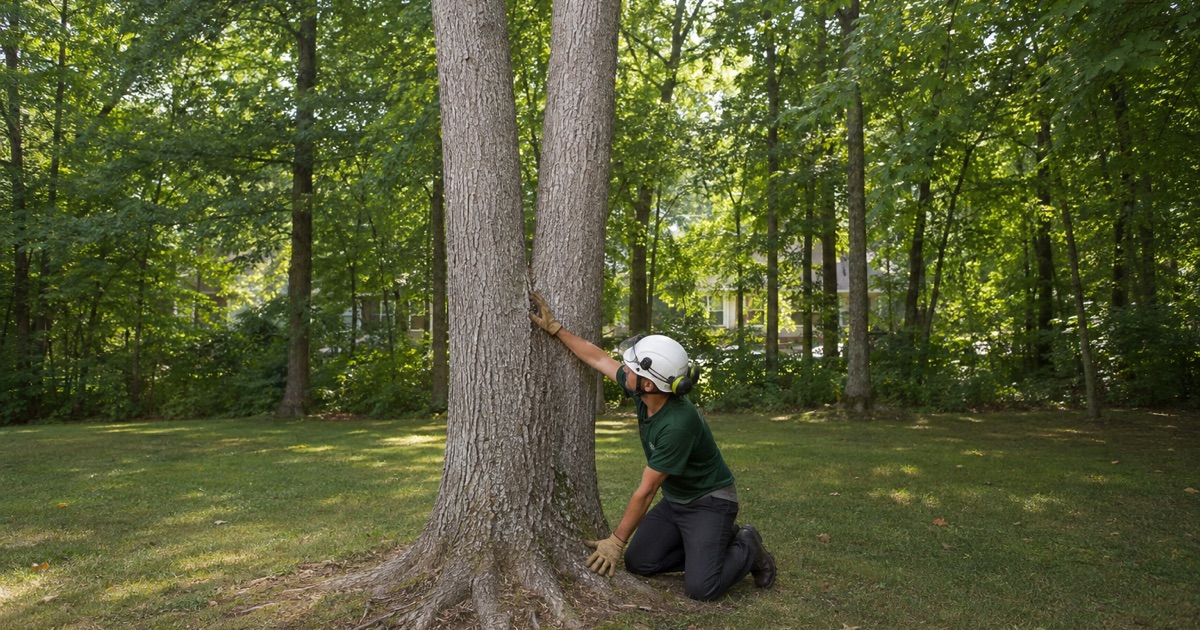
Foresters take diameter at breast height, 4.5 feet up the trunk, and most published size thresholds in this trade are written that way. The covenant is not. Measuring at two feet puts the tape nearer the root collar, where the trunk is wider, so a tree that reads under the line at chest height can sit comfortably over it at the point the covenant actually cares about.
Trunks that argue with the tape
Co-dominant stems and included bark complicate the reading, because two leaders fused at a weak union can measure as one trunk low down and as two higher up. Root collar excavation with an air spade sometimes settles the question, and it answers a second one at the same time, which is whether the flare is buried and quietly rotting. We measure and photograph the trunk at the covenant point before anything is filed, so the application and the tree agree with each other.
A dead tree is still a covenant tree
Dead trees sit inside that rule rather than outside it, which surprises people who assume a standing skeleton is nobody’s business. Emerald ash borer has been established in Maryland since 2003 and kills a large ash in roughly three years, leaving brittle standing deadwood, and that is a different removal from a live tree: sectional dismantling from an aerial lift instead of a climber working the spar. The application still goes in, and the inspection still happens.
When the tree cannot wait
Village covenant practice reported for Town Center allows removal without prior written Architectural Review Committee approval where trees are a safety hazard and in danger of falling, on the condition that the Covenant Advisor is notified immediately. That exception exists because the weather here does not negotiate. A destructive-tier Severe Thunderstorm Warning issued on August 10, 2026 for northern Howard County and southwestern Baltimore County named Columbia among the communities in its path, more than 25,500 BGE customers lost power, and a tree was reported down onto a house here. The destructive tier is triggered when radar indicates gusts of 80 mph or greater.
Open Space or your lot
Columbia’s open space is interleaved with its housing rather than fenced off at the edge of it, which is why our first move on a property here is working out where the line runs. The Columbia Association governs Open Space throughout Columbia, and through Open Space Management it inspects and approves removal of covenant-regulated trees on assessed property. A tree ten steps from a back door can belong to a pathway corridor rather than to the lot it shades.
Getting that boundary wrong is expensive in both directions. Taking down a Columbia Association tree without the association’s approval is a covenant violation against the homeowner, and paying to remove a tree that is not on the lot is money spent on someone else’s property. We settle it against the plat and the association’s own mapping before the estimate is written, and we say plainly when the answer is that the tree is not yours to remove.
Right-of-way is a third category
Trees whose trunks stand in the county road right-of-way belong to the Howard County Department of Public Works, Bureau of Highways - Tree Division: limb elevation, removal of dead trees, storm limb clearance and stump grinding, reached during business hours at 410-313-7450. The county’s own caution is that stump grinding may take up to a year, depending on the current workload and backlog. Where the road is a state highway, the trees in that right-of-way belong to the Maryland Department of Transportation State Highway Administration instead.
The permit that follows the trunk
The Roadside Tree Law turns on where the trunk stands within the public right-of-way, not on who planted the tree or who has been mowing around it. A Roadside Tree Care Permit comes from the Maryland Department of Natural Resources Forest Service, and Natural Resources Article section 5-406(d) bars a county or municipality from issuing a building permit until that roadside tree permit is obtained. Emergency work is allowed, with a one-week reporting duty attached to it under COMAR 08.07.02.03C.
Lines, not limbs
Baltimore Gas and Electric handles vegetation management on its own distribution circuits under COMAR 20.50.12.09 and is not responsible for removing the wood afterward, which is the gap most homeowners find the morning after a storm. Report a downed line to 1-877-778-2222 and a limb resting on a line to 1-800-685-0123, and keep everyone clear until the utility has dealt with the circuit. We take the tree once the line is safe, and the hauling and cleanup are written into the scope rather than added to the invoice later.
Ten villages, ten committees
Columbia has ten villages, being Dorsey’s Search, Harper’s Choice, Hickory Ridge, Kings Contrivance, Long Reach, Oakland Mills, Owen Brown, River Hill, Town Center and Wilde Lake, and each one runs its own Architectural Committee with its own Covenant Advisor. The six-inch line quoted above is the Wilde Lake wording, and it should be read as that village’s covenant rather than as a number holding everywhere. We confirm the language that governs the address before filing anything, because a committee working from a different guideline will not accept an application written to someone else’s.
Age of the stock, age of the canopy
The villages went up in waves and the trees went in with them. Some 31.5% of Columbia’s housing units date from the 1970s, 25.7% from the 1980s and 17.0% from the 1990s, with 42.9% built in 1979 or earlier and only 2.3% predating 1960. A canopy planted alongside those subdivisions is now well into the decades when co-dominant unions let go, epicormic shoots crowd the scars of old topping cuts, and deadwooding stops being cosmetic work.
The species that came with the 1990s
Callery pear, sold and planted as Bradford, went into a great many subdivisions of that era and is prohibited for sale in Maryland from January 15, 2026. It is the textbook case of included bark at a co-dominant union, and the failure arrives in one storm rather than gradually, usually taking half the crown with it. Crown reduction and crown thinning buy time on a young one; on a mature specimen the honest answer is often removal and replacement.
What the ground does to a stump
Surface geology under Columbia samples as 53.3% Loch Raven and Oella schist, 14.3% Baltimore Gneiss, 10.1% Patuxent, Arundel Clay and Patapsco material, 8.8% Guilford Granite and 7.4% Baltimore Complex metagabbro. Schist weathers to a saprolite that a stump grinder works through far faster than granite or metagabbro does, so grinding effort varies materially from one part of the community to the next. All of it sits in the Piedmont Plateau Province on the upland side of the Fall Line, which is also why northern red oak reads as a locally appropriate replacement here.
Access, boards and equipment that fits
Detached single-family units make up 39.5% of the stock and attached single-family 25.4%, with 14.3% of units in structures of 10 to 19 units and 9.2% in structures of 50 or more. That mix means gated rear yards, shared lot lines and grounds answering to a board rather than to one owner. We bring compact equipment through tight access, lay lawn and hardscape protection matting on every job, and bring in a crane when a tree stands over a structure. Scheduling is built around HOA boards, property managers and multifamily grounds staff who need a date they can post.
- 20+ Years in Anne Arundel
- Free Written Estimates
- 24-Hour Storm Response








