
Glen Burnie Tree Removal has handled tree removal in Catonsville for more than 20 years, and most of what we take down on these blocks was in the ground long before the house beside it was finished. The crew that walks the property for the estimate is the crew that does the work, and the estimate is free and written, with the debris hauling and cleanup spelled out before a saw comes off the truck.
A removal here is usually as much rigging as it is cutting. We bring compact equipment through gates and side yards instead of driving a machine across a lawn, lay protection matting under anything that rolls over turf or hardscape, and set a crane when a tree stands over a roof and there is no safe direction to drop it. Storm calls get a 24-hour response, and fallen trees do not wait for a scheduling window.
Two things decide how a job runs on a property here, and neither of them is the species on the tag. The first is how long ago the planting went in. The second is what the roots found when they tried to go down.
Trees that predate the driveway
Catonsville grew as a streetcar suburb, and the housing stock still reads that way: 45.7% of it was built before 1960 and 18.5% of it predates 1940. Another 20.8% went up during the 1950s. The pre-1960 share is the number that governs the work, because it means the shade trees were not planted around the current site plan — they were there first, and everything else was fitted in around them.
What that produces is a full-size canopy sitting inside a layout that kept being extended underneath it. Garages, additions, patios, sheds and fence lines arrived in the decades after the trees did, so a trunk that had open ground around it as a sapling now stands a few strides from a roof, a shared property line and a service drop. Detached single-family houses are 49.8% of the stock and attached houses another 18.5%, so a great many of these trees are working over two owners at once.
What an old tree tells us before it fails
We read the unions first. Co-dominant stems with included bark are the classic failure point on a large, open-grown tree, because bark trapped in the crotch never knits into wood and the two leaders slowly lever each other apart. On a tree that has already lost a leader, epicormic shoots along the stripped side and deadwood accumulating in the upper crown say the same thing from a different direction.
A seam that opens after a wind event, a mushroom line at the base, or a lean that was not there last season moves the recommendation from pruning to removal. Where the tree is sound and the defect is local, cabling and bracing plus deadwooding keeps it standing. We put which of the two we are recommending, and why, in the written estimate rather than settling it at the truck.
Access is the constraint, not the saw
Deep rear yards on the older streets frequently have no vehicle access at all. Where that is the case, the removal becomes sectional dismantling from climbing lines or from an aerial lift set out front, with every piece rigged down and hand-carried out through a gate. Lot size is no help by itself — a generous back yard behind a fence, a garden and a neighbor’s garage is a harder removal than a small one a chipper can back into.
Looking for tree-removal closer to Crofton? See Tree-Removal in Crofton.
Metagabbro under the root plate
The whole community sits in the Piedmont Plateau Province, on the upland side of the Fall Line, and the surface geology samples as 64.3% Baltimore Complex metagabbro, gabbro and amphibolite. Another 12.3% is Cretaceous Patuxent, Arundel Clay and Patapsco material, 7.7% upland sand and gravel, 6.6% Ellicott City Granite and 3.9% Relay quartz diorite. Northern red oak, which is flagged as rare down on the coastal plain, is a locally appropriate species on this side of that line.
Metagabbro and granite are hard, dense rock. Where they lie shallow under a lawn, a root system does not go down — it goes out. That single fact drives most of what is different about tree work in this community.
Wide, shallow plates and windthrow
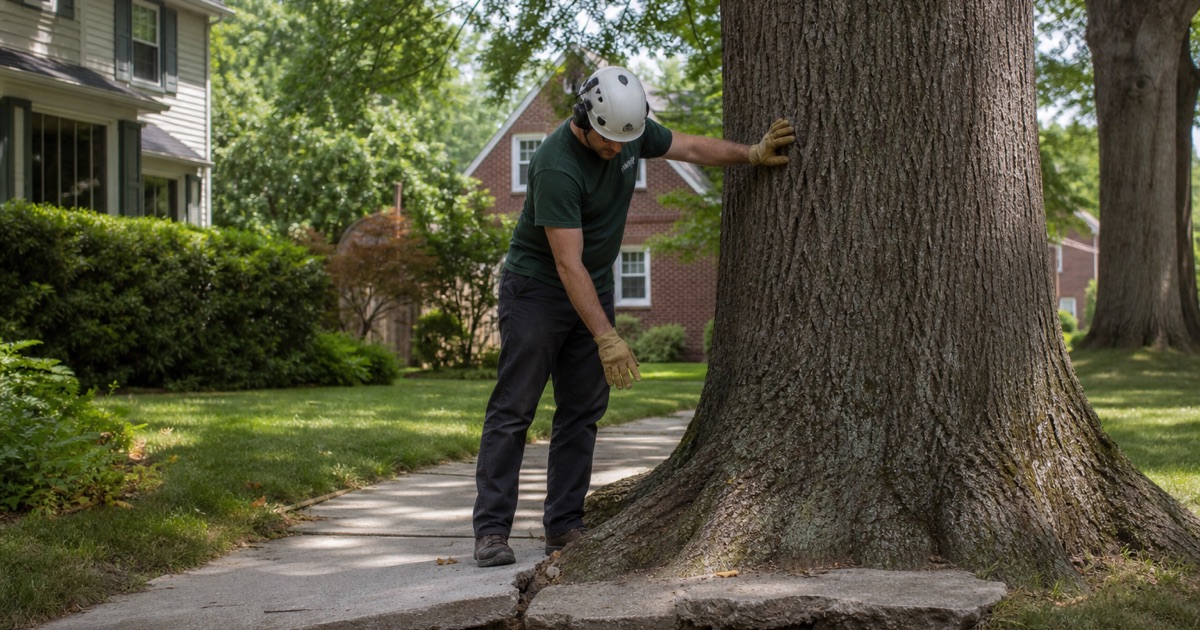
A root plate that spreads wide and shallow instead of anchoring deep is a windthrow factor on a tall mature tree, and it is why a healthy-looking oak can go over in saturated ground while a smaller neighbor rides the same gusts out. We look for plate movement — turf lifting on the windward side, a soil crack following the drip line, a trunk that has shifted in relation to a fixed edge like a walk or a wall.
Where the flare is buried under decades of mulch and grade change, root collar excavation with an air spade opens the collar without cutting anything, and that is usually how a girdling root gets told apart from decay. It is a cheap look at the part of the tree that decides whether the rest of it stays.
What rock does to a stump
A stump grinder working over shallow metagabbro reaches rock before it reaches the depth the same machine would get on a sand lot, and pretending otherwise is how a job ends in an argument. We say in the written estimate what we expect to reach, what happens if we hit rock early, and whether the grindings stay on site as backfill or leave with the rest of the debris.
Root plates that ran sideways also mean the grinding footprint is wider than the stump looks. On a narrow strip between a walk and a foundation that is worth knowing before the machine arrives rather than after.
Street trees, right-of-way and who signs off
Mature street trees along the older Frederick Road grid frequently stand inside the county right-of-way, and that changes who authorizes the work rather than who pays for it. The Roadside Tree Law turns on the position of the trunk, not on who planted the tree or who has been raking under it. A Roadside Tree Care Permit from the Maryland Department of Natural Resources Forest Service is required before removing, trimming or otherwise caring for a roadside tree.
Natural Resources Article section 5-406(d) also bars a county or municipality from issuing a building permit until that roadside tree permit is in hand, so a curbside maple can hold up a project that has nothing to do with it. Penalties under the law are $2,000 and $5,000. Genuine hazard work has an emergency exception, and it carries a one-week reporting duty under COMAR 08.07.02.03C.
When the county owns the problem
The Baltimore County Department of Public Works Bureau of Highways removes dead and storm-damaged trees and broken limbs from county roads and roadsides by work order, where the trunk is inside the county right-of-way. Requests go to highways@baltimorecountymd.gov or 410-887-3560, and the right-of-way question is settled when the work order application is started. Removing fallen trees and debris from private property stays the owner’s responsibility, and that is the call we take.
Wires before saws
Baltimore Gas and Electric handles vegetation management on its own distribution circuits under COMAR 20.50.12.09 and is not responsible for removing the wood afterward. Report a downed line to 1-877-778-2222 and a limb resting on a line to 1-800-685-0123, and let the utility clear it before anyone puts a rope in the tree. We schedule the removal and the cleanup around whatever the utility has already done.
Clearing more than one tree
Larger clearing runs through the county forest conservation program at Article 33, Title 6 of the Baltimore County Code, sections 33-6-101 through 33-6-122, administered by the Baltimore County Department of Environmental Protection and Sustainability. Section 33-6-104 carries a declaration of intent with a five-year forward window, which is the piece that catches owners who clear now and apply to build later. Building and grading permits themselves come from the Baltimore County Department of Permits, Approvals and Inspections, and we plan the sequence around both before quoting a lot.
Keeping the trees worth keeping
Most calls on a pre-1960 street should not end in a removal. Crown reduction on a limb overextended toward a roof, crown thinning where a dense canopy is sailing in wind, and deadwooding on a specimen tree that has simply outgrown its last pruning cycle all buy years. Diameter at breast height and the condition of the unions decide that, not the age on the deed.
A dead ash is a different removal
Emerald ash borer has been established in Maryland since 2003, and it kills a large ash within roughly three years, leaving brittle standing deadwood behind it. Brittle is the operative word: a dead ash does not hinge the way a live tree does, and pieces come apart in the air. Those get taken down in smaller sections, earlier rather than later, and they are not trees to leave standing another season while a decision gets made.
After the storm
On August 10, 2026 a destructive-tier Severe Thunderstorm Warning named this community among those in its path. That tier is issued when radar indicates gusts of 80 mph or greater, and it carries the wording that considerable damage to trees and power lines should be expected. More than 25,500 Baltimore Gas and Electric customers lost power behind it. The community sits in National Weather Service forecast zone MDZ011, Southern Baltimore, under the Baltimore/Washington forecast office.
Our crews have worked this region’s storm season for two decades and know which species come apart first. Where 10.7% of local units sit in buildings of 50 or more, and Patapsco Valley State Park’s 16,043 acres run along 32 miles of river at the edge of town, the work after a line of storms is rarely one address at a time. We schedule around HOA boards, property managers and multifamily grounds staff, and the estimate visit still costs nothing.
- 20+ Years in Anne Arundel
- Free Written Estimates
- 24-Hour Storm Response








