
Glen Burnie Tree Removal has handled tree removal in Brooklyn Park for more than 20 years, and on these lots the decision that matters usually gets made below the grass rather than up in the crown. Two trunks of the same diameter can call for two different jobs three blocks apart, because what the roots are gripping is not the same ground.
Every removal starts with a free on-site estimate, written out before any saw leaves the truck, with the takedown, the stump, the hauling and the final cleanup each set down in plain terms. The crew that walks the property during that visit is the crew that arrives on the work date and the crew that rakes the yard before leaving.
Access shapes the plan as much as the tree does. We bring compact machines through gates and side yards a full-size chipper truck cannot clear, lay protection matting over lawn and hardscape, and set a crane when a stem stands over a roof instead of over open ground. Storm work gets a 24-hour response, because a split maple leaning on a shared wall is not a next-week problem.
Why Root Plates Differ From One Street to the Next
This community is not built on one soil. A nine-point sample of the USDA soil survey spread across the CDP returned nine different map units: the Christiana-Sassafras-Urban land complex on 5 to 15 percent slopes, loamy Udorthents on the same grade, Chillum loam at 2 to 5 percent, Chillum-Urban land, two separate Sassafras-Urban land complexes, Russett-Urban land, Russett-Christiana-Hambrook, and open water. Nine points returning nine answers is about as varied as ground gets inside one small place.
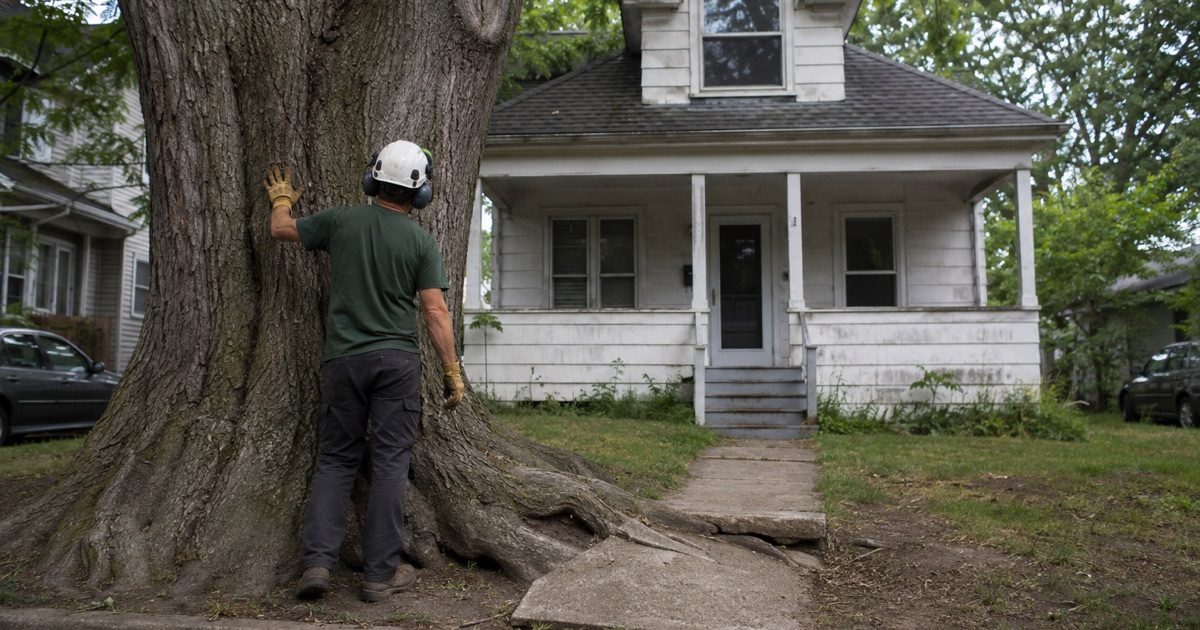
That is why we will not quote a removal from a photograph. What a root plate is anchored in decides whether a tree can be felled in one piece or has to come down in sections, and that answer changes street to street here.
Christiana clay under the yard
The Christiana series is classified as a fine, kaolinitic, mesic Aquic Hapludults, which in working terms is a heavy kaolin clay subsoil that is only moderately well drained. Clay of that kind holds water rather than letting it pass through, and root systems meeting it tend to spread sideways instead of driving down.
Wide, shallow anchorage changes two things on a work day. A leaning stem is less forgiving to hinge, and the ground around the trunk can still be saturated days after rain while a lot two streets over has already drained and will carry a machine.
The sandier and the steeper units
Sassafras and Russett ground behaves differently. It drains faster, firms up sooner after a wet week, and takes equipment traffic with less damage to the turf underneath.
Slope is the other half of the read. Several of the mapped units here sit on 5 to 15 percent grades, and a grade decides where a chipper can be parked, where a grinder can be turned around, and whether a crane can set outriggers level and still be close enough to be useful.
Reading it on the walk-through
We look at surface roots, the flare at the base of the trunk and the way water has moved across the yard before anything gets written down. Where the ground is soft, the answer is usually matting and a longer reach rather than a heavier machine parked closer in.
That same walk is where included bark, co-dominant stems and deadwood high in the crown get noted, because those decide the rigging more than the diameter at breast height does.
Looking for tree-removal closer to Linthicum? See Linthicum Tree-Removal.
Fill Soils and What They Hide
Loamy Udorthents on 5 to 15 percent slopes is the survey’s way of saying made ground on a hill. Somebody graded, filled and built, and what sits under the lawn is not a natural profile that formed in place.
Fill on a grade is the least predictable material our equipment meets in this community. Along this stretch of the Patapsco it can carry rubble, slag and buried construction debris left from the industrial decades, and none of that announces itself at the surface.
Why it matters after the tree is down
A crew can take a tree apart without ever knowing what is under it. The grinder finds out. We plan made-ground stumps as their own line rather than as an afterthought to the removal, and we work down in passes, checking the spoil, instead of forcing a wheel through something solid and unidentified.
Water leaves here by one route
Brooklyn Park drains entirely to the Patapsco, through both the tidal and the non-tidal watersheds, by way of Cabin Branch, Cabin Branch 2, Curtis Creek, Holly Creek, the Patapsco Mainstem and one unnamed tributary. Anything that washes off a torn-up work area ends up in one of them.
That is a practical reason to keep spoil contained and the disturbed area raked back down before we leave, not an environmental slogan. Loose fill on a slope moves the first time it rains hard.
Where the Critical Area reaches
The Chesapeake Bay Critical Area comes into this community along its Patapsco frontage as the 1,000-foot band landward of tidal water and tidal wetlands, and all three classes are present inside the CDP: Intensely Developed Area, Limited Development Area and Resource Conservation Area. The obligation attaches to a waterfront address, not to the community as a whole.
Where it does apply, an approved Vegetation Management Plan has to be in hand before any vegetation in the Buffer is removed, dead trees included, and the county is explicit that stems under 4 inches are not exempt. The Anne Arundel County Department of Inspections and Permits runs that review through its Forestry Program at (410) 222-7441. We plan waterfront work around that approval instead of against it.
Trees Older Than the Houses Around Them
More than a third of the housing here, 37.3 percent, predates 1950, and 81.6 percent of it predates 1980. The 1940s and 1950s built most of this place, and the yard trees planted with those houses are now 75 years old and older on a large share of lots.
A tree of that age on a lot of that size is usually past felling whole. There is no drop zone, and the neighbor’s roof is closer than the tree is tall.
Dismantling instead of felling
Sectional dismantling is the normal method on these blocks rather than the exception: the tree comes apart in controlled pieces, rigged and lowered instead of dropped. Where a stem stands directly over a roof, a garage or a fence line, we crane it out, so the weight is held before the cut is finished rather than after.
Either way the work is planned under the industry’s ANSI Z133 safety practice, and the equipment decision is made at the estimate rather than improvised on the day. Protection matting goes down over lawn and hardscape before the first piece is lowered, because the ground beneath a drop zone takes that weight whether or not anybody planned for it.
Rowhouses, alleys and party walls
Attached frontage is 26.4 percent of the housing stock, against 62.3 percent detached single-unit homes. On an interior rowhouse or duplex unit there is no side access at all, the wall is shared, and the back yard is reached from an alley rather than a driveway.
Rigging, drop zone and debris route all have to be worked out off the street or off the alley before the first cut. For HOA boards, property managers and multifamily grounds we schedule that end of it deliberately, so residents get notice, cars are moved and the alley stays passable while a crew is in it.
Ash, and why the method changes
Emerald ash borer has been established in Maryland since 2003, and a large ash it kills goes brittle within about three years. Brittle standing wood is the reason a dead ash gets an aerial lift or a crane rather than a climber, and the reason it is worth dealing with before it starts shedding limbs.
We flag ash on the written estimate whether or not the tree has dropped anything yet, because the safe method for one is not the safe method for the other.
Grinding Into Made Ground
What clay and fill do to a grinder
A stump hole opened in Christiana clay can stand full of water a day after rain, and the grinder throws wetter, stickier spoil than the sandier parts of the county produce. In Udorthents fill the difficulty is the opposite kind, which is that nobody knows what is down there until the wheel reaches it.
Both cases are handled the same way: a realistic grinding depth agreed in writing, spoil raked back rather than left mounded, and a stop-and-check rather than a forced pass when the machine finds something it should not be cutting.
Where the wood and the chips go
Anne Arundel County curbside collection takes limbs under 4 feet long and 4 inches thick, bundled under 40 pounds, and will not take logs at all. BGE does not remove the wood after a line-clearance cut either, so that material stays with the property owner unless somebody hauls it.
Debris hauling and cleanup are written into our estimate with what is included stated plainly, which is the part homeowners most often find missing when they compare quotes. If a limb is resting on a line, BGE’s number is 1-800-685-0123; a line already down is 1-877-778-2222 and an emergency call rather than a tree-service call.
Permits, boundaries and who may do the work
Whether the trunk stands inside the property line or in the public right-of-way decides whether the state’s Roadside Tree Care Permit applies. The test is where the trunk stands, not where the canopy reaches, so a tree leaning over the roadway from a front yard is not a roadside tree. The Maryland Department of Natural Resources Forest Service issues that permit, the project fee is $25, and a county building permit cannot be issued until the state permit is in hand.
Maryland requires tree work performed for hire to be done under a Licensed Tree Expert, exempts trees 20 feet tall and under, and requires a written contract under COMAR 08.07.07. The northern edge of this community is the Baltimore City line, and Baltimore City keeps its own forestry rules and its own right-of-way authority, so an address a block either side of that line can answer to a different office over the same street tree.
What the storm season here actually looks like
This community sits in National Weather Service public forecast zone MDZ014, forecast county-wide out of the Baltimore/Washington office. The local storm record is led by summer convective thunderstorm wind and by tornadoes rather than by winter coastal systems, which means the damage calls cluster in warm-weather afternoons and arrive fast.
That is what the 24-hour response is built for. A crew that already knows which blocks sit on fill, which yards drain slowly and which back yards can only be reached from an alley does not lose the first hour of a storm call working that out.
- 20+ Years in Anne Arundel
- Free Written Estimates
- 24-Hour Storm Response








