
Glen Burnie Tree Removal handles tree removal in Bel Air with more than twenty years of work behind us, and the first thing we settle on any job here is whether the tree stands in the Town right-of-way or on the owner’s side of the line. That answer decides who pays, who issues the permit, and how long the job takes to reach a saw. It is not a formality in this town, because the Town of Bel Air wrote both routes into its own code.
Bel Air Town Code Chapter 435 gives the Town full power and authority over trees and shrubs in street rights-of-way, parks and public places, and it reaches onto private ground in two ways that matter to a property owner. One is a licensing rule that covers back-yard work as well as street work. The other is an order the Town can issue against a hazardous tree, with a deadline attached and a lien standing behind it.
Our estimates here are free and written before any work begins, and they say plainly which of those routes a tree falls under and what the cleanup includes. The rest of this page walks through the permit the Town already holds, the resident-funded route for a healthy roadside tree, the hazard finding that shifts the cost, and what the ground under this town does to a stump.
Who pays, and the finding that changes the answer
The roadside tree is the Town’s tree
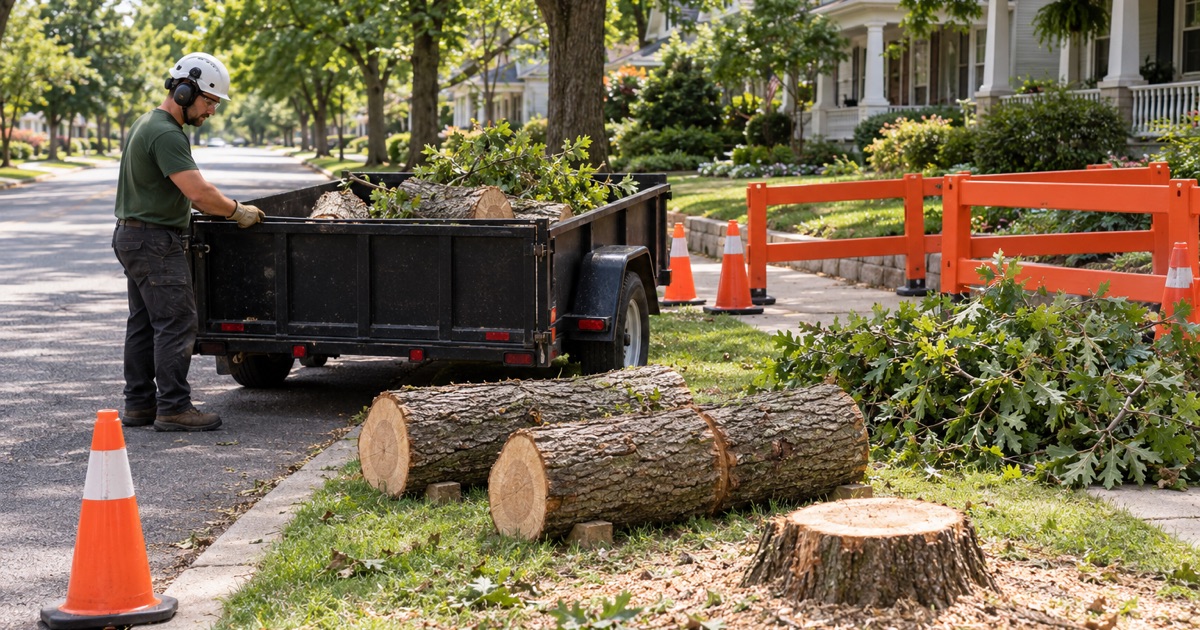
A roadside tree in front of a Bel Air property is the Town’s tree rather than yours, which is why you cannot simply hire someone to drop it. Section 435-5C of the Town code sets out the only written route for taking down a roadside tree that is otherwise healthy, and that route is funded by the resident who wants it gone. The resident pays the removal cost and the replacement cost, and the replacement money is paid to the Town rather than to the contractor.
The line is not always obvious from the driveway, because the paved edge of a street is not the edge of the right-of-way. A tree that reads as a front-lawn tree from the sidewalk can still be a street tree in the Town’s records. We settle that question before we price the work, since a quote written on the wrong side of the line is worth nothing to anyone.
The hazard finding that moves the bill
The funding arrangement flips on a single determination. Where the Maryland Department of Natural Resources Forest Service finds that a roadside tree is hazardous, the removal and replacement costs fall on the Town rather than on the resident. Which of those two routes a job takes is the first question worth settling on any Bel Air right-of-way tree, and it is worth settling before anyone signs anything.
A private tree under a Town order
Section 435-5G runs in the other direction. The Town may order a hazardous tree or branch on private property removed where it threatens traffic in the right-of-way, life or property, or where it harbors insects or disease threatening other trees. The owner must comply at their own expense within 45 days of written notice, and the work is to be supervised by a certified tree care expert on the Town’s staff or performed by a licensed tree expert. If the owner does not comply, the Town does the work itself and may place a lien on the property, collected the way delinquent taxes are collected.
When a letter like that lands, the calendar is usually a bigger problem than the tree. We respond within 24 hours to storm damage and fallen trees, and on an ordered removal we put the scope, the debris hauling and the disposal in writing so the file handed back to the Town shows exactly what was done. The estimate visit itself carries no charge.
Looking for tree-removal closer to Pasadena? See Tree-Removal in Pasadena.
The blanket permit the Town already holds
Maryland regulates work on roadside trees at the state level, and the Town does not go back to the state tree by tree. Section 435-3D grants the Town its working authority through an annual blanket roadside tree permit issued to public agencies by the Maryland Department of Natural Resources Forest Service. That permit covers removal, pruning and planting under Forest Service supervision, and its stated purpose is eliminating hazard to property, public safety or health.
What the blanket permit does not cover
The blanket permit belongs to the Town, not to a property owner and not to a contractor. A resident who wants a healthy roadside tree removed does not work under it, and goes through Section 435-5C instead, where the Forest Service issues a separate roadside tree permit directly to that resident. Confusing the two is the most common way a Bel Air roadside job stalls before a crew is ever scheduled.
A license is required to work here at all
Section 435-4A is the rule that catches people by surprise, because it does not stop at the curb. No person or firm may engage in the business of pruning, treating or removing street or park trees, or trees on private property within the Town, without a valid tree expert license issued under the state’s Maryland Licensed Tree Expert program, together with proof of liability and property damage insurance consistent with State of Maryland requirements. That reaches a fenced back yard and not only the right-of-way, and it is a fair thing to ask any bidder to put in front of you before the trucks arrive.
Who reviews a removal request
Requests to take down an otherwise healthy roadside tree are reviewed by the Town of Bel Air Tree Committee and by the Forest Service, and the code makes those decisions final. The same committee advises on street tree species and on planting standards, which is why the replacement question tends to come up in the same conversation as the removal. Where a tree is tangled in the electric distribution system, line clearance belongs to Baltimore Gas and Electric Company rather than to us, and BGE states that it is not responsible for removing wood debris. That detail decides who cleans up after a utility crew has been through, and it is the gap we are most often called into.
The resident-funded route for a healthy roadside tree
Section 435-5C is a written policy the Town developed with the Forest Service, and it runs in a fixed order. The resident pays all removal and replacement costs, and the replacement funds are paid directly to the Town. The request is reviewed by the Town Tree Committee and by the Forest Service, and the code states that their decisions are final. One tree is replaced for each tree removed, in the same or a similar location.
The permit is the last step rather than the first. Once the Town has received both the replacement funds and the contractor’s information, the Forest Service issues the roadside tree permit directly to the resident. That means a contractor’s details are part of the paperwork before any permit exists, and a crew that cannot supply them in usable form holds the whole file up.
Not every request ends in a removal
Crown reduction, crown thinning and deadwooding will sometimes settle the complaint that started a request, and pruning already sits inside what the Town’s blanket permit covers. Cabling and bracing is worth pricing against removal on a mature tree with co-dominant stems and included bark, where the defect is structural rather than terminal. We say so in the estimate when we think that is the honest answer.
What we hand you for the file
We write the estimate before any work begins, with the removal scope, the replacement obligation and the debris hauling stated separately, so the numbers sent to the Town are the numbers that were agreed. The same crew that walks the property for the estimate is the crew that shows up on the day, which matters when a permit names a contractor. There is no charge for the estimate visit, in the right-of-way or behind the house.
The standards the code names
Bel Air holds tree work to standards by name rather than by preference. Planting and maintenance are to follow ANSI A-300, and no land disturbance is permitted within the critical root zone of a public tree unless tree protection measures under ANSI A300 Part 5 are installed. Topping is discouraged by ordinance, with a narrow exception for a tree severely damaged by storms or other causes, or one creating a dangerous condition around utility wires or other obstructions. On the replacement side, northern red oak sits comfortably in the Piedmont mix here, and species selection is one of the things the Tree Committee advises on.
Stumps below grade, and the ground they sit in
Section 435-5F sets a finish standard for street and park trees: all stumps are to be removed below the surface of the ground, so that the top of the stump does not project above grade. That is a measurable outcome rather than a matter of taste, and it belongs in any contract written for a Bel Air roadside job. We grind below grade as a matter of course, and we state in writing what happens to the grindings and to the wood.
What the ground here does to a grinder
Bel Air sits on the Piedmont Plateau, and state geology maps the Baltimore Gabbro Complex beneath the town. The mapped soil at the town centroid is the Neshaminy series, in its very deep over gabbro phase, at 85 percent of the map unit. In practical terms that is clay-rich residuum sitting on basic igneous rock, which means heavy spoil to move, slow grinding once the pad is opened, and a wide rocky plate lifted with the root mass when a large tree fails.
Access, matting and the crane call
A great deal of removal work in this town is not reachable from the street. We run compact equipment that fits through gates and into tight back yards, we put lawn and hardscape protection matting down on every job, and we bring in a crane when a tree stands over a structure and sectional dismantling from an aerial lift is not the safer answer. Debris hauling and cleanup are included, and what is included is stated in the written estimate rather than settled afterward.
Who is actually buying the work
Bel Air is the county seat of Harford County, and its housing stock is not quite the detached-home picture the phrase suggests. Close to 40 percent of housing units here sit in buildings of five or more units, so a large share of the tree work is bought by an apartment or condominium manager rather than by a homeowner. The detached side of the market is largely a 1970s and 1980s stock now carrying 45 to 55 years of growth, and we build scheduling around HOA boards, property managers and multifamily grounds staff.
Bel Air also falls in National Weather Service forecast zone MDZ507, Northwest Harford, while the tidewater end of the county falls in a different zone. That line is real, and it is worth remembering when a countywide forecast is doing the deciding about whether crews roll.
- 20+ Years in Anne Arundel
- Free Written Estimates
- 24-Hour Storm Response








