
Glen Burnie Tree Removal has handled emergency tree removal in Baltimore for more than 20 years, and the calls that come in after a storm here almost never start with the tree. They start with how a crew is going to reach it. Access sets the method, the schedule and the price on these blocks far more than species or height does.
We answer storm damage and fallen trees within 24 hours, and the first thing we settle on arrival is what the tree legally is. A tree in a back yard, a tree in the strip between sidewalk and curb, and a tree leaning over a shared rear alley are three different jobs under the city code, even when they are the same species at the same diameter. Getting that wrong costs a property owner a violation rather than a delay.
Our estimates are free and written on site before anything is cut, and they state what the removal covers, what the cleanup covers and where the wood ends up. On an emergency call that written scope earns its keep, because the work usually splits in two: the immediate hazard cleared now, the balance scheduled once the city paperwork is in hand.
Getting a Crew and Its Equipment Down an Alley
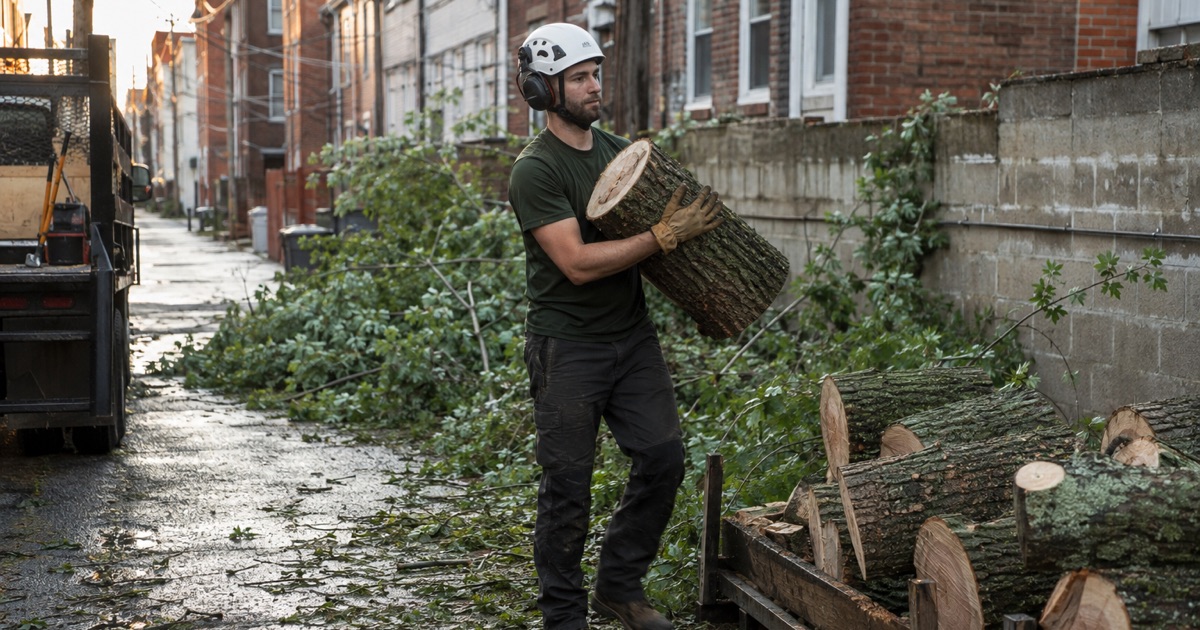
The housing stock here is attached far more often than not — 50.4% of the city’s units are single-family attached and 14.7% are detached — and on an attached block the limiting factor is rigging rather than sawing. There is frequently no driveway, no side yard and no clear drop zone at all. The way into a back yard is a shared rear alley or a gate the width of the house, and which of those it is changes the plan before anyone touches a rope.
Access decides the method
A tree that a bucket truck would take down in a morning from a suburban driveway becomes a sectional dismantling job when the only approach is an alley. We rig each piece, lower it under control and walk it out instead of dropping it, which is slower and far less likely to put a limb through a rear addition or a parked car. Our compact equipment exists for this exact problem — gated back yards and tight-access lots where a full-size truck never gets past the gatepost.
When nothing on the ground can reach it
Where a tree stands over a roof and the alley is too narrow to work from, we set a crane on the street and lift the sections out over the building. That is a different plan, a different permit conversation and a different day’s work, so we say so at the estimate rather than discovering it on the morning of the job. Crane-assisted removal is the honest answer on a good number of rowhouse blocks, and pretending a ground crew can manage it is how rear additions get damaged.
Protecting the ground we cross
Whatever route the equipment takes across a property gets protection matting — lawn, brick, pavers, whatever has to carry the weight. On a narrow lot that route is short and heavily loaded, which makes the matting matter more rather than less. The crew that walks the property at the estimate is the crew that walks it out at the end, so the cleanup matches what the estimate said it would be.
Looking for tree-removal closer to Catonsville? See Catonsville Tree-Removal.
The Alley Is Regulated Ground: Section 53-12 and the Permit Clock
Baltimore City Code Article 7, section 53-12 makes an alley a regulated tree location in its own right. No person may spray, mulch, fertilize or otherwise treat, remove, destroy, break, cut or trim any tree or part of a tree in a street, lane or alley without a written permit from the Department of Transportation, issued in consultation with the Department of Recreation and Parks. That reaches work most owners would never think of as regulated, including trimming a limb that hangs over the alley behind their own house.
The tree out front is often not yours
Removing a tree in or along a public street takes a written permit from the Department of Recreation and Parks under section 53-15, and the department has 20 business days to approve it, deny it, ask for more information and determine whether mitigation is required. Twenty business days is most of a calendar month once holidays land in it. We open that conversation the day we survey, because on a non-emergency removal it is the longest item on the schedule and nothing further down can be compressed to make up for it.
The permit writes the state license into itself: a removal authorized under section 53-15 must be completed by a licensed tree expert in accordance with Title 5, Subtitle 4, Part III of the Natural Resources Article. Work on a roadside tree standing in the public right-of-way can additionally require a Tree Care Permit from the Maryland Department of Natural Resources Forest Service, which is a separate application to a separate agency.
Five days of notice, fixed to the tree
Section 53-5 requires a durable, legible statement of intent affixed to the tree and easily visible for not less than 5 days before a removal, giving the reason and naming who a protest should be directed to. A fallen tree or another condition requiring immediate removal is excepted from that wait, and the City Council must then be notified of the circumstances. That exception is the line between an emergency call and a scheduled one, and it is not a call we make loosely to save a week.
Thirty days to finish once it is issued
All work covered by a permit issued under that subtitle must be completed within 30 days of the date shown on the permit. We schedule against that date rather than against our own convenience, and on multifamily grounds and HOA-managed parcels we line the work up against board meetings and the permit calendar together, because neither one moves for a contractor.
Specimen Trees at Twenty Inches, and the Root Zone Around Them
The city’s forest conservation code sets its thresholds by diameter, and those numbers shape how a removal gets planned. A specimen tree is one of 20 inches diameter at breast height or more, or one at 75% or more of the diameter of the current state champion of its species. Breast height is measured 4.5 feet off the ground, while a caliper inch — the measure used for a replacement tree — is taken 6 inches up.
The critical root zone is a work area, not a line on a form
Section 41-2(e) defines the critical root zone as 1 foot of radial distance for every inch of trunk diameter, with a minimum 8-foot radius, and 1.5 feet per inch on a specimen tree. On a rowhouse lot that circle routinely runs under a patio, a shed pad and half the alley pavement. Reading it before anything moves is how we decide where the chipper parks and where the matting goes, and ignoring it is how a neighbor’s healthy tree gets hurt by a job that had nothing to do with it.
What mitigation asks for
On a street-tree removal, mitigation runs inch for inch for any tree greater than 1 inch diameter at breast height, measured at breast height for the tree removed and at caliper inch for its replacement, with a fee-in-lieu set by the Board of Estimates where replanting is not possible. Trees that are dead, dying, diseased or high-risk may be exempted from it. In a public park the trigger sits somewhere else entirely: 8 inches at breast height, or 1 inch for a tree that was deliberately planted.
What the subtitle does not count as a tree
The definition of a tree in that subtitle excludes shrubs that do not grow higher than 15 feet, which is why an overgrown screen planting is a different job from a removal and can often start the same week. Nothing about that changes once a shrub line has grown past the threshold, so we measure rather than guess on the borderline ones.
Two Tree Markets Inside One City Line
Working here means working over two kinds of ground, sometimes within a few blocks of each other. State geology maps the Piedmont Plateau and the Baltimore Gabbro Complex at the city center and at Roland Park and Mount Washington, and the Atlantic Coastal Plain over the Potomac Group at Highlandtown and toward the harbor. Piedmont blocks sit over shallow rock with clay residuum above it, while coastal-plain blocks sit over unconsolidated sand and clay. Root plates hold differently on the two, and so do the failures we get called out to clear.
The storm calls arrive in clusters
On May 16, 2025 an EF-1 tornado with estimated peak winds of 110 mph entered the city at 5:51 p.m. and tracked 5.8 miles east-southeast through Federal Hill Park, Canton Waterfront Park, the Shops at Canton Crossing and Holabird Industrial Park. The National Weather Service survey recorded uprooted trees along with snapped middle and upper branches. The June 5, 2024 outbreak had already put an EF-0 through the Canton neighborhood at an estimated 70 mph. Damage on that pattern does not arrive as one call, which is what our 24-hour storm crews are staffed and equipped for.
City tree or your tree
The Forestry Division maintains roughly 200,000 street trees with four in-house crews and nine contract crews, and it defines an emergency narrowly — a tree or part of a tree blocking a road, or fallen on private property such as a car or a house. It also states that it will not remove a street tree because the tree conflicts with a sidewalk. Working out which side of that line a tree sits on tells an owner whether they are waiting on the city or hiring privately, and we say plainly when the answer is that they should be calling the city instead of us.
What the utility crew leaves behind
Baltimore Gas and Electric handles line clearance on its distribution system and states that it is not responsible for removing wood debris. A limb cut clear of a conductor is therefore still lying in somebody’s yard afterward, and getting it off the property is a separate job from the clearance that created it. We put debris hauling and cleanup in the written scope for that reason, so nobody is arguing at the end of the day about what leaves and what stays.
- 20+ Years in Anne Arundel
- Free Written Estimates
- 24-Hour Storm Response








