
Glen Burnie Tree Removal has spent more than 20 years taking trees down in Arnold, and on most of these properties the ground settles the plan before the tree does. A stem that would be a straightforward afternoon on flat lawn becomes a rigging problem as soon as the yard falls away behind the house. The pitch is what we price, and the pitch is what we plan around.
That planning happens at a free on-site estimate, written out before anyone starts work, so the rigging approach, the equipment route and exactly what the cleanup covers are on paper instead of in somebody’s memory. The crew that walks the slope with you during the estimate is the same crew that arrives on the work day, which matters more than it sounds on ground where the plan gets adjusted while it is being executed.
When a tree is already down we respond within 24 hours, and storm work on a grade is its own problem: the trunk has usually moved, the root plate may still be under tension, and the safe approach is rarely the one a homeowner used to get to it. The sections below cover how we rig, what the soil does on a grade, what the measured wind here has actually done, and how machines get down a bank.
Rigging a removal on a slope
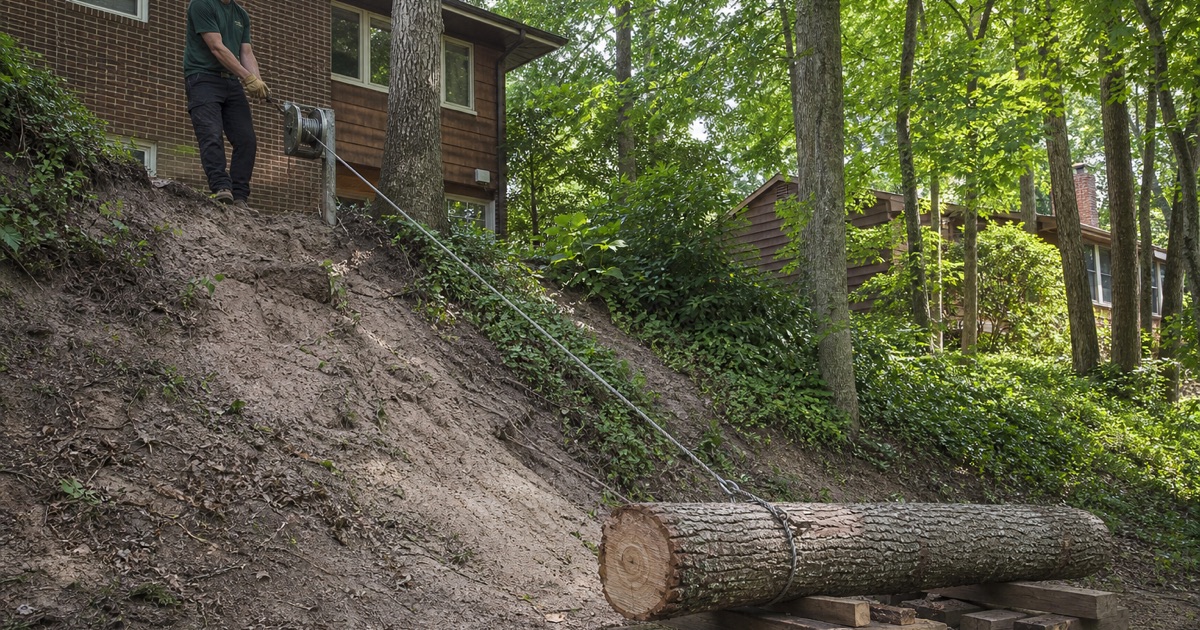
On level ground the drop zone is the part of the job you think about least. On a lot that steps down toward the water it is the whole job, because gravity is already acting on every piece before the saw finishes the cut. Anything that rolls keeps rolling until a fence, a shed or a neighbor’s siding stops it.
Setting the picks above the load
Almost every removal on a grade here is sectional dismantling rather than felling. The tree comes apart in pieces small enough to control, each one lowered on a rigging line to a landing we have already cleared and stationed a groundsman beside, rather than dropped and left to run downhill. Where the stem allows it the anchor point goes above and uphill of the cut, so the piece swings into the bank instead of away from it.
Slope also changes what a piece weighs by the time anyone touches it. A block set high in the tree multiplies shock load through the stem, and a stem carrying co-dominant leaders with included bark at the union has less capacity to absorb that than it appears to. On steep lots we take smaller pieces more often, which is slower on the clock and much easier to keep off the roof below.
When a crane is the safer tool
Some removals here cannot be rigged out of the tree at all. A declining stem standing over a roof, a lot whose only landing is a deck, or a bank too steep to set an aerial lift on all point the same direction, which is a crane-assisted removal worked from the street side of the house. The crane picks each section and lifts it clear over the structure to a truck at the curb, so nothing heavy travels down the slope at all.
We work to ANSI Z133 on the safety side of all of this: drop zone control, who is permitted underneath a suspended load, and the limits on a rigging line. On a grade, most of what that standard does in practice is keep people out from under a piece that is already trying to go downhill.
Looking for tree-removal closer to Dundalk? See Tree-Removal in Dundalk.
Which soils hold a root plate on a grade
A root plate is only as good as what it is anchored in, and Arnold does not have one soil to describe. The mapped units change over short distances, and so does the answer to whether a leaning tree is a slow problem or a same-week problem. That is a soil question before it is a tree question.
Collington, Wist and Westphalia on the interior slopes
The interior of the community maps mostly as Collington, Wist and Westphalia soils, well drained Ultisols sitting on 15 to 25 percent slopes, and Annapolis fine sandy loam is mapped locally at 25 to 40 and even 40 to 80 percent on the ravine walls and shoreline banks. Well drained ground is good for root development and unhelpful for footing once it has been cut into a steep face.
Those grades are why the same species behaves differently a few streets apart. A Collington slope holds a plate well until water gets under it on the steepest mapped faces, and then the failure is a whole-plate lift rather than a stem break. That is what we are looking for when we open a root collar excavation with an air spade before deciding whether a tree can be kept.
Sand, wet ground and the shoreline edge
Not all of it is that firm. Excessively drained Evesboro and Galestown sands are mapped alongside somewhat poorly drained Fallsington sandy loams and moderately well drained Mattapex and Adelphia soils, so root plate condition and machine footing can change inside a single street. We identify the unit before committing a machine to a route rather than after, because walking a chipper the long way around costs less than recovering one.
At the shoreline edges the map turns to Mispillion and Transquaking soils, tidally flooded. That is not ground a wheeled chipper or a stump grinder crosses, and on those lots the equipment stays uphill while the wood comes to it on a line or, where the reach exists, on a crane hook. Planning that approach is most of what the estimate visit is for on a waterfront lot.
What 67 mph did here
The wind that takes trees down in Arnold is severe thunderstorm wind, and here it is measured rather than assumed. Mesonet stations inside the community recorded a 67 mph gust on May 19, 2017 and a 62 mph gust on August 12, 2017. Those are local readings, not a regional figure borrowed from an airport half an hour away.
The measured record inside the community
The August 2017 event put a tree across two right lanes of Governor Ritchie Highway at Cypress Creek Road. A tree came down near Jones Station Road on August 31, 2018, trees went over on hole 16 at Bay Hills Golf Club on June 21, 2021, and on June 25, 2025 trees blocked the southbound lanes of MD 2 at College Parkway and came down on MD 648 Baltimore Annapolis Boulevard.
Hail reaches the community as well, with quarter-size hail reported near Governor Ritchie Highway and Chautauqua Road on July 1, 2020, and hail matters here because it strips foliage and opens wounds without dropping anything a homeowner would notice. Arnold sits in NWS public forecast zone MDZ014, forecast by the Baltimore/Washington office, which is the zone we watch when we decide whether a slope job holds until tomorrow.
Getting to a storm tree on a bank
A 67 mph gust does different damage on ground that pitches this hard than it does on a flat lot. Trees above the house fail toward it, while trees below the house tend to fail away and end up hanging off the bank with the plate partly attached, which is a rigging job and not a cutting job. We treat the second kind as loaded until we have relieved it.
Storm response is within 24 hours, and on a graded lot that first visit is often about making the tree safe to leave overnight rather than removing it in the dark. If a conductor is involved we stop and report it, because line clearance and downed conductors on the distribution system belong to Baltimore Gas and Electric Company, and nobody on our crew touches a tree in contact with one.
Getting equipment down a bank
The last constraint on a removal here is usually neither the tree nor the soil but the route to it. Waterfront and ravine lots put the house between the street and the work, and the only vehicle approach is frequently a driveway on the high side with a gate at the end of it. Everything past that gate is carried, winched or lifted.
Access, matting and machine footing
We run compact equipment for exactly this situation: gated back yards, narrow side passages and lawns that will not take a full-size machine. Lawn and hardscape protection matting goes down on every job, and on a slope it is doing two things at once, protecting turf and pavers while giving a tracked machine something predictable to sit on where the soil underneath drains fast and cuts up easily.
Stump work follows the same logic. A stump grinder has to reach the stump under its own power, so on a steep or soft approach we settle the grinding route during the estimate rather than discovering the problem on the day, and where a machine genuinely cannot get there we put that in writing before anything is signed. Debris hauling and cleanup are spelled out the same way, so what leaves the property and what stays is not a conversation at the end of the job.
The reviews that come before the cut
Arnold is unincorporated, so this work runs through Anne Arundel County rather than a town hall. The Chesapeake Bay Critical Area reaches the community from the Severn River on the south and the Magothy River on the north, and Intensely Developed, Limited Development and Resource Conservation Area polygons are all mapped inside the boundary, so the applicable standard changes as a lot gets closer to either river.
Cutting, pruning or removing natural vegetation in the Critical Area buffer, a minimum of 100 feet from tidal waters and tidal wetlands, requires a Standard Vegetation Management Plan submitted to the Anne Arundel County Department of Inspections and Permits, Forestry Program, and the county forester takes those questions at (410) 222-7441. We plan the job around that review instead of meeting it as a surprise.
Where a trunk stands in a public right-of-way the tree is not the owner’s call at all. A Roadside Tree Care Permit from the Maryland Department of Natural Resources Forest Service governs that work, trees in state highway right-of-way are the Maryland Department of Transportation State Highway Administration’s, and trees in county road right-of-way belong to the Anne Arundel County Department of Public Works, Bureau of Highways. Knowing which one applies before the truck arrives is the difference between a morning’s work and a stopped job.
- 20+ Years in Anne Arundel
- Free Written Estimates
- 24-Hour Storm Response








