
Glen Burnie Tree Removal handles tree removal in Arbutus, and after more than 20 years of work across this county and Anne Arundel, most of what we take down here was already tall when the current owner signed the deed. Every job opens with a free on-site visit and a written estimate handed over before a saw comes off the truck. The people who walk the property with you are the same crew that runs the job and rakes the beds out at the end of it.
That estimate says what it covers in plain terms: the removal itself, the stump if you want it ground out, and exactly which debris leaves with the truck. Storm calls are answered within 24 hours, and a limb across a driveway at daybreak is not priced differently from one reported at noon. There is no charge for the estimate visit.
What follows is the part that belongs to this address rather than to the trade in general: how old the trees on these lots actually are, what the ground beneath them does once it is saturated, and which trees cannot be touched until somebody at the county or the state signs a permit.
Yard trees older than most of the people who own them
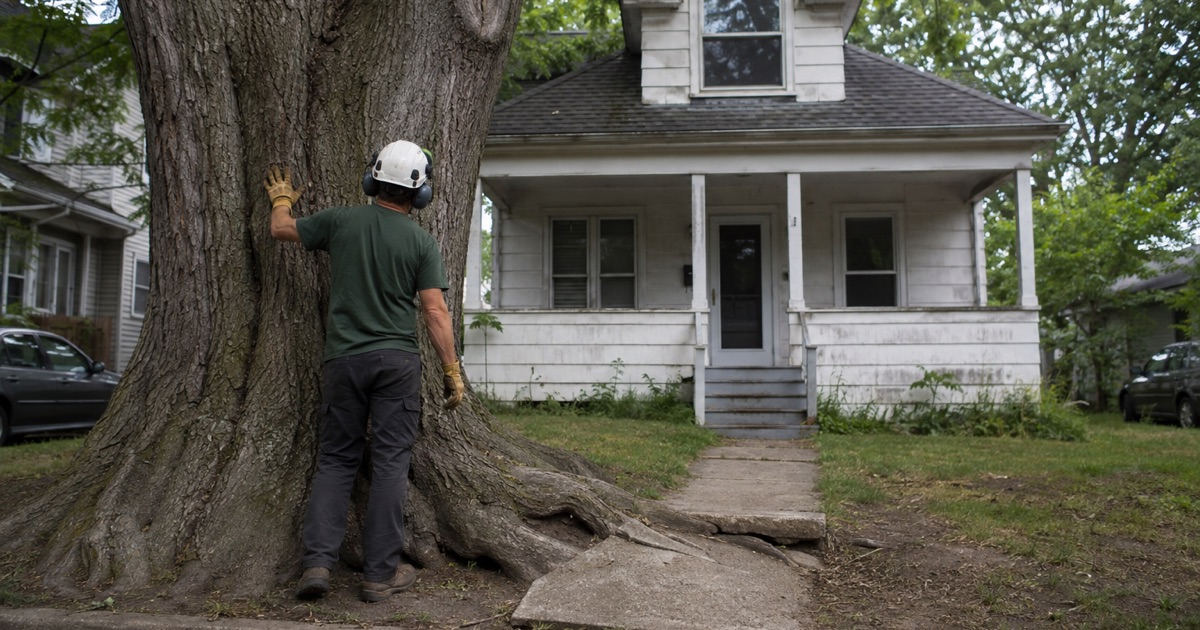
Arbutus housing stock is old even by the standards of the surrounding county: 62.8% of units predate 1960, 30.5% went up during the 1950s, and 18.1% are older than 1940, while only 6.3% were built in 2000 or later. A shade tree set out when one of those houses was new has had every year since to put on diameter. That is why so many of the removals we quote in this community involve a full specimen tree rather than a sapling that outgrew its spot.
What full size does to a tree
Fast-growing yard species carry their history in their structure. Co-dominant stems that forked low when the tree was young end up as two competing leaders with included bark pinched into the union, and that seam is where a mature tree splits. Epicormic shoots along old topping cuts are another tell, because they are attached shallowly and they fail in wind long before the trunk does.
Deciding between a removal and another season
Not every old tree is a removal. Diameter at breast height, the amount of deadwood in the upper crown and the condition of the root collar together say more than age does, and root collar excavation with an air spade shows whether the flare has been buried under decades of added grade and mulch. Where the structure is still sound, deadwooding, crown reduction or crown thinning done to ANSI A300 buys years, and cabling and bracing can hold a co-dominant union that is not yet failing. We say so when that is the honest answer, because a removal we talk you out of this year is a call we get in a later one.
Ash, and the trees that are not the problem here
Emerald ash borer has been established in Maryland since 2003 and kills a large ash within about three years, and the standing deadwood it leaves behind is brittle enough that the takedown has to be planned as a dead tree rather than a live one. Callery pear, which Maryland prohibits from sale beginning January 15, 2026, went into subdivisions built through the 1990s and the years after 2000; that era is a thin slice of the housing here, so the species turns up on these streets far less often than it does in newer neighborhoods.
Looking for tree-removal closer to Elkridge? See Elkridge Tree-Removal.
Where the ground changes under the roots
Arbutus straddles the Atlantic Seaboard Fall Line. Grid sampling places 87.4% of the community inside the Piedmont Plateau Province and 12.6% inside the Atlantic Coastal Plain along its southeastern edge, and the surface geology follows: 62.2% Cretaceous Patuxent, Arundel Clay and Patapsco formations, 22.5% Cenozoic Lowland Deposits of silt, clay and sand, 7.5% Baltimore Gneiss and 7.4% Relay quartz diorite. Most of the community therefore sits on soft, unconsolidated material rather than on shallow crystalline rock. That one fact cuts both ways on a removal.
Easier grinding, looser root plates
Soft ground is kind to a stump grinder, because the wheel is not fighting rock a foot down, and a grind-out on these lots usually finishes in the same visit instead of turning into an excavation. The same softness is why root plates here lift so readily once the profile is saturated. A tall tree that has stood through every previous storm is not proving that it will stand through the next one; it is telling you what the ground happened to be like on those particular days.
Arundel Clay and where the truck can sit
Arundel Clay is heavy and poorly drained, and where it comes to the surface the ground holds water long after the rain has stopped. That governs where a crane or a bucket truck can be set up, because outriggers need bearing and saturated clay does not give it, and it is why we occasionally ask to move a removal by a day rather than work off ground that will not hold. It is also why lawn and hardscape protection matting goes down on every job we run, not only on the ones that look wet when we arrive.
Reading the drainage before the estimate is written
Where a yard sheds water tells us how a removal has to be staged, so the estimate visit covers the low corners and the route the truck will take rather than the tree alone. Compact equipment gets us through a side gate and onto turf that a full-size chip truck would rut, and on the wetter lots that is the difference between finishing in a day and waiting for the ground to firm up.
Access on lots that were laid out in the 1950s
Detached single-family houses are 52.6% of the Arbutus stock and attached single-family another 28.7%, while just 1.4% of units sit in structures of 20 or more. Owner-occupancy runs at 69.2% across 8,424 occupied units. In practice that means most of our work in this community happens in a private back yard reached through a side gate, with a neighbor’s property line closer to the drop zone than anybody would choose.
Taking a tree down in pieces
Where there is no room to fell, the tree comes out by sectional dismantling, with a climber or an aerial lift working the crown down in rigged pieces and nothing dropped that is not controlled on a line. Our crews work to ANSI Z133 practices for that. Tight access is exactly what the compact equipment is for, because it fits through a standard gate instead of requiring a fence panel to come out first.
When the tree stands over the house
A mature tree leaning across a roof or a shared wall is the case for a crane-assisted removal, where each section is picked and swung clear rather than lowered past the structure. Bringing a crane in costs more, and the written estimate says so beforehand rather than afterward. On an attached-housing street the setup has to account for the neighbor’s roof as well, which is one of the things we look at during the estimate visit.
What leaves with us
Cleanup is written into the estimate: which wood is hauled away, whether the chips stay behind for beds, and whether the stump is ground out and to what depth. Old back yards produce more debris than owners expect, because a tree that has been in place since the house was built has a crown to match. None of that gets decided on the day, and nothing is added to the total after the work is done.
When age becomes a hazard, and who signs off
On August 10, 2026 a destructive-tier Severe Thunderstorm Warning named Arbutus among the communities in its path, a tier triggered when radar indicates gusts of 80 mph or greater, and more than 25,500 BGE customers lost power. The community sits in forecast zone MDZ011, Southern Baltimore, under the Baltimore/Washington forecast office. Our 24-hour response exists for the days after a warning like that one, when a leaning trunk or a hanger over a walkway is the entire problem and it cannot wait for a routine appointment.
Lines, limbs and what the utility does not do
BGE carries vegetation-management duties on its own distribution circuits under COMAR 20.50.12.09, and with 79.7% of the housing here built in 1979 or earlier, overhead service along these streets is the rule rather than the exception. Report a downed line to 1-877-778-2222 and a limb resting on a line to 1-800-685-0123, and keep clear of both until the utility has released them. What the utility does not do is take the wood away, so after a line-clearance cut the debris on the ground is still the owner’s, and hauling it is one of the things we get called for.
Which trees are not yours to remove
The Roadside Tree Law turns on where the trunk stands rather than on who planted the tree, so a trunk inside the public right-of-way needs a Roadside Tree Care Permit from the Maryland Department of Natural Resources Forest Service before it is removed, trimmed or otherwise worked on. Penalties reach $2,000 and $5,000, and Natural Resources Article section 5-406(d) bars a county or municipality from issuing a building permit until that roadside permit is obtained. Emergency work is allowed, carrying a one-week reporting duty under COMAR 08.07.02.03C. For a tree in the county right-of-way the Baltimore County Bureau of Highways removes dead and storm-damaged trees and broken limbs by work order, at highways@baltimorecountymd.gov or 410-887-3560, and the right-of-way question itself is settled when that application is started.
Clearing, permits and the paperwork we plan around
Anything larger than a single takedown runs into the county forest conservation program at Article 33, Title 6 of the Baltimore County Code, sections 33-6-101 through 33-6-122, which the Department of Environmental Protection and Sustainability administers. A declaration of intent under section 33-6-104 carries a five-year forward window, in the same form the Forest Conservation Act establishes statewide, so a clearing decision made now constrains what can be permitted on that ground for years afterward. Tree work for hire in Maryland requires a Licensed Tree Expert license under Natural Resources Article section 5-417(a)(1), with crew allowed to work under that supervision by section 5-417(a)(2) and an exemption at section 5-415(c)(2)(iii) for trees 20 feet tall or less. We plan the permit side of a job before the day it happens, and the written contract COMAR 08.07.07.03D calls for is the same document you were handed at the estimate.
- 20+ Years in Anne Arundel
- Free Written Estimates
- 24-Hour Storm Response








