
Glen Burnie Tree Removal has handled tree removal in Annapolis for more than 20 years, and on a job inside the city limits the first question is never which saw to bring. It is which permit the tree sits under. Three separate instruments can land on a single trunk here, and they do not share a trigger, an office or a timeline.
A city tree permit turns on the size and the position of the tree. A buffer management plan turns on how close it stands to tidal water. Approval from the historic commission turns on nothing but the address, and a waterfront lot in the older part of town can need all three at once.
We work that out before the estimate goes out. The estimate itself costs nothing, arrives in writing, and states what leaves the property as well as what comes down, so the debris hauling is not a separate conversation later. The crew that walks the site is the crew that does the work, which means nothing agreed at the curb has to be explained twice.
Which of the three permits your tree needs
The city tree permit comes out of Annapolis City Code Chapter 14.12, administered by the Department of Planning and Zoning. What sets it apart is that it keys on the tree rather than on the parcel. There is no lot-size or disturbance floor to clear before it applies, so a modest trunk in the wrong position needs paperwork that a far larger tree somewhere else would not.
What triggers a Chapter 14.12 permit
A permit is required to remove a tree over five inches in diameter at breast height inside a tree conservation area, for any tree standing within 100 feet of the water measured at mean high tide, and for a tree anywhere in the historic district. The city adds one more case in its own guidance: where no building or grading permit is involved, a tree permit may still be required if the tree sits in a front, side or rear setback adjacent to a public right-of-way.
Taking down a tree that needed a permit and did not have one carries a fine of at least $500 for each tree removed. That is the reason we ask for the plat and the address before quoting rather than after, and the reason a job on a corner lot gets checked twice.
Replacement trees belong in the quote
Replacement scales to the trunk that comes out. A tree over 20 inches in diameter at breast height requires three replacement trees, a mid-range trunk requires two, and one in the 5 to 10 inch range requires one. A removal quote in this city is therefore rarely just a removal, and we put the planting obligation next to the takedown line in writing instead of leaving it to arrive from the city afterward.
Where the other chapters pick up
Chapter 17.09 pulls the same tree requirements into building permit applications, grading permit applications and site design plan review, which is how a tree question reaches a project that was never about trees. The city’s forest conservation chapter, Chapter 21.71, is a separate regime with its own land-area threshold, and by its own terms it does not reach areas governed by the Chesapeake Bay Critical Area Protection Law. A job can fall under one of these and not the others.
Looking for tree-removal closer to Columbia? See Tree-Removal Services in Columbia.
The simplified plan for five trees or fewer
Anything near tidal water in Annapolis sits inside the Chesapeake Bay Critical Area, and the buffer rules are written into City Code Chapter 21.54. Work inside that buffer runs on a buffer management plan approved by the Director of Planning and Zoning. There is a lighter version of that instrument for small jobs, and which one applies is worth settling before anything is cut.
Counting the trees before the filing
Cutting up to five dead, diseased, dying, invasive or hazardous trees in the buffer falls under a Simplified Buffer Management Plan rather than the full document. Most residential storm work along these shorelines runs on that instrument. It is also why we count and categorize on site before quoting, since a sixth tree, or a healthy one added to the list, changes the filing that has to be made.
Where the buffer line actually sits
Section 21.54.105 puts the buffer at a minimum of 100 feet landward from the mean high water line of a tidal water, from the edge of each bank of a tributary stream, and from the upland boundary of a tidal wetland, and widens it further on steep slopes. Subdivision and site plan applications in the Resource Conservation Area approved after July 1, 2008 carry a minimum of 200 feet instead. Two lots on the same creek can measure out differently for that reason alone.
Fee in lieu, and which classification you are in
Where mitigation planting cannot be fitted onto the site, the city collects a fee in lieu of buffer mitigation of no less than $1.50 per square foot. On a narrow waterfront lot that figure can outweigh the cost of the removal, so it belongs in the estimate rather than in a letter three weeks later.
The city is mapped in all three Critical Area classifications, Intensely Developed, Limited Development and Resource Conservation, with a Federal Land classification over the United States Naval Academy property. Annapolis also maps its own Modified Buffer Areas, which accommodate limited use of the buffer in shoreline blocks that were already built out. Two addresses a few streets apart can sit under different standards, and for property managers and HOA boards running several buildings at once, that is the detail that decides the schedule.
Trees inside the historic district
Removal of a tree in the historic district goes to the Historic Preservation Commission for approval, whatever Chapter 14.12 would have said on its own. The commission’s by-laws are adopted under City Code Sections 21.56.010 through 21.56.220, and they state its purpose as the preservation of sites, structures and districts of historical, cultural, archaeological or architectural significance, together with their appurtenances and environmental settings.
That last phrase is the hook. A mature tree in a downtown yard is not reviewed only as a permit item, it is reviewed as part of the setting of the property around it, which is a different question and a different application. Preparing it properly the first time is cheaper than answering it twice.
Getting equipment into an old block
A great deal of the housing here is old, with 3,034 units built in 1939 or earlier, and those blocks were never laid out for a chip truck at the curb. We bring compact equipment through gated side yards and narrow back gardens where a full-size machine will not turn, and lawn and hardscape protection matting goes down on every job, brick walks and garden beds included.
Taking the tree out in pieces
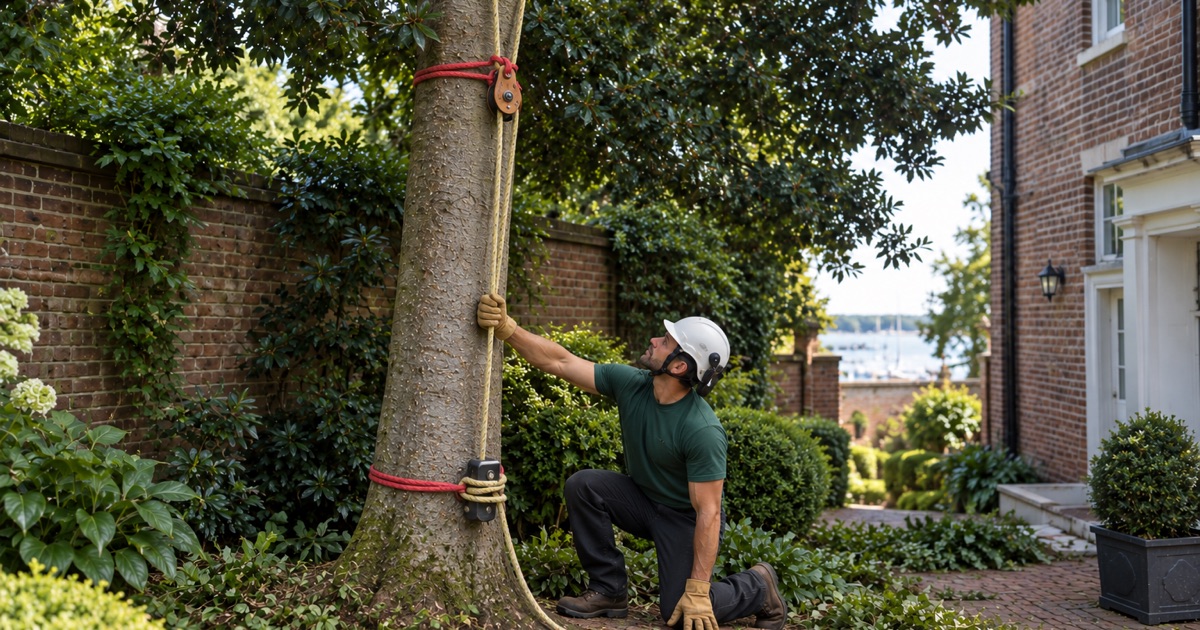
Where there is no room to fell, the tree comes down in sections, rigged piece by piece over whatever is underneath it. When a trunk stands over a roof, a porch or a shared fence and rigging alone will not clear it, we set a crane and lift the sections out instead. Co-dominant stems with included bark get the hardest look on an old yard tree, because that union is where the failure tends to start.
After-the-fact filing when the tree is already down
The buffer rules anticipate an emergency. Where cutting is immediately necessary, the Simplified Buffer Management Plan is filed at the earliest possible time after the tree has been cut rather than before it, so a hazard on a waterfront lot does not sit and wait on an office. We respond to storm damage and fallen trees within 24 hours, and the paperwork follows the work.
What the local record actually shows
Summer convective wind and tornadoes drive the tree damage here. On September 1, 2021 an EF-2 tornado ran 11.43 miles on a path 200 yards wide with peak winds estimated at 125 mph and crossed western Annapolis at full strength; the survey recorded snapped trees, downed poles and wire on West Street at Lee Street, roughly a dozen trees snapped in Admiral Heights, and the final damage at the end of Acorn Drive on the Severn River shore. A storm on July 1, 2021 blew down several dozen trees, wires and poles nearby with gusts estimated at 70 knots, and on June 30, 2024 several trees came down on Wardour Drive, one of them onto a house.
Water is the other half of it. On July 31, 2025 a waterspout over Spa Creek came ashore as an EF-0 tornado at the northern point of Eastport before moving back over the mouth of the Severn River. Tidal flooding is a separate hazard again, with the river gauge here cresting at 3.87 feet MLLW on November 21, 2023 against a 3.3 foot threshold, and high water closing Dock Street and Compromise Street on June 18, 2025.
Ground conditions, wire and right-of-way
Much of the city sits on the Annapolis soil series, a well drained fine sandy loam and loamy sand mapped from flat ground up onto the creek walls. The tidally flooded Mispillion and Transquaking soils, the frequently flooded Widewater and Issue soils, and the made ground mapped as Udorthents with a sulfidic substratum are poor footing for equipment. Matting and a longer reach are the answer on those, not a heavier machine.
Downed conductors and line clearance are Baltimore Gas and Electric’s call, and we work around a live wire rather than through it. A tree whose trunk stands in a public right-of-way needs a Roadside Tree Care Permit from the Maryland Department of Natural Resources Forest Service, which is also the agency that licenses tree experts in this state. Trees in state highway right-of-way answer to the Maryland Department of Transportation State Highway Administration, and city street and park trees to the Annapolis Department of Public Works.
None of that is a homeowner’s job to untangle. We walk the property, work out which office holds the say, and put the answer in the written estimate before a saw comes off the truck, with the same crew from that first visit through the last load of debris leaving the driveway.
- 20+ Years in Anne Arundel
- Free Written Estimates
- 24-Hour Storm Response








